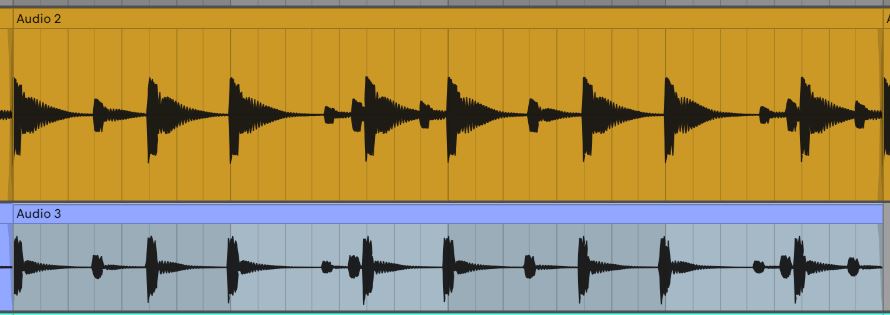
Here’s something I don’t get. The top soundwave is a lined up kick the bottom one is a newly recorded one after the update. First transient lined up but then the next ones go further and further off grid.
2 Likes
AT or LG Mode?
How are the TR-1000 and DAW synchronised?
I’m wondering if the new Roll MFX could eventually make full TR-1000-only live sets possible, with smooth transitions between different patterns and kits.
I’m particularly interested in whether it’s possible to keep the previous pattern looping while gradually introducing sounds from the next kit, ideally with independent volume control.
Has anyone experimented with this or found a reliable workflow?
1 Like
all tracks. I am just recording the tr-1000 main outs into a focusrite. I haven’t changed any sync delay settings on my DAW or the TR.
Ahh so a lot of folks use Layered Gens? I’ve always had mine set to All tracks, and aint changing. Good to know that USB MIDI response is a bit snappier. Should really try connecting my RK008 into the TR-1000s USB port…
1 Like
Layered gens way too sloppy for me
How are the two synchronised ??
What is master / slave ???
You know when USB MIDI is better than 5 pin - there is a problem 
3 Likes
Please keep the jitter and clocking issues in the discussion. Roland won’t work to improve it unless it remains an issue for many users, and the users who don’t mind the jitter lose nothing by the ongoing discussion.
I’ve considered selling my TR-1000 because I’m frustrated by having to chop up the audio that comes out of it in the DAW.
12 Likes
I’ve been layering the analog 909 kick on BD A and the analog 808 kick on BD B. Does anyone else do this? I saw in a video that Surco was doing this and had a third kick on his modular that he layered in sometimes.
I’m hoping for some advice about how to sculpt the 808 as a complementary element to the 909 which is the primary sound. I’m making techno. I like to bring some 808 kick in with drive and a bit more decay to really shake a room. I still want the 909 as the main thing.
How would you approach this? I’ve been experimenting with envelope (attack mostly), or a low pass or a high pass
There is a tiny delay you can put on layer B (or A) on layer tracks for this purpose.
I think it’s on the last page of the GEN screen from memory. Or it’s near the phase invert setting (also useful for the above task).
It adds a tiny fraction of time before the sound trigs.
So you can have say 909 attack with an 808 bottom end but delay the bottom end by miliseconds so it doesn’t mess with the 909 attack.
2 Likes
When it comes to USB from Cirklon, this isn’t the case. Colin found years ago that USB MIDI from Cirklon was far closer to synchronous than DIN MIDI could ever be based on MIDI 1 specs.
Below is Colin’s post on this from the Sequentix Forum:
‘The serial nature of MIDI is clear when you listen carefully to percussive sounds with near-instant attack times triggered “simultaneously”.
Even with running status, there is still a 0.64ms delay between each MIDI note-on.
Before I started using the prototype Cirklon, I sequenced my 909 internally, synced up to a P3.
The P3 wasn’t ideal for drum programming, so that was the best way to work, although it did give me the problem of having to remember which drum patterns went with which P3 banks & parts.
When I switched to using the Cirklon, I started to sequence the 909 via MIDI.
I was happy enough with the timing until I tried driving a VST 909 emulator (Drumazon) via USB MIDI, just to check the USB MIDI was working…
The VST was a pretty good match for the original, but playing multiple sounds together, it sounded better than my real 909.
The reason being that USB MIDI can carry multiple MIDI note messages in the same packet, so there was no timing spread of the triggers - every sound triggered on the same tick would trigger at exactly the same time.
That was the motivation to develop the d-mux output for Cirklon, to drive dedicated drum trigger output modules, or a retrofitted drum machine in a way that could guarantee all drum triggers on the same tick would happen at exactly the same time.’
6 Likes
Afaik as long as you don’t speak about a computer transmitting midi over usb (where the realtime-ness of midi over usb is a variable), midi over usb is pretty much better in every technical way in contrary to din midi, which is just old and way slower.
5 Likes
Roll MFX doesn’t have a mix/balance value, so you can’t mix what’s playing in the pattern with what the looper buffer has picked up. Now that I’ve seen this loop buffer length drift (assumption of the problem here), I wonder if omission of a mix control was intentional.
The only workaround I can think of is to set tracks on your target pattern so that they don’t route through the MFX, then you’d be able to bring them in arbitrarily while the Roll MFX loop is playing after switching patterns.
Maybe in the future when the “All Knobs” mode of the Morph slider gets documentation we can assign a track’s FX Route parameter to the Morph slider and use that to re-route track sounds on the fly, but the “All Knobs” Morph Edit mode seems to do nothing new (as far as I can figure out) and be undocumented at the moment. Anyone have luck figuring that one out?
aren’t these settings only relevant to midi? i’m not using midi.
I do this often and the key to keeping it from getting muddy is to keep to release on the 909 low, flip the polarity in on the 808 and give the 808 a small delay (the parameter for this is on the same page as polarity)
1 Like
Maybe route individual outs (from back or via usb) into a hardware / software mixer. mixer generates a submix that is then routed to the ext in, and the ext in gets the master fx (nothing else gets the master fx). The effected ext in then comes back into the mixer and you can mix it as you see fit with the original?
Downside is some sort of external mixer is needed…
Edit: actually might be able to just use the track faders/mutes and the ext in volume to control the mix?
that’s too much work 
Thanks Dave
Colin’s right on simultaneity. 5-pin DIN MIDI runs at 31,250 baud, 320 µs per byte, so with running status each extra note-on (2 bytes) adds 0.64 ms - stacked notes on the same step get spread out. USB MIDI can carry several note messages in one transfer, so they can arrive together.
But I assume he’s talking about MIDI triggered multi-voice spread on a single tick, not the timing stability between ticks. That’s where USB MIDI 1.0 falls short. Its messages carry no timestamps, and packets only move on the host’s schedule - 1 ms frames on full-speed USB, 125 µs microframes on high-speed - so event timing can wobble by a frame or more. Hardware to hardware, one side still has to act as the USB host.
USB MIDI is faster at moving chunks of data absolutely - not so good at keeping stable event-to-event time.
For low jitter, 5-pin DIN MIDI done right is still the benchmark - nothing in the delivery method itself adds any timing variation. USB MIDI 1.0 and network MIDI offer convenience but both add their own packet-based delivery timing limitations.
For hardware drums with voice trigger inputs, Colin’s answer was the d-mux - driven from the Cirklon’s DIN sync socket in a special mode, with any of its 16 trigger outputs fired on the same tick synchronised within a few microseconds. Our own 16 x output trigger module runs parallel for this exact reason.
Unfortunately - the TR-1000 has no per-voice trigger inputs.
My TR-1000 tests use one MIDI note per grid-tick, so there’s no polyphony limit spread involved - the incoming 5-pin DIN notes were measured within 20 µs of the target interval, and the results show how steadily the TR-1000 turns these stable events back into audio.
But the main takeaway for me in all this is - none of this would even be discussed on this thread if the TR-1000 sequencer was stable and the gen voice triggering was parallel.
11 Likes
Bit more new info on 1.5…
Quantize snapping of a performance in TR REC mode seems SUPER tight now. I’m not seeming to get the messed up patterns anymore. It’s placing my passes on the correct beats. Finally!!!
However - sample chopping of pads and stuff seems extra clicky, with no real way to remove the clicks. The envelopes in GEN or AMP are not affecting the clicking going on. Feels worse than before.
Also… Man, sometimes switching to Layered Gens after being in All Tracks, can feel just magical.
6 Likes