Yeah I heard the chop clicks today. Bummed me out.
Would you mind elaborating? I don’t completely understand the difference between the two modes.
2 Likes
All Tracks - super tight internal timing between any and all types of layers. High latency.
Layered Gens - looser timing. Low latency.
Sometimes I find all tracks feels too stiff and switching to layered gens can feel really cool. Sometimes it feels sloppy. But often I find I prefer the looser timing of the layered gens feel. Easy to switch.
2 Likes
Stooby out of curiousity what BPM are you running in your sessions ? 120? 130 ? 160?
I mean, it depends on what I’m doing. I’m not a “same tempo every track “guy
I was just wondering if the jitter is happening more often at above 140 BPM or if it’s happening even at 120 for you.
I don’t think it’s tempo specific. The errors come in fixed time steps - multiples of about 0.67 ms - not a percentage of the tempo. On earlier firmware I measured 16ths, 8ths and quarters at 100 BPM, and a 50 BPM capture, and the errors stayed on the same 0.67 ms steps every time. I haven’t captured 120 or 140, but there’s nothing to suggest they’d differ.
In my experience, what changes with tempo is how much you feel / hear it.
As Justin London puts it in Hearing in Time (2nd edn, 2012, p. 27): “The lower limit for meter … is about 100 ms” - the shortest interval we can hear or perform as part of a rhythm.
| Tempo | 16ths | 8ths | Quarters |
|---|---|---|---|
| 100 BPM | 150 ms | 300 ms | 600 ms |
| 120 BPM | 125 ms | 250 ms | 500 ms |
| 140 BPM | 107 ms | 214 ms | 429 ms |
| 160 BPM | 94 ms | 188 ms | 375 ms |
At 100 BPM the 16ths are well clear of that limit - easy to lock to. By 160 BPM they’re under it, and even the 8ths start to get very close together and so you are left with the dominant quarters. At slower tempos there’s more space between all intervals / events - any errors stand out more.
At 140 BPM plus in any DAW / DAWless rig with more than a few bits of gear playing together - all the rough edges - the collective interval errors plus any master / slave sync / start offsets - they are still there - the high tempo just gives the illusion everything is locked.
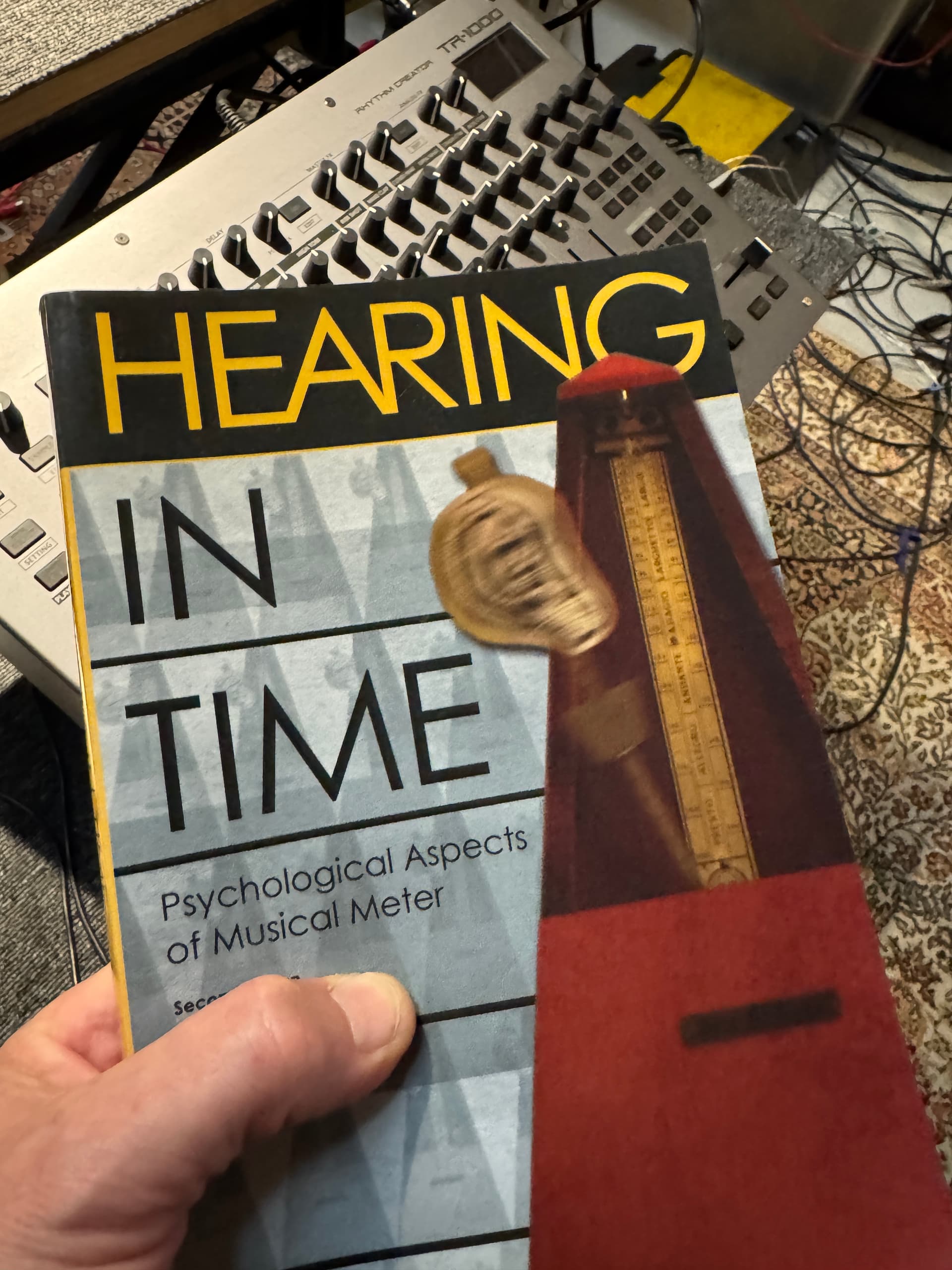
12 Likes
Are you running it on its own or with other gear?
Probably alone. Before 1.50, even all tracks with a synced drum machine sounded not good most of the time. But it can indeed sound funky standalone with layered gens sometimes, just not all the time. The thing with going this way: there will be a point where you want tighter timing and your sample tracks in sync, not 8 ms behind. Then all your kits/patterns (microtiming) won’t fit anymore. Much better to have timing as precise as possible and then use the really good sequencer features like microtiming. That way you’re always in control of your groove and have a consistent project.
4 Likes
I’not claiming there isnt “a problem”. Just saying that I dont mind it, I’ve gotten by with shittier gear. YMMV (JFC I am repeating my opinion on the matter, just as you are repeating yours, nothing personal here)
2 Likes
That’s actually not a terrible solution! 
To keep them analog/through and switch 2/3 elements we would wanna keep right before engaging the looper.
Need to test it out!
1 Like
On its own, and slaved from Logic. I haven’t yet checked if there’s much difference between the two (ie. when I press play on the TR itself, vs press play inside logic which triggers the TR)
1 Like
I ran a test: TR→ OXI One MK2 → DFAM
Just two 1/16th notes over 8 steps.
Clock jitter for me was pretty high ± .5, and it was really obvious with the DFAM due to phase issues and envelope retriggering.
Alesis SR18 on the way. We’ll see what it can do.
2 Likes
Fascinating how much you can do with just 1 kit and 1 pattern on the TR-1000 just now I found that hitting “shift+morph” I have access to 16 morphs per pattern across 8 variations + 4 fills 
Loving the morph here I hadn’t even looked much into it until this afternoon… 1 pattern can go a long way.
11 Likes
my exact sentiment… hopefully roland can do some reverse engineering wizardry to get it right. the drummer is the backbone of the band after all (((:
1 Like
Nice to hear something non-jitter related.
I’ve been on the fence with the TR1000 for about a year.
As annoying as the jitter is (for lots of reasons), I assume that people are just recording clips into DAW (in my case Ableton) and quantizing the audio?
If this is working well enough for people, I can look past the jitter for my use case (beat machine which I’ll record into Ableton and quantize).
1 Like
For me this changes the audio too much, especially with hi-hats or rides with longer sustain/release.
2 Likes
Plus if any device is tempo-synced correctly and has low sequencer slop you get to use more than just a few bars with zero editing required.
Create / Jam / Perform - then capture the whole lot while the whole studio is running togther tightly. Move on.
1 Like
Yeah finding new stuff all the time with the TR-1000 saving stuff and backing up as I go 
But yes I don’t need to mention jitter or latency as everything works fine for me no matter how I use the drum machine (all tracks or layered gens) just adjust clock to suit and your off.
1 Like