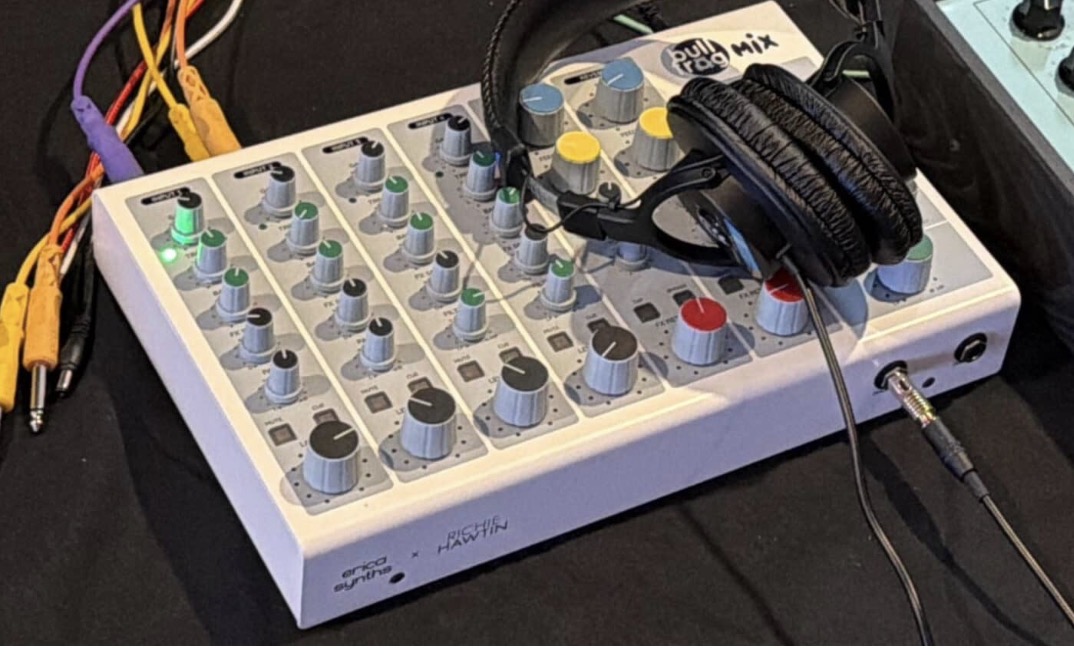
Idk if this will help open to be corrected as well
Pre = “this knob controls the send vol”
Post = “this knob controls the send vol as a percentage of channel volume”
If Channel Vol is at full, Pre/Post send the same level (assuming the channel is not muted). If Channel Vol is less than full, than Pre sends a stronger signal than Post (for the same position on the Send Vol) because in Post it is first scaled by the Channel Vol.
I would say Post tends to be more intuitive for FX Sends - you get the right ratio set up and then as you change the Channel Vol, more/less is sent to the FX. Pre offers possibilities for full wet FX
I have my Strymon Volante (set to receive line level) on a POST send. I also like sending only the Dry signal of my keyboard to the filter, so I can play the filter on the dry and leave the delay to fill in the gaps
It would also make sense to check if you selected the dry kill option on the pedal as you may want to receive only the wet signal in your external in and not to duplicate the dry.
They’re great for reverb because you can get 100% wet by turning down the channel fader, plus every level of wet/dry in between. With post fader you’re only ever getting a maximum 50/50 wet dry mix. The downside is that if you mute the channel you still hear the reverb but that can have creative uses too. The best way to understand is just to send something to a verb and try it out pre/post and turning the channel fader up and down.
Similarly you can also use a send essentially as an insert because you can turn the channel down completely so you’re only hearing the wet signal of whatever effect you’re sending to.
It can also be useful for routing stuff to different outputs like multiple sets of speakers, or different recorder tracks because you can turn down the channel fader and take that signal out of the mains and have it only going to the send.
These, exactly. I also love to put an Analog Heat on one of my aux buses instead of master, set those channels to PRE, so they get processed thru the heat without any dry mix, and other stuff can be bypassed, or put thru another FX chain, then the Heat.
A huge pet-peeve of mine is when only one AUX channel has a PRE/POST switch.
LOL, yeah - it’s particular to the pedals/inputs you choose, obviously. Modern ones are often designed to work at line and instruments levels, but the XTC lets you amp up the instrument-level and intermediate ones, as well as flipping the phase and varying/overdriving the I/O levels. Radial produce some great ‘tools’, including DI’s and stereo-to-mono mixers.
After several days using the Jellymix, this is my verdict :
I prefer the Sound of the Bébé Chérie. I prefer its saturation, tilt EQ, overall warmth, knobs and the fact that it has a Compressor. I don’t care much about the Aux/Ext as I prefer to have dedicated pedal FXs for my Synths. All in all, I would prefer to have 2 Bébé Chérie instead.
Hmm… I know the Jellymix is more of a live performance mixer and the analog saturation makes it rich live, but when I tried recording into a TX-6 USB, the mix is rather boxy. Even tweaking the EQ on the TX-6 didn’t quite get rid of the boxiness without the snares and HH becoming too tinny. Any tricks I should try to make it more balanced?
Without turning this in a Bébé Chérie thread, I’m really into the sound of the OTO boxes (currently have BIM, BAM, and had the BOUM), and have thought about one of these. Does the Bébé Chérie have more “analog character” compared? I’m especially interested in the Bliss enhancer on this, and like the idea, instead of something that is super clean.
yeah, not exactly the same. but also quite a small footprint per function. i wont replace my jelly for this but when it sounds great i am tempted anyway ^.^
Too many variables to answer you on this one. I would say that you need to make sure you are gainstaging everything properly. I submix my drums and don’t have any issues with boxiness. I hit the jelly fairly hard with the drum mixer but at 10 o clock on the gain knob it’s all green. I push that knob into the red a little and adjust the volume to taste. For sampler and synths I keep everything in the green typically. The mixes sound wide open and well balanced to me.
That said, I’ll try and do some stems straight into my interface to compare. I use the Jellymix as my performance mixer but I have an octatrack coming and may be able to route everything into that and use that performance instead while also recording the stems straight into my interface as a backup. Not sure I want to go that route because I use reverb and delay on the sends of the Jellymix and I’ve been really happy with the overall sound of everything. But it’s something I may look into so I can compare.
Main thing here is the mixes coming out of the Jellymix sound really good to my ears.
I record mine into a Scarlett 18i20 and I think it sounds very dynamic and rich.
My best guess is that the converters in the TX-6 are not as clean as you think they are and the resulting compression is impacting your recording. Maybe you’re hitting them too hard? The Jellymix puts out quite a hot signal.
 open to be corrected as well