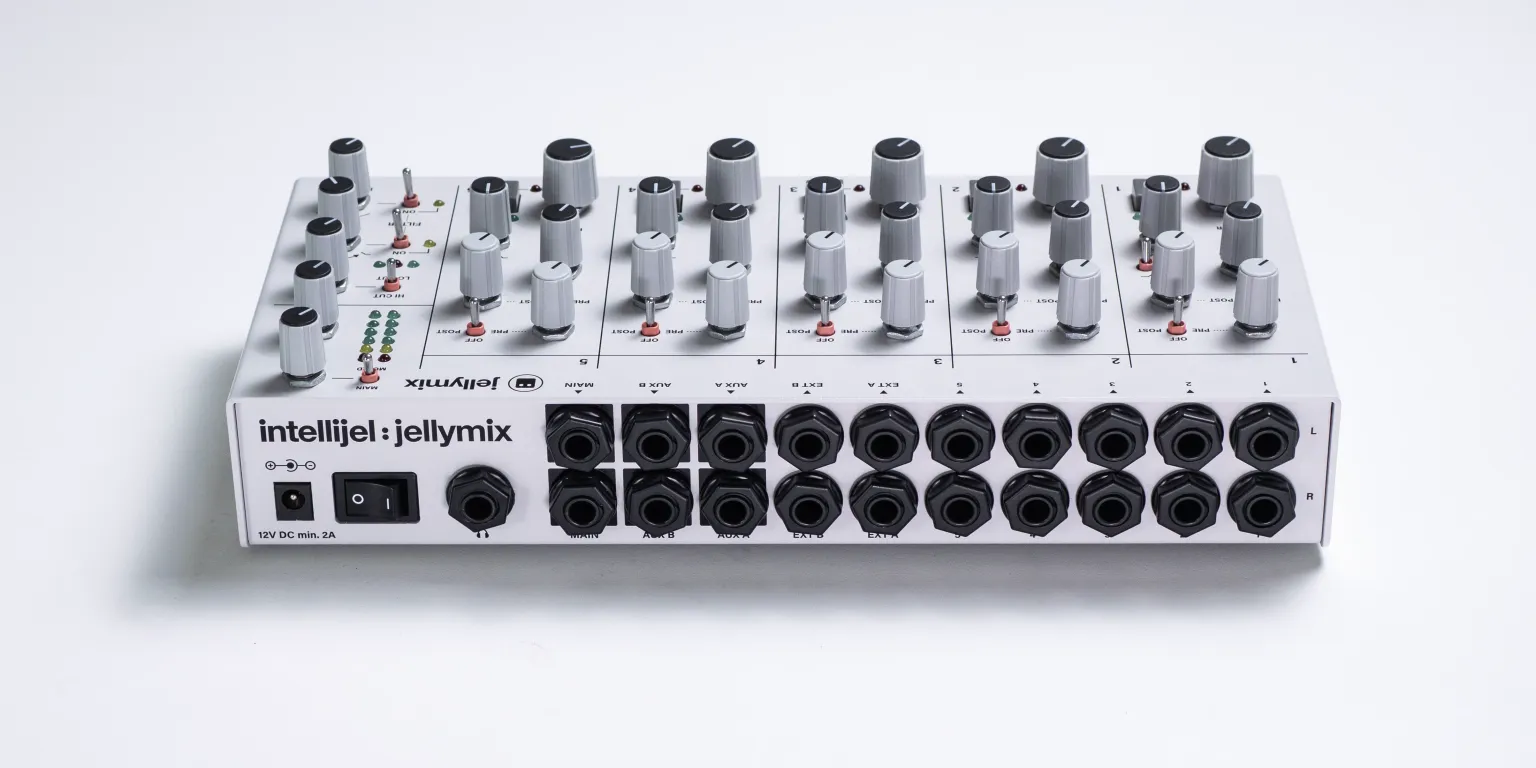
The Jellymix was first shown as a prototype earlier this year. Intellijel has now revealed an updated version with several changes based on user feedback. This post summarizes the current state of the mixer.
5 stereo channel strips with balanced ¼” line inputs and clickless mutes
2 stereo balanced AUX Sends per channel (PRE/POST w/ mono sum normalling)
2 stereo balanced EXT inputs (summed to MAIN bus, can be used as AUX Returns)
Hi-Z Instrument input on channel one (for connecting guitars, etc.)
Stereo SVF master filters with separate LO CUT (HPF) and HI CUT (LPF) controls, dedicated resonance knob (Q), and clickless bypass switches.
Main output level control with led meter
Headphone output with selectable source (MAIN or MUTED bus)
Pleasing overdrive via soft clipping on all critical stages of the audio paths: channel gains/sums, EQ, aux busses, filter bus, and main output bus
All analog design with high-quality and durable construction: Neutrik jacks, Alpha pots, Salecom sealed switches, Sound Semiconductor VCAs, and Low-noise/Low-distortion op-amps
Dimensions: 277mm x 122mm x 66mm / 10.9" x 4.8" x 2.6"
DC Power Supply included (Meanwell 30W/12Vx2.5A)
Five Stereo Channel Strips
Input gain with up to +26dB
Switchable 150Hz LO CUT (with FILM caps)
Tilt EQ with 810Hz center, 10dB Boost/Cut
Dual stereo aux sends with selectable PRE, OFF, or POST routing
MAIN/FILTER routing switch
Large rotary level control knobs
L and R signal level indicator LEDs (green) and overload LED (red)
MUTE switch with clickless muting and LED indicator
MUTED channels routed to the MUTED bus (CUE for headphone monitoring)
Hi-Z Instrument mode (Ch. 1 Only)
Soft clipping on channel gain stage, tilt EQ, aux busses, and summing bus
Main / Filter Bus
Dual stereo SVF MAIN filters with clickless bypasses
Low Cut (HPF) and High Cut (LPF) controls
Assignable filter resonance control (Low/High/Both)
MAIN level control with soft clipping and LED meter
Headphone output with selectable source (MAIN or MUTED bus)
This is extremely musical looking. My only criticism is the mute switches are so small, hard to read in the dark. Sort of wish they’d use a blinking red light or something to show that channel is muted. But this looks like a great mixer, tilting EQ is underused.
Tilting EQ is pretty handy. Only times when I feel like its not enough is when the input channel is a groovebox with only a single stereo out, since you cannot do the “smiley curve” boost EQ with one. For a mix where stuff is more spread out across the channels, tilting EQ is totally enough to get by IME
looks great! and looks very solidly built. no controls for the external ins (i.e. aux returns) is a bit of an odd choice. but at least it has something for the aux returns! I hate mixers where you have to sacrifice entire channels just for aux returns. but this is funny because their Cascadia has controls for send, return, level selection, and wet/dry. here you just have to live with send.
I know how I would use it, but I’d like to see them discuss it, and hear what their envisioned use-case is for it.
also how often do we see mixers with an odd number of channels?
Dedicated aux returns are only useful if your fx unit is fully featured enough (ie has some EQ or filtering for the wet signal). Still, nice to see them here since the channel count is so low (especially if these are stereo returns).
Perhaps a better use case for the fx returns will be using them with stereo gear which has decent enough internal processing (master eq etc), and then blowing two channels of the regular inputs for fx returns? This allows both feedback via aux sends as well as tilt eqing and filtering…
My master sounds mixer is set up in a similar way with the way the aux send is set up. It does indeed limit your choices of what will work. Something like the korg nts1 just doesn’t have the gain/headroom to keep up, some stuff doesn’t have a full wet mode. But yeah the right fx will work great. This actually has me tempted for sure. Would love to see essentially this mixer but with modulation options for pan and for level.
If that price is correct, I am probably buying this and backing off from upgrading my interface. This will not only cost me less, but also suit my workflow better.
Regarding AUXes having dedicated return, while I get that not everyone’s workflow is similar, for me that is not an issue, since I love having full channel for FX return.
I need to sleep few nights before pulling the trigger to calm down any unseen enthusiasm.