First of all, “modern” specs (especially from the vantage point of the idealistic, armchair tech designer) will never be a thing. It takes years to develop a piece of hardware like this, and component decisions must be made at the outset. You have to build around whatever tech is readily available at conception, and must commit to that, from the drawing board through to manufacturing, if the project is ever to come to fruition.
Second of all, it seems to me that if you were capable of out-programming these brilliant engineers, you’d have their jobs.
Thirdly, as a musician whose primary focus when buying and instrument is playing it, I can’t say that I’ve ever needed 2000 voices; but if I did, I’d simply use software.
To that end, software will always be a decade ahead of physical instruments, because it’s dynamic: i.e. when code is your only concern, the burden of advancing hardware falls on someone else, like Apple or IBM, and a thousand unbranded subsidiary companies.
Anyway, bravo ASM, for making a truly remarkable, robust, and ridiculously capable instrument for the touring musicians of the world.
A ‘proper comparison’ would be between the Minilogue XD and the Minifreak since they both have analog filters. I actually thought some of the switches between presets were well chosen, but, price point aside, it’s an apples/oranges comparison. Minifreak sounded nice, if a bit ‘samey’.
Alex Spiers did the music for this open movie Charge with just the Hydrasynth Explorer and Logic Pro. The sampled sounds come from somewhere else, i think.
The video itself is pretty amazing production using Blender.
Found this in a blog from retailer zZounds. Good on them for doing this.
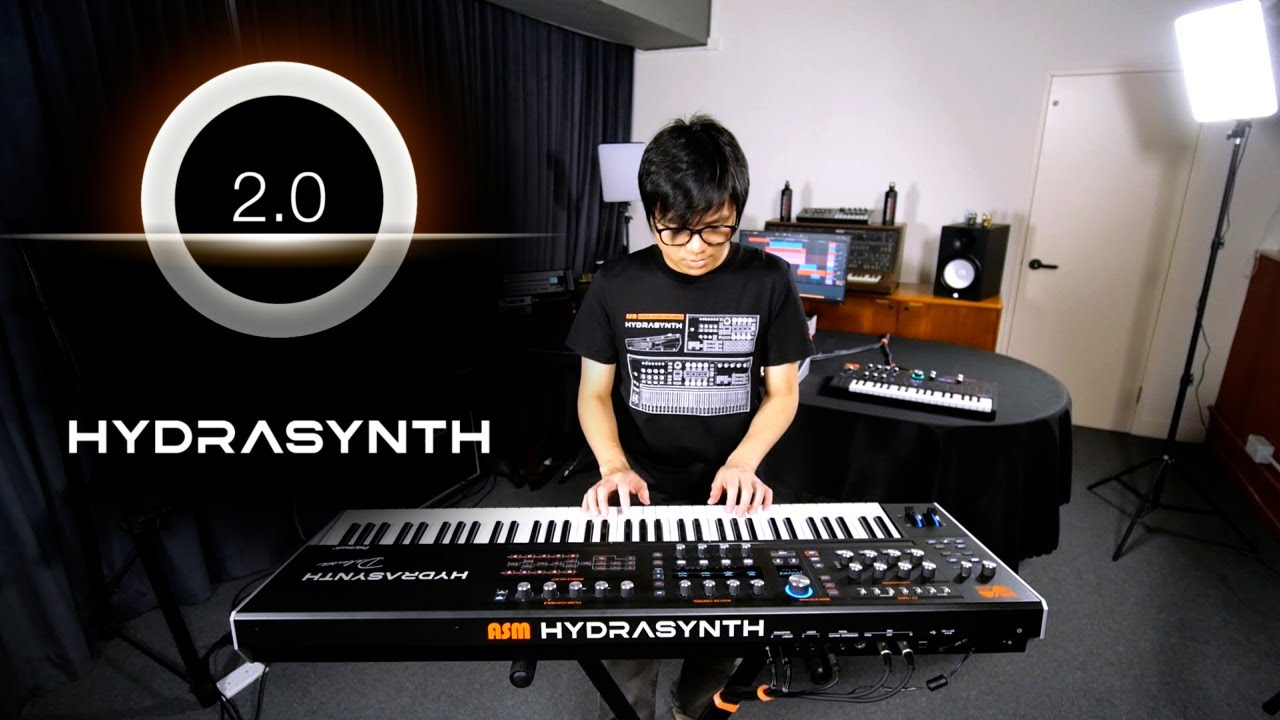
We are happy to announce the new 2.0 firmware for the full Hydrasynth line of products.
New features include: Expanded memory to 8 banks (49, Desktop, Explorer only); NEW modulation source, VOICE MODULATOR; OSC Bit reducer; LFO quantizer; ENV quantizer; LFO Step Advance; Global FX bypass; Increased Vibrato resolution; New Sustain pedal options including Sostenuto; more LED options; Glissando in glide options; Arp Range goes to 6 octaves; Arp Step Offset parameter; more Rand/Init shortcuts (all STEP LFO steps, Wavescan waves, Voice mod offsets), Local On/Off saved, and more.
I’m not going to get a chance to see if it’s possible until after work but I have a suspicion the per voice mod/LFO step advance could allow for Brecker style chord rotation.
Man… this really has been update season for me lol. Digitakt, SP-404 MK2, S2400, Hydrasynth, Matriarch, Oxi One all dropping updates in a few weeks of each other.
This is really one heck of an update, So many of these features sparked ideas in my head for interesting modulation routing options. I can’t wait to sit down and deep dive on this.
No room for more keys in the studio, so I’ll have to grab another desktop version. This update has features that I wanted, and ones that I didn’t know I needed until three minutes ago.