I had already posted a few times here, but now things are getting real:
My synth is now available for beta testing as an iOS app and AUv3 instrument:
TestFlight link:
I’m looking for a few people who like to experiment new synths on iPad/iPhone and would be willing to test it properly — especially inside hosts like AUM, Logic Pro for iPad, GarageBand, Cubasis, Loopy Pro, etc.
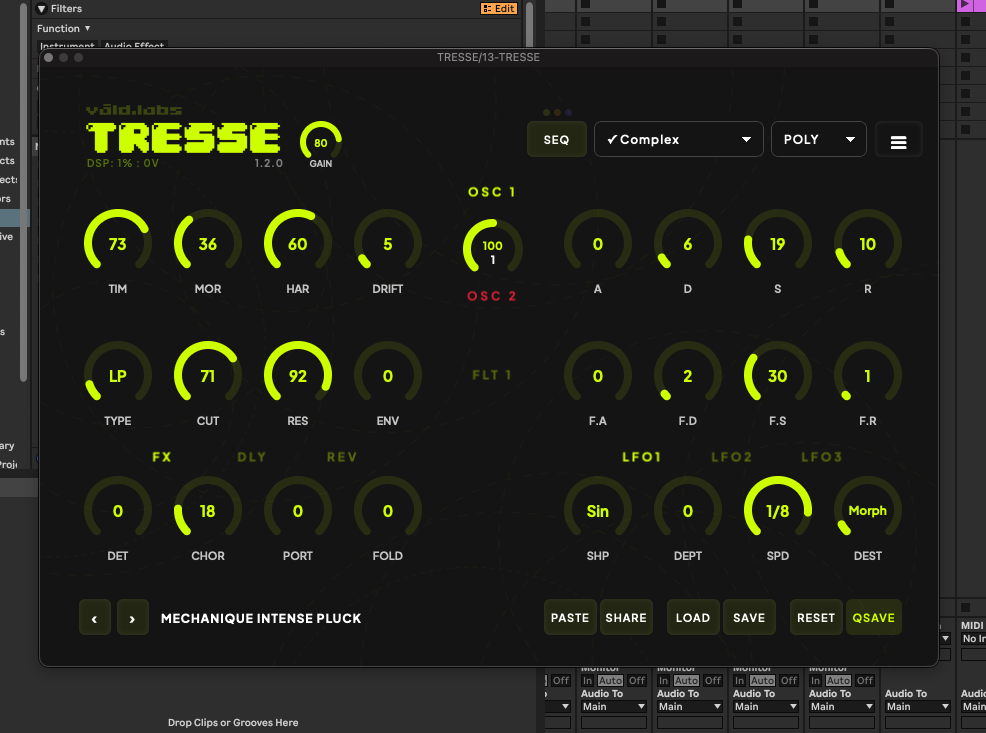
TRESSE started as a hardware synth experiment and later became a software instrument. The early version grew out of experiments with the Plaits DSP architecture, but it has expanded quite a lot since then:
Current features include:
39 sound engines
Full polyphony
Variable SEM-style filter
2 envelopes
LFO
Spread
Wavefolder
Compact UI for quick experimentation
AUv3 support
iPhone and iPad support
The idea is to make something immediate: choose an engine, shape it quickly, randomize when needed, and get to useful/weird sounds without turning the process into menu-diving.
I’m not asking for reviews or promotion.
I’m mostly looking for honest beta feedback to make this something special.
Does the AUv3 behave properly in your host?
Does the interface make sense?
Is the sound engine selection clear?
Does the synth feel immediate enough?
Are there bugs, crashes, weird UI issues, missing features?
Does the freemium model feel fair?
The app will be freemium, with a one-time full unlock planned at around €7.99 for launch and then €9.99. I’d like the free version to be genuinely useful, not a fake demo, so feedback on that balance would also be really helpful.
This is part of a wider project that also includes Vekte, an algorithmic sequencer, and Rekke, a hardware sequencer I’m developing — but for now I’d really like to focus the beta feedback on TRESSE itself.
Thanks in advance to anyone who tries it. I’d genuinely appreciate brutal, practical feedback more than polite encouragement.
Hey, just gave it a quick try using it as AUV3 in Koala on iPhone.
Seems like a great app with a lot of potential!
I’ve been looking for a synth app for iPhone with a good touchscreen UI, lots of engines/sound design possibility and easy randomisation (with subsequent customisation). I think this ticks all those boxes!
In term of feedback
Love that the interface is very touch screen friendly. Think this is a strong point. One page, no menus. Awesome.
That being said, everything is very small on an iPhone! The text under the controls is really hard to read. Would be great if everything could be made much bigger.
Would be great if it had a better portrait orientation mode. Doesn’t seem like many apps consider this, but Koala is great in portrait and would be nice to have a synth for it that is also portrait mode friendly.
Would be nice to be able have the random button also randomise the synth engine
INIT is on the bottom left of the interface doesn’t do anything? Tried tapping it to reset before realising that the init button was on the right side (next to load/save).
thanks for all the feedback! indeed i’ll work on those points, especially the UI labels size.
INIT on the bottom right is actually the preset name, I still don’t have any presets pre-loaded but that will change.
Random button will also randomise the synth engine, will make it global
Portrait wasn’t in the list but I guess it will not be a very difficult one to change.
For the AUM, that’s indeed the biggest bug which somehow slipped trough - you need to run the native app once, then load it on AUM and reload the app, that should make it appear on AUM! Will be the biggest priority for the next version.
Thank you everyone for trying it out!
PS: To access all the presets you can simply tap “Restore” or “Buy it” (you won’t be charged on Testflight).
Hi everyone — TRESSE 1.2.0 is up on TestFlight, and it’s a big update.
TRESSE is a 39-engine, 8-voice polyphonic synth for iPhone and iPad.
It combines the Mutable Instruments Plaits engines — FM, wavetable, additive, granular, speech, chords, resonators, drums — with 15 custom engines you won’t find anywhere else: custom Karplus-Strong, sympathetic strings, modal resonators, supersaw, Hammond drawbars, bytebeat, wavefolders, VåldFM engine and more.
Every engine plays through the same expressive voice: a self-stable SEM-style morphing filter (LP→BP→HP→Notch, never blows up at full resonance), dual ADSRs, per-voice analog drift, and a delay + shimmer reverb section.
It runs as an AUv3 instrument in AUM, AudioBus, Drambo and GarageBand, plus standalone with Bluetooth and Network MIDI.
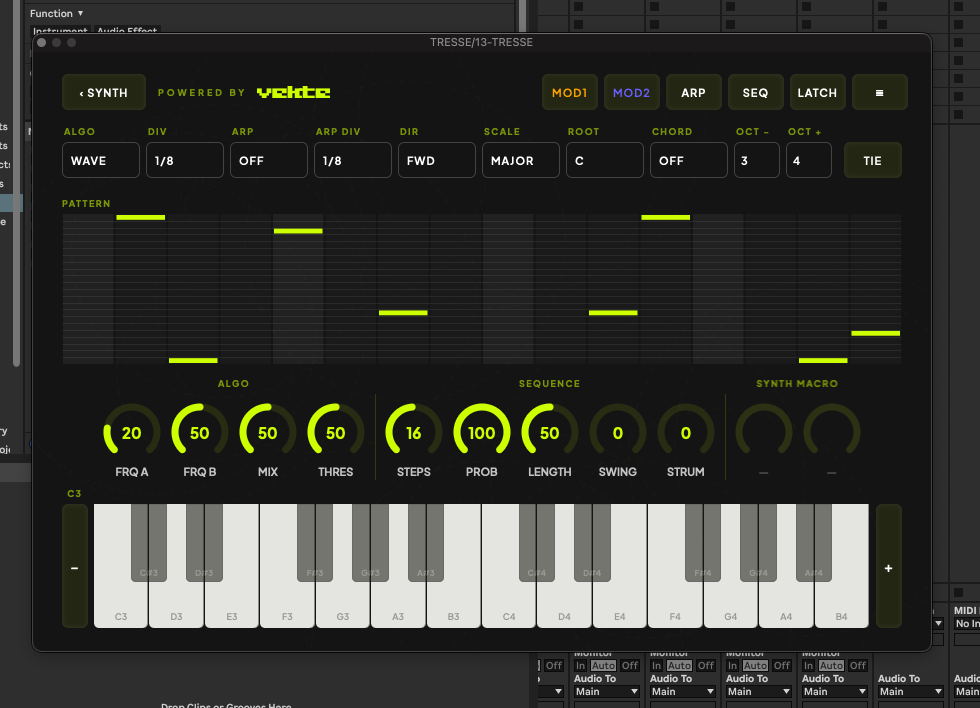
Last but not least, it now integrates a small but powerful version of our generative sequencer Vekte so you can work immediately. It also features an arpeggiator with the capability of replaying the source sequence at different rates, enabling mind bending patterns which are close to random but sounding very coherent.
Want in? Get it here:
Feedback very welcome, especially host quirks and older-device reports.
39-engine, 8-voice polyphonic synthesizer by Vald Labs. iOS Standalone + AUv3 instrument — combines the Mutable Instruments Plaits engines with 15 custom engines and a generative sequencer in one instrument.
Platforms & formats
iOS: Standalone app + AUv3 instrument — loads in AUM, AudioBus, Drambo, GarageBand; state saves with your host project
Per-engine gain normalization — engines switch without level jumps
Dual oscillator layers (new in 1.2.0)
Two full macro-oscillator layers, each with its own engine, timbre controls (TIM/MOR/HAR/DRIFT), amp ADSR, complete filter (type/cutoff/reso/env + filter ADSR) and voice mode
OSC mixer: bipolar crossfade knob — hard left = OSC1 alone, center 50:50, hard right = OSC2 alone; shares always sum to 100%
8 + 8 voices when both layers run; tails ring out cleanly on layer close
SEQ, ARP and MOD lanes drive both layers from one note stream
Per-voice DRIFT — decorrelated analog wander (pitch + timbre movement)
Per-voice detune, portamento glide, stereo CHORUS macro on one knob
Self-stable SEM-style filter (TPT): continuous LP → BP → HP → Notch morph, never blows up at full resonance; bipolar filter envelope (center off, right sweeps up, left down)
Two ADSR envelopes per voice per layer (amp + filter, ~4 ms–4 s exponential)
Three LFOs — 6 shapes each (Sin, Tri, Saw, Sqr, S&H, Rnd), free-running or host-BPM synced (4 bar…1/32)
Two generative MOD lanes (MOD1/MOD2) — each is its own step sequencer with its own algorithm, driving any modulation target with absolute MIN…MAX ranges
One 50-entry destination table shared by all LFOs and MOD lanes:
Per-layer pairs — hit OSC1 only, OSC2 only, or both
Bal — modulate the layer crossfade itself
Delay & reverb knobs
SEQ knobs — LFOs morph the generated pattern live (still deterministic)
Every targeted knob animates on screen and names its source; multiple sources combine predictably
Generative sequencer
Five algorithms from the VEKTE engine: WAVE (wave interference), EUCL (Euclidean), WALK (random walk), LOGI (logistic map), CELL (cellular automaton) — four knobs each, labels follow the algorithm
32-step patterns, 1–32 step window, step lengths 1/32 … 2 BAR — slow evolving pads and fast arps from the same control
Per-step probability (rerolled once per cycle — stable cycles, no mid-note flicker), gate length, swing, velocity, FWD/REV/PING/RAND direction
TIE: a note plus its rests becomes one long held note — and a held key to the arp
Deterministic: every pattern is a pure function of algorithm + knobs; presets recall the exact sequence
Two synth MACRO knobs on the SEQ page, bindable to any parameter
Arpeggiator
Modes: SEQ:NOTES/TRUE × RTRG/FREE (the sequence as arp material, two independent read laws), plus UP / DOWN / UP-DN / DN-UP / ORDER / RAND / CHORD on held notes
Own step length (ARP DIV) beside the sequencer’s DIV — two independent playheads, drawn separately on the grid
Held-note modes fall back to the sequence when nothing is held — selecting an arp mode never silences a running SEQ
Additive LATCH: presses add to the pool, re-press removes one note, latch-off clears
Two-octave on-screen keyboard with glissando, feeds the arp pool, lights for host MIDI too
Transport & sync
Sync: FREE / SLAVE / MASTER — SLAVE follows the host transport fully (play/pause/stop, locked to song position); works in AUM with transport stopped (FREE runs on tempo)
Start: NEXT BAR / IMMEDIATE — mid-bar transport starts stay armed (pulsing) until the bar line
Effects
Delay (DLY): DIGITAL / TAPE / PING / LOFI; bipolar TIME — free 10 ms–2 s one way, tempo-synced 1/32…2 BAR at host BPM the other; feedback as decay time (0–10 s)
Reverb (REV): HALL / ROOM / PLATE / SHIMMER — dual pitch-shifter shimmer with a stereo-orbiting halo into a dedicated FDN tail (2–30 s decay)
One shared post-mix FX stage for both layers; chorus + wavefolder at chain end
Sharing & presets
TRS2 share key: the entire patch — both OSC layers, all three LFOs, delay/reverb, the full SEQ system and both MOD lanes — in one ~155-character string
Patch QR: SHARE modal renders the key as a QR + exports a 1080×1350 social card via the iOS share sheet
Scan patch QR… — read a patch off a screen or print with the camera
Preset save / load / rename / delete in the UI; QSAVE one-tap save under a generated two-word name
Våld factory bank (★ presets), read-only
Presets shared between standalone and AUv3 — one library everywhere
MIDI & connectivity
MIDI CC mapping: learn by moving a controller or type the CC number directly; per-knob long-press menu; persisted with state
Bluetooth MIDI pairing (CoreAudioKit sheet)
Network MIDI (RTP-MIDI session) — wireless MIDI from a Mac or another iOS device
After just 20mins my impression that this is really cohesive & intuitive all round, was able to understand it without the manual. The sequencer is fantastic. Looking forward to exploring it more…not noticed any bugs yet
It became a multi-engine synth with a built-in generative sequencer. 39 synthesis engines, 8 voices.
VST3 on macOS and Windows, AU on macOS. The iOS version, with AUv3 support, is in review.
But it started as a simple hardware instrument prototype:
A 4-voice box I built with some spare components and a 3D printed box.
The plugin grew from that idea, but without the enclosure.
The beta ran for a couple of months, and much of what improved came from you using it in ways I hadn’t anticipated.
Thanks to everyone who tested it, broke it and told me about it.
If something’s broken, tell me. I’ll work on fixing it!