The cycle length is defined by the number of steps, which is independent of the number of pulses.
You can randomize the number of steps down, but you would need to set the pulses by hand otherwise they will be redistributed through the new step-count.
Hope that helps, not sure I entirely understood what you are attempting to achieve.
Also random can be applied to the cycles parameter itself (how many the pattern goes through) as well.
Ok so - Imagine 2 patterns. For the sake of simplicity, we’ll set “steps” to 16 for both.
One has “Pulses” set to 5, the other has “Pulses” set to 7 for example.
I’ll briefly visualize these the way they’d look on the T1.
X means a pulse, O means no pulse, | marks the midway point:
5:16 ->  X O O X O O X O |
         O X O O X O O O

7:16 ->  X O O X O X O X |
         O O X O X O X O
I would like to chain the first 8 steps of the pattern with “Pulses” set to 5, with the last 8 steps of the pattern with “Pulses” set to 7. Like you’re snipping both patterns in half with a scissor and gluing the different parts together.
5|7:16 ->    X O O X O O X O |
             O O X O X O X O
With the ability to modulate “Pulses” and “Rotation” for either half of the pattern.
This would be possible using pattern chaining and setting the “Length” and “Quantize” parameters really low. This would however require to chain ALL tracks at length 8, which is not what i want at all.
So my thought was to either use “Cycles” or Step-Edit the euclidean parameters. However, cycle length is determined by the “steps” parameter, which in turn determines the placement of pulses via the “pulses” parameter. You can’t have them independent from each other apparently, which means as far as i understand you can never have a Cycle that lasts X steps with a euclidean pattern that is distributed over any other number than X.
I really hope i’m wrong here.
As said before step-editing euclidean parameters didn’t do anything at all last time i had a T1. In my opinion that would be the most straightforward thing as a user, but i can imagine it being a pain in the ass to implement for torso.
As far as i understand there is no way to achieve this (seemingly) simple thing using the T1, but i’m hoping i missed something important! It’s been a while since i’ve used it, and the manual isn’t really helpful here…
I know it sounds crazy complicated when you write it down like this, but it’s not at all! It was literally the first thing i tried when i had the T1 because it just made sense given the parameters of it.
You got it right, it can’t be done with Euclidean engine.
Try using ordinary pulses instead of Euclidean, they won’t redistribute when step parameter is changed.
1 Like
While you can lock in a 7/23 pattern if you enter it manually, and then reduce the number of steps to 16, everything beyond step 16 is discarded if you try to rotate it - at least on firmware 2.0.
I haven’t been able to install the 2.1 betas - so maybe someone here can confirm whether that behavior is the same or has been changed.
I don’t think I’ve seen a Euclidean sequencer that lets you specify the ratio independently of the track/step length.
I tried the same thing on Oxi One, and it behaves similarly to the T-1.
You can create a 7/23 Euclidean sequence and then set the end point at step 16 - without having to manually place steps.
But as soon as you try to rotate it, it becomes a 7/16 sequence.
If you do manually place the steps, you can rotate the pattern without losing the rest of the sequence; but the rotation only applies to the active steps.
I think Elektron’s Euclidean sequencing option behaves the same as the T-1, where reducing the number of steps from 23 immediately makes it a 7/16 pattern.
It does sound like it could be a useful feature - though I’m not sure how you’d implement it on the T-1 when it doesn’t have a display.
Seems like something you could implement on the Oxi One or Elektron boxes when they have a screen to display the ratio independently of the step count though.
2 Likes
aw man that’s too bad. it’s still an excellent sequencer, just a bit of a shame that this sort of thing isn’t possible. i think that’s really where generative sequencers shine, allowing you to create deterministic patterns that evolve over a long time with only a few parameters.
and i really believe that this would totally fit into the core idea of what the T1 is about.
here’s an online example of how easy splicing different euclidean rhythms together across cycles is, and how musical the results are:
https://strudel.cc/?xTQ42gxRiV2k
feel free to play around with that example! the euclidean syntax is very simple, it’s
(pulses, step, rotate)
the cool thing is that if you enter several numbers instead of one for each value, it will divide the cycle into that many parts and each part will have the value you entered.
if you put these guys <> around your values (like <1 2 3>), it will instead alternate between the values every cycle.
endless fun to be had there. if you’re into jersey club or other non 4/4 dance music the drum patterns practically write themselves with this approach.
I think found a way, not very elegant however.
Set track 1 steps 9 to 16 to midi channel none.
Set track 2 steps 1 to 8 to midi channel none.
5 Likes
hey, as long as it works!
it would take up 2 tracks, but a constantly shifting sequence probably takes up more of the listener’s attention as well so it seems like a fair tradeoff.
thanks!
hmm, is it possible to somehow “print” the euclid pulses into “manual” pulses? in one gesture target than manually each step one by one?
The quickest way I can think of is double-tap on each Euclidean pulse to change it to manual pulse. With a little practice it should be easy to change them even on multiple pages.
2-finger slide across all 16 steps.
Twice.
It’s also a great technique to improvise with manual pulses. Especially across multiple tracks.
5 Likes
oh no, that’s too cool  thanks!
1 Like

brilliant.
1 Like
One would lose note info and p-locked parameters on those pulses though, right?
P-locks/step-edits are preserved, as you are basically de-/activating pulses.
As I mentioned above it’s real fun when you do it with multiple tracks selected.
Whatever the pulse “on/off status” is on the other tracks, gets inverted, de-/activated.
I even noticed that I’m using the actual euclidean stuff less, and often just punch/slide in pulses across tracks.
2 Likes
Holy shit! This is awesome. Never thought of this.
1 Like
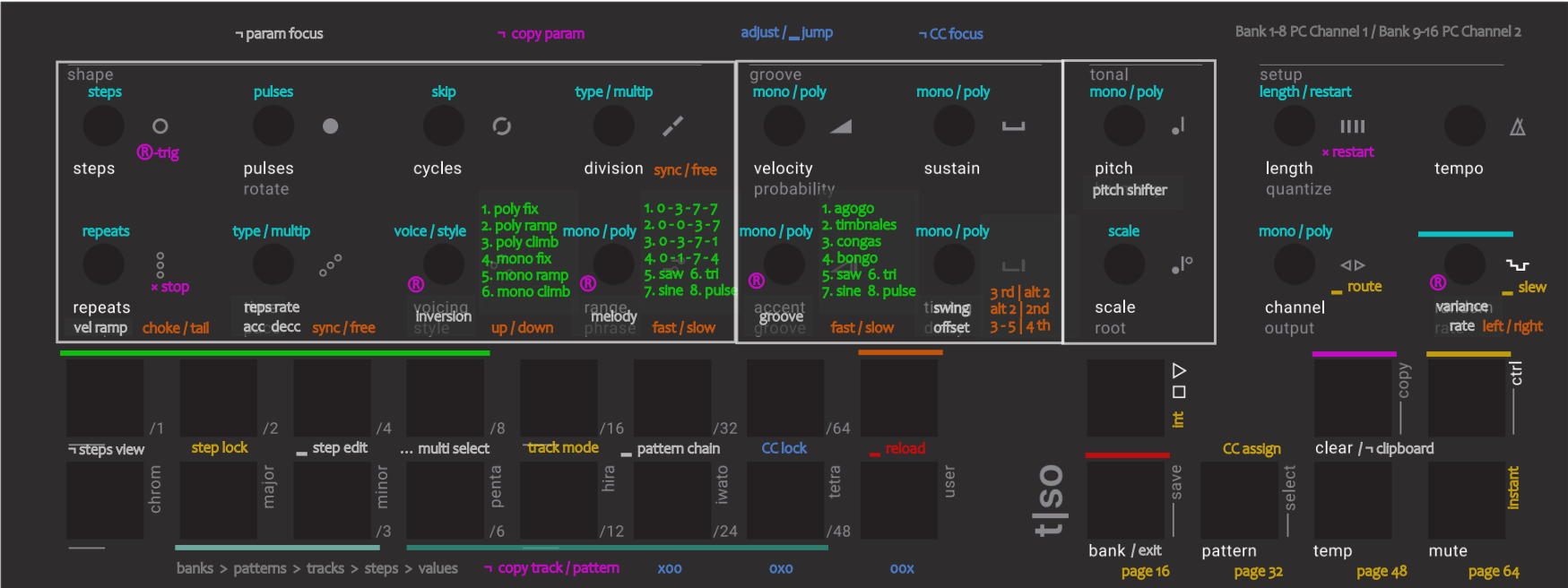
one thing i can’t remember (and can’t find in the manual or online)
are the random sequences retained between power cycles, and in between patterns?
or is there any other way to “print” the random modulation of parameters?
AFAIR random sequences are retained between power cycles, just remember to save the bank before switching off the T-1.
1 Like
it shouldn’t be hard to test, generate something freeze it, record it, power down, play and record again