How does it compare to the OP1?
I wouldn’t know, I never used an OP-1.
Totally different. It’s step-sequencer based rather than tape-based.
I much prefer the OP-Z. It’s the fastest sequencer I’ve ever used, and most creative, for me.
2 Likes
I’m wondering if that’s normal that my battery is depleting itself when the OPZ is shut off? When fully charged, if never turn it on for week the battery is completely depleted, which I find strange as it’s advertised with years of standby time…
Do you have the same behavior, or is my battery defective?
it can be various things.
one of them is that over-charging batteries in general make them less stronger.
if you happen to be accidentally over-charging your device over night or always using it for long sessions while plugged in at 100% could be a possibility.
There’s no overcharging with lipo/li-ion battery as there’s a chip to take care of that. Overcharging would mean explosion otherwise…
That being said, I use my OPZ mostly on battery and don’t leave it charging, as it often never ends charging (another signal that something may be wrong with my battery). It has this behavior since I bought it last year.
1 Like
I don’t think I realized how much different this makes the two machines. The OP-Z is an amazing sequencer-based machine. I’ve got some nitpicky complaints, but it’s really really good.
The OP-1 has sequencers, but it isn’t a sequencer like the OP-Z or an Elektron machine. You can’t really save a sequence with parameters the way you can on an OP-Z. It’s more like a looper, and the sequencers are mainly useful for laying down a loop on the tape. You don’t have to loop the tape, of course. You could just play it straight through. But it’s a tape machine.
So think about how your Elektron machines are laid out. You build a sequence, turn off the machine, come back a few days later, and decide you want to add to it, tweak it, perform it, or whatever. It’ll be there. That’s exactly how the OP-Z works, but that’s not at all how the OP-1 works.
3 Likes
I would try contacting TE support. There is a little bit of a lag in response time, but they will get back to you.
Yea in a lot of ways the op-z is like elektron digi-junior. Half sampling half synthesis, or all sampling if you want. But sooo many key combos to remember.
1 Like
I found using the app as a good gateway to going screenless, and then it is just practice (which is fun) to get familiar with the interface.
1 Like
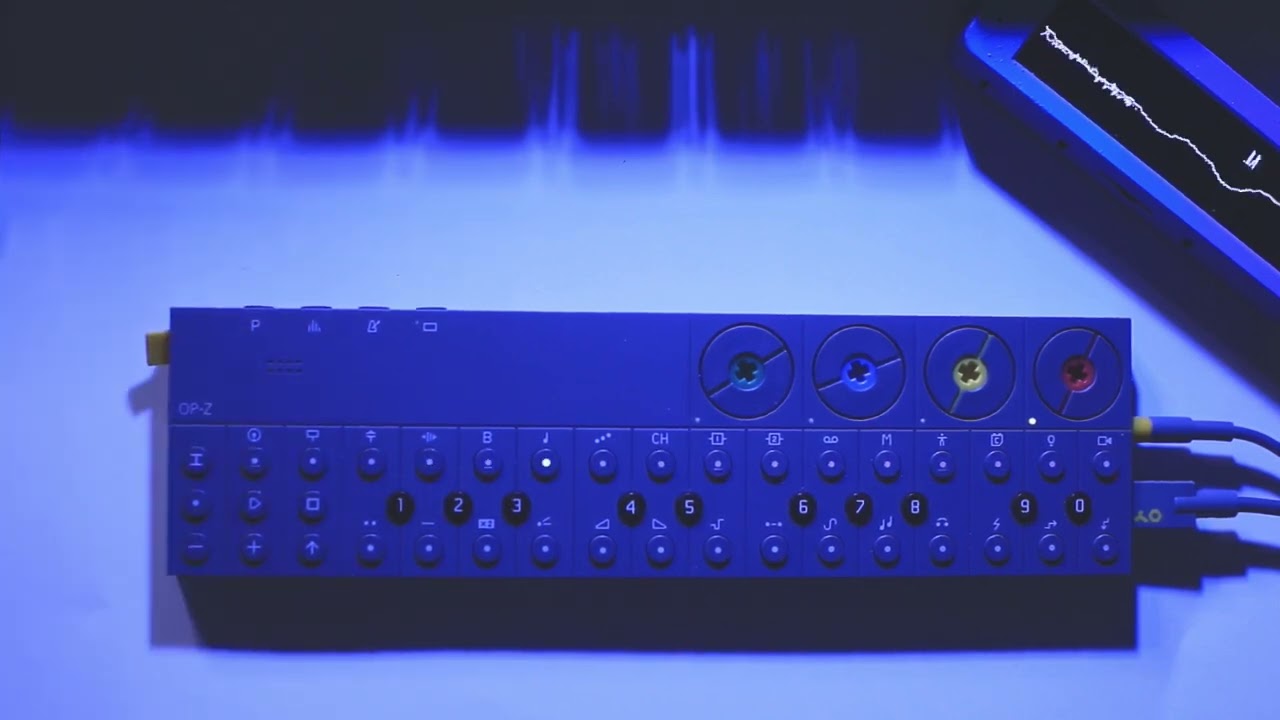
I wanted to try out my new camera arm so I figured I’d do a little OP-Z set since I always have a bunch of patterns which I don’t use on there…
Regarding the set itself I like to have some live elements so I usually keep my loop and performance tracks empty so that I can program them while playing the set, it’s just more fun that way…
Have a listen if you find the time.
5 Likes
A few years ago I was incredibly excited to finally get my OP-Z. It didn’t come bent, but the encoders would pop which was annoying, but could live with it.
The first few days were fun, but after that it became increasingly apparent that OP-Z was a machine without a clear goal. The sequencer is ok at most. Yes the components are fun, but only a few are useful. The engines are nice and I loved the second reverb added later, but overal it still felt like I was using something that wasn’t finished.
Compared to OP-1 which lives in its own little beautiful music universe, the Z is a master of none. The video component is laughable and although DMX is very nice, it’s not a real world feature many people will use.
Overal I’m just sad to see how the Z turned out and hopefully one day we can get custom firmwares that change the sequencer into a proper one with 64 steps and more useful trig conditions
2 Likes
I find the limitations of the Z to be extremly inspiring actually. The only thing Elektron sequencers have over Z is 64 steps instead of 16.
At first I was pretty annoyed over the 16 step limitation as well, but after a while I started to adapt to it and use creative ways to circumvent that limitation… For song structure there isn’t a sequencer out there that can cram so much into one pattern as the Op-Z. Some tracks though kind of feel like bloatware tbh.
Also I’ve noticed that I seem to respond really well with color coded UI’s. I have a Clank Chaos Eurorack module which uses color and light in similar ways to OP-Z and i just gel with that… so maybe I’m partial to the OP-Z due to the way I seem to respond to color coding.
6 Likes
Ah happy to hear you’re embracing it! Limitations are always good, but only if you like the workflow.
I disagree on this though. Polyend Tracker for example runs circles around the Z in terms of filling patterns. Then there’s also Cirklon that is just on a whole different level that it’s unfair to even compare.
The color coding is great! As on the OP-1 it really invites to experiment with parameters you might not touch as often on labeled synths.
I also share a lot of love for the OP-Z and agree with @MichaalHell on the 16 steps. I don’t like paging through different parts of a pattern.
+16 steps is more than enough for the simple stuff I make.
I think compared to the Elektron sequencer the OP-Z wins by a landslide…
4 Likes
As a former owner of the tracker we can maybe leave it at agree to disagree…
But of course circlon is “better” but that thing is complex as hell and take ages to set up in comparison to OP-Z.
I’ve had the opputunity to see the cirklon at our local synth group and while it’s rad, i wasn’t particularly blown away by it… but I’m guessing it’s the deeper parts of the device that are mind blowing
Which tracks are unnecessary? I think the matter track and tape are some of my favorite… love the punch in track… the picture track lets you sequence normal video files with your beat… I can’t imagine anyone would not like that… club lights sequencing is cool and unity sequencing could be cool if it ever is really explored…
1 Like
No way, step components are quite cool even if many of them are not that useful, but only 16 steps, the ultra fiddly and imprecise buttons really kill any enjoyment of using it for me. The speed division allows longer than 1 bar patterns but the resolution and editing of individual notes let it down.
I really think had TE wanted to make a really excellent and usable sequencer they could have, but they were fixated on making it cheaply built (though not retail price) and being edgelord about it being annoying to use - even mentioning it in the marketing blurb.
I can get music made on it that I am happy with using custom samples, but I find it incredibly fiddly and annoying to use, to the point where once I have something I’m happy with I record the midi or audio output into something else to continue working. It is a great idea starter, but for me that is all it is.
Edit: I should add I was tempted to re-engineer a new proper sized case, with proper buttons and offer them commercially but it would be too cost prohibitive.
2 Likes
I love the way TE manage to change note trig length by just pressing the start and end trig at once. This workflow is so much faster than editing the length parameter in the Elektron workflow
2 Likes
I understand your sentiment…and I would agree that they should re-issue it made to Elektron built standards.
BUT. The ease of use is unparalleled in my opinion. Elektron devices always take more clicks for each task and it adds up. Also the non-existent overdub on MIDI tracks is a drag and doesn’t suit my workflow. Of course horses and courses goes without saying 
2 Likes