Thank you all for your input! It’s weird that you can’t adjust slices with knobs - works well on bb. My plan was to use it as multisampler - did few cool patches with bb - but also as notepad / recorder for 404 / organelle on the go.
I think it’s work really well for that. “Multi-sampling notepad” is a pretty good description of it actually haha
1 Like
here a v ideo of me rocking this nanobox, it’s dubby deep house. all sounds and samples come from the nanobox and are sequenced in the nanobox itself. it gets the job done but man o man the sequencer can be painful.
i mapped some fx send and parameters(lfo to filter for the main pad) to some knobs on the melbourne instruments roto control and can also trigger pads via that midi controller.
what i think is a very good plus is it’s ADDA converters(or how are they called?) because, well if you listen to my beat, no external processing done except a Fabfilter L2 limiter thingy.
But it sounds like a powerhouse!
deep house on the nanobox tangerine
I like it, yeah, I thing slicing is also very convenient, and although the company lacks updating their hardware to give priority to new items i get by. but i wouldnt call it worth its money perse, maybe after some updates.
4 Likes
Currently owning it, but so far, if I wanted to loop samples in a better manner especially for multisampled works, there’s a bit of a convoluted workaround:
https://forum.1010music.com/forum/general-topics/19862-wav-tags-we-support
Users have to take advantage of a WAV editor for looping multisampled audio to work better I guess.
Doesn’t help there’s no step sequencer.
Still gonna try and make the most of this device until it genuinely frustrates me. I love the very compact form factor, but it’s clear that 1010music do want people to buy multiple ones of their nanoboxes for their profit as a way to fix the shortcomings of each other (lemonbox and fireball for synthesis that may be better suited for pad-like sounds, razzmatazz as a drum machine with a dedicated step sequencer). Only the Blackbox and Bento seem to be better suited for more dedicated music production, and of course they cost more than the individuals nanoboxes themselves.
1 Like
New firmware up
Tangerine 1.2.28
01-09-2026, 04:35 PM
Tangerine 1.2.28 includes a couple of new features:
- New global setting: MIDI Pads: on/off
- Support for MIDI Program change messages on the pad MIDI channel
These new features make tangerine more useful in a complex MIDI setup. On the global MIDI channel you can disable the note to pad control. You can also send MIDI Program Change messages on all channels that the device is listening to: either the pad channels or the global channel. Check it out and let us know what you think.
There are also two bug fixes:
- MIDI CCs don’t hit the center point exactly. This is most noticeable on controls like pitch where you want to get back to unity pitch if you make an adjustment.
- MIDI USB did not work in the previous beta version (1.2.2)
11 Likes
thanks for the heads up on this / anyone avoiding midi via usb due to unwanted noise?
how are you powering the Tangerine?
was powering via the mioxl, but i’ve opted to powering via the nanobox now.
I think that just means, that the Tangerine can receive program changes on its pad channels now. Previously, it could only receive the pc messages on its ‘midi global in’ channel
1 Like
Nano Tangerine and Oxi One mod lanes.
I do not have the latest firmware (re: mod CC channel) because I wasn’t aware of it till I came to post this just now
Trying to replicate some patches from my Summit, I’ve come across a few things:
- Needs portamento
- Needs at least one ADSR modulation envelope
- Does it sample after you release the note? This is what I understand the release length to be. If that’s the case, does it jump to the release point at note off on the multi sampled patch? Since a lot of summit patches are effects heavy, I want to hear the reverb, not just decay the active part of the note.
- Needs a key amount and velocity amount parameter for modulation. Sometimes, for example, I don’t want all the notes to vibrato at the same rate. It sounds crowded.
- An aftertouch sample layer. Some patches have things like a blue note or distortion that makes the patch really expressive
ad 3) Release length can be set to a max of 16 seconds. Up to you to set it up accordingly or you can just record (and name) all your samples manually if you think that autosampling would be too limited. Afterwards, trigger or gate launch modes will play through the sample as recorded unless you define the adsr to do something else. There is no magic happening here.
ad 4) Velocity and key modulation sources do exist. It is also recommended that you disable velocity to volume modulation on the sound source, even when recording velocity layers. This will allow you to shape volume via velocity seamlessly using Tangerine’s envelope. Tangerine cannot interpolate between layers, so the velocity response will be stepped, which in case of volume can be annoying.
-
What i would expect it to do, since it has all the information on capture, is to jump to the reverb tail on release. this would be the release length part of the sample. So, for example, I set the sample length to be 12 seconds and the release to be 3 seconds. on the nano, i want to be able to play a note for five seconds, then, on release, jump to the release part of the recording to catch the reverb tail and and release articulations from the original. Aside from the reverb tail, the Arturia Wurly shows a good example of such an application: playing the Wurly’s physical key noise when you release a key. If I tried to autosample the wurly it would just decay on note off without playing the key noise
-
where are the effects ADSR envelopes? i only see an amp emvelope and lfo’s. so say if i want pitch lfo (vibrato) to increase over time with an adsr envelope then taper off or for pitch to lower at the release part of the note
this is the only way i can avoid noise when powering.
i’m gonna look into getting a ground loop noise isolator to see if that helps.
This is what I use for my Seqtrak. For my Tangerine I use a PD (Power Delivery-enabled charger) and that seems to work. It also has a battery case which I suppose adds another buffer.
My noise floor is -72 db.
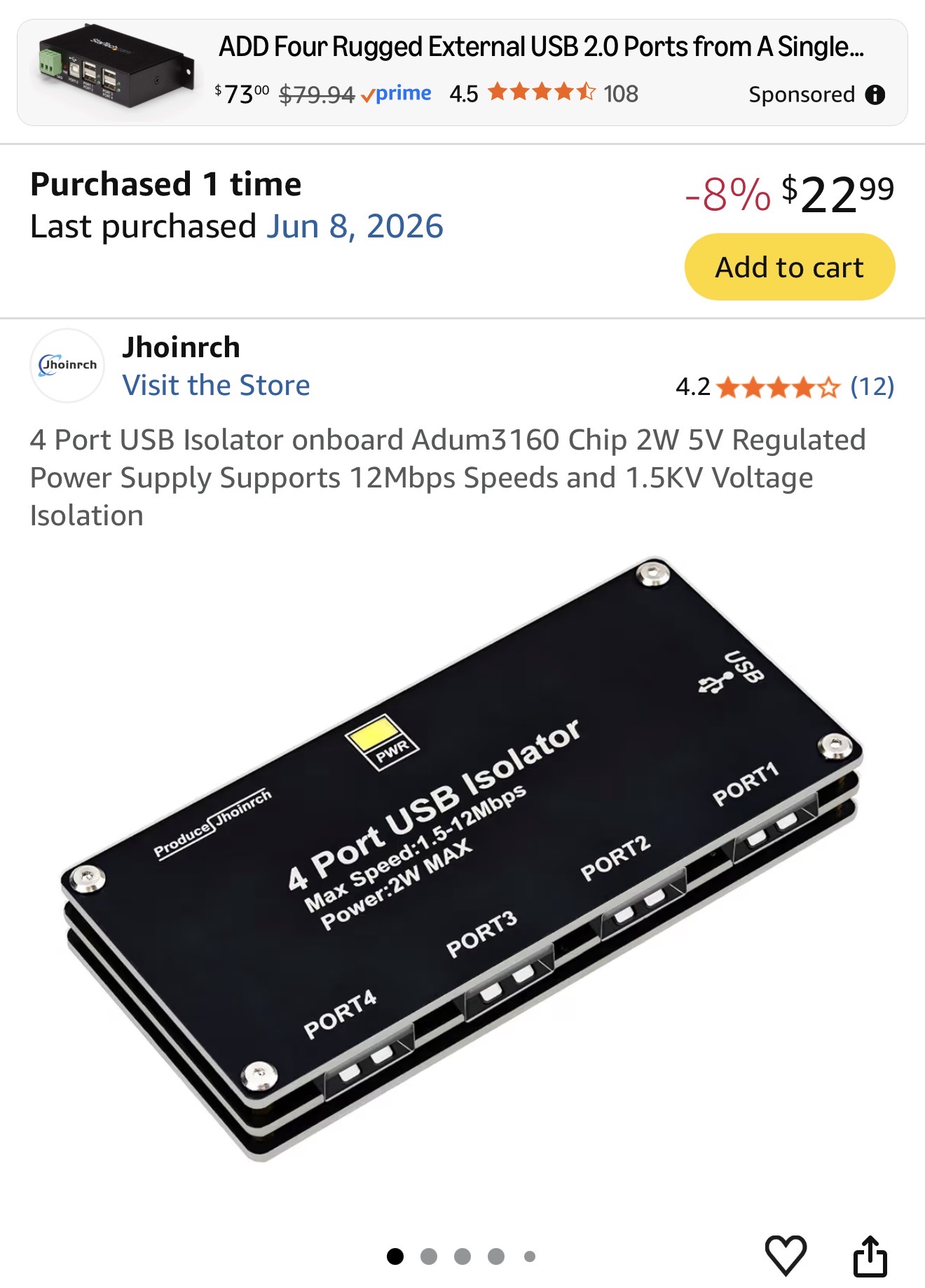
2 Likes
You only need one hardware synth and a Nano Tangerine IMO.
Everything else is just gravy. As far as cloning synths, I struggle to find something better than the Nano Tang in hardware form as far as specs go, even at several times the price.
I do wish it had more mod ADSR envelopes, mod matrix, and a jump-to-release point feature integrated into the auto sampling, but otherwise it’s pretty full featured IMO.
1 Like
The sequencer could really use some love too. I know it’s just supposed to be a sketch pad, but….not being able to even erase one of the pads to re-do it if you need to, is just asinine IMO
2 Likes