Damn I almost thought I had finally found a reason to fire up SY Chip on my RYTM. I understand your lab restrictions, though. This is a really fun explorative series you started @Nils.
The thing I like the most about SY Chip is the selection of animated waveforms, so I focused there!
This is track 9, 10, and 11 all assigned as SY Chip. I’m using the animated waveforms for all three tracks and only track 3 has offsets enabled.
Tracks 9 and 11 are using LP shelf filters with envelopes.
I recorded this using the Polyend Synth as a controller for the chord following feature and arpeggios, and I was really enjoying the classic analog synth sound as I played around with layering arpeggios. I sort of like how the analog tracks break when they go too high.
I’m sure everyone will come up with more exciting recordings! I hope to get enough time to make something different in the coming days.
Lovely melodies! I guess using an external arp and controller helps unlocking the melodies? I’m finding it really hard to p-lock offsets to get the right notes, it’s a painfully unintuitive way of working. Feels like playing chords with a calculator or something.
I haven’t tried it, but it guess the SY Chip machine doesn’t respond polyphonically to external midi notes?
Thanks @Tchu. I know the theory, I just find it slow p-locking and auditing the offsets. Would be great if it was possible to enter them from a midi keyb. Oh well. That’s for another thread
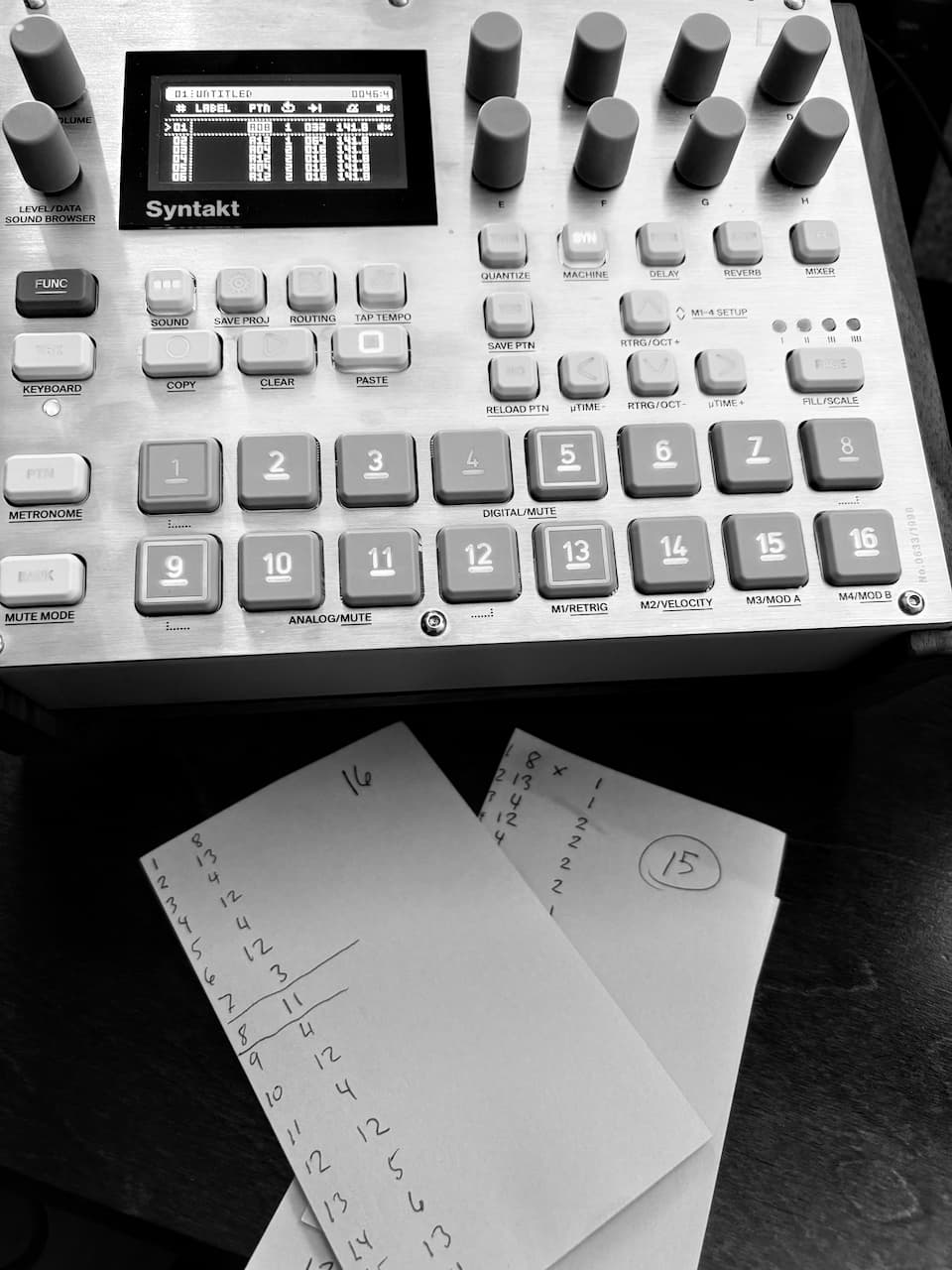
Here’s my entry. I want to explore some more, but started having fun with this one. I’ll likely try something different before the next machine SSL is up.
9 patterns, but two of the patterns are intro/outro duties. Another two could have been combined if running short on space, but left it as is.
All put in Song in mode, so the final output is the same as what’s recorded.
As for process, I need to write things out. Normally I use a dry-erase board, but was in a different spot and used my loved ones’ post-its. Chicken scratch the order and the 3rd time around is the right order.
EDIT: Some things tried:
Synth speed vs LFO assigned to Filter Frequency. There’s room to dial in the snare from doing just this alone.
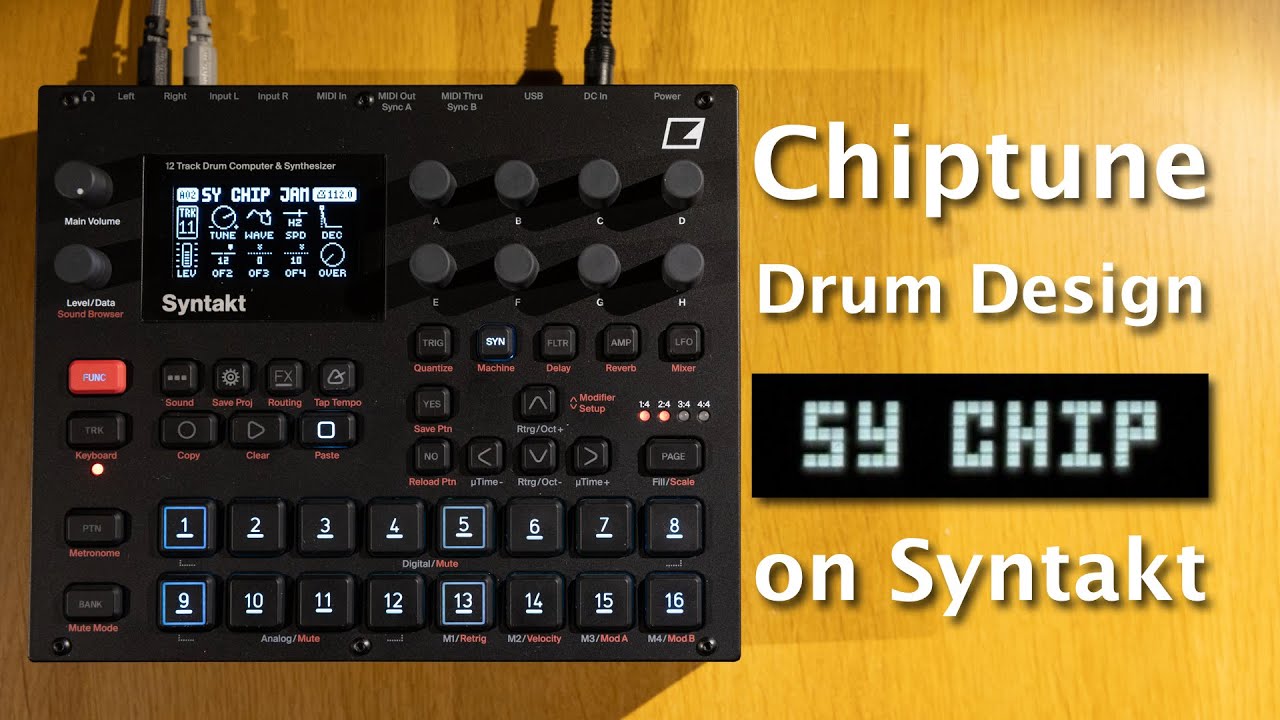
Fun to hear the different takes on this machine! I’m naturally holding it close to my heart, and have been making quite a few SY CHIP-only videos lately, on both Syntakt and Analog Rytm. If you want some inspiration on how to use it for the “design goal” (which it of course neither is nor should be limited to at all) I made this tutorial on chiptune drum sounds, only using SC:
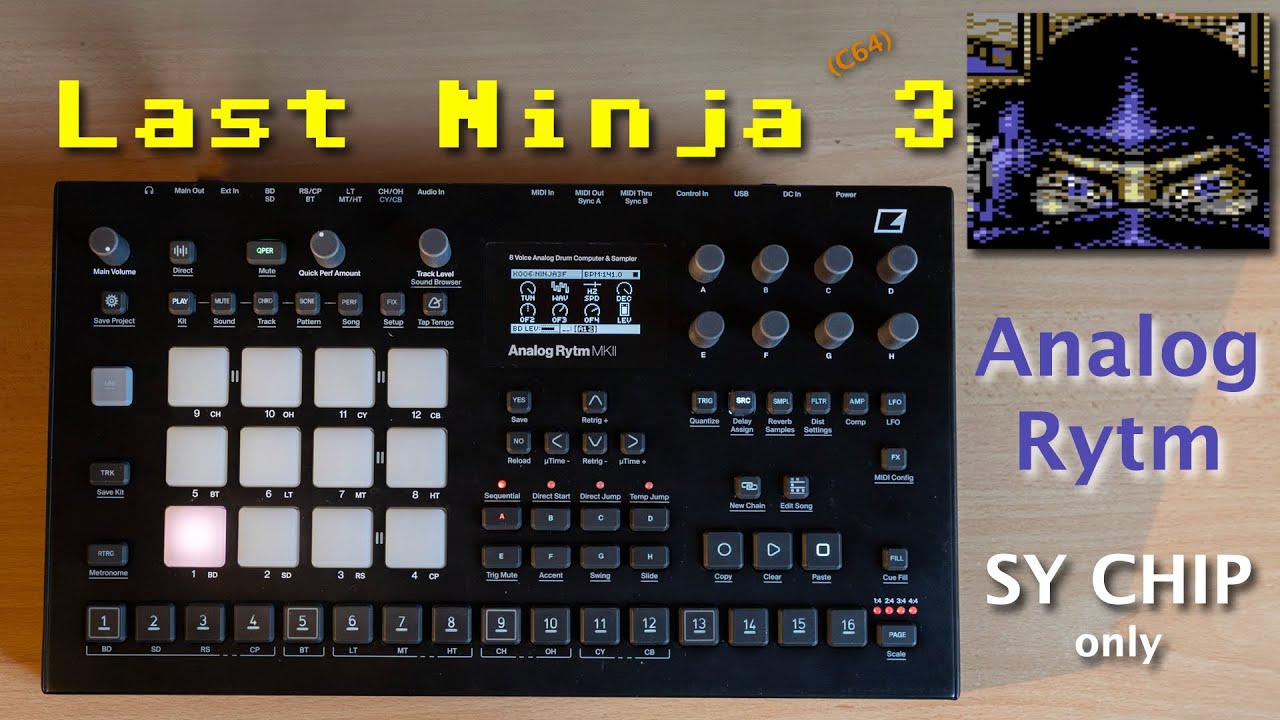
And this recent one is also SC-only, albeit on the Analog Rytm. The same song could sort of have been made on Syntakt as well, but then I would swap the parameter slides for the second LFO and Legato Portamento.
Yeah, I’ve heard lots of the cool chiptune work you’ve done on Syntakt. I love the covers!
Nope, just the main note, then the following notes “offset” by the amount of semitones you set.
In my example I just have the one track that uses the offset by -12, 12, then 24 to arpeggiate 4 octaves! Lots of movement, with very little theory.
Well, thanks for listening, and for the flattering comment.
There are three SY CHIP tracks. First one using conditional locks to alternate the not-quite quarter note trigs, with lock trigs in-between to change the CHIP speed.
Second has a single length 16 trig, again alternating with another one, and 14 lock trigs affecting Offset 3 and some LFO settings. Third has conditional trigs of different notes, with lock trigs changing start phase of the LFO which is set to Decay.
The FX block has 16 lock trigs changing the Bandpass filter frequency, plus some Drive variation, and LFOs for Delay Feedback plus Reverb Decay.
Velocity Mod used in tracks 9 and 11, too - partially obvious stuff, and to modulate the LFOs.
Possibly the main point of interest in the Song is that the FX Block is muted until row 04. Otherwise it’s a very simple alternation of the three tracks.
I’ve used 2 LFOs. One Ramp LFO on the speed (my classic that I wanted to share so thanks for asking ) and one Saw LFO on the Filter Frequency. I’ve also p-locked some Waveforms. Nothing to fancy for a first entry.
I’ve noticed that it sounds awful on a cell phone because a lot of the interesting things are in the Low registry.



 ) and one Saw LFO on the Filter Frequency. I’ve also p-locked some Waveforms. Nothing to fancy for a first entry.