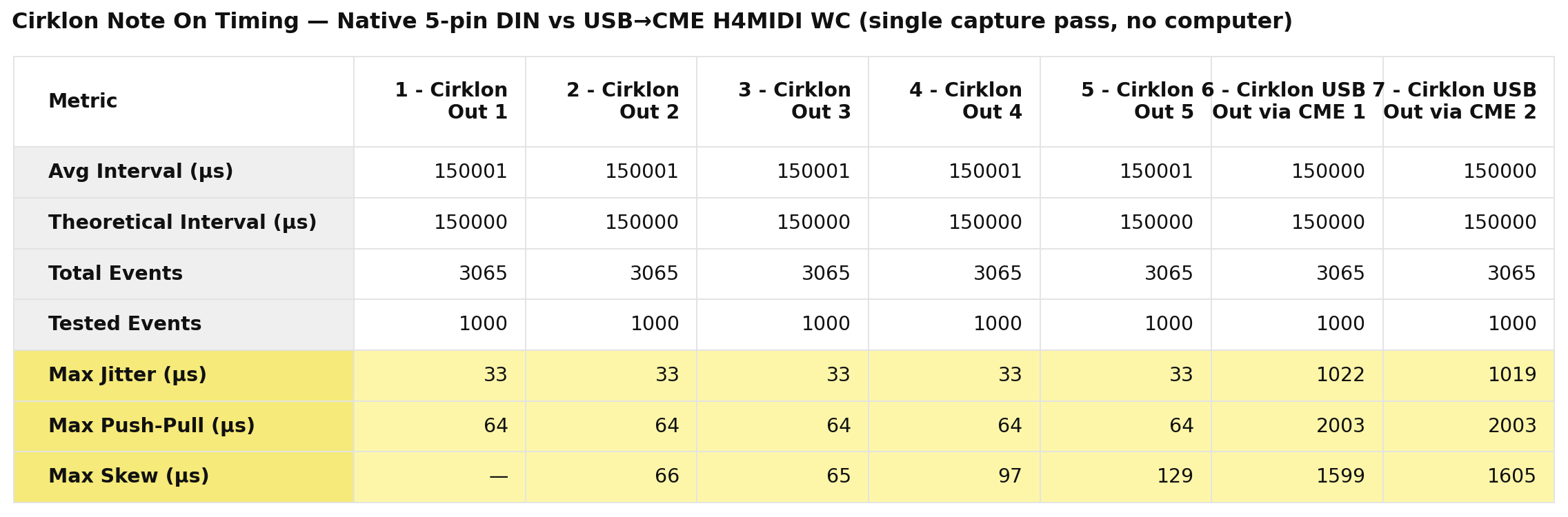
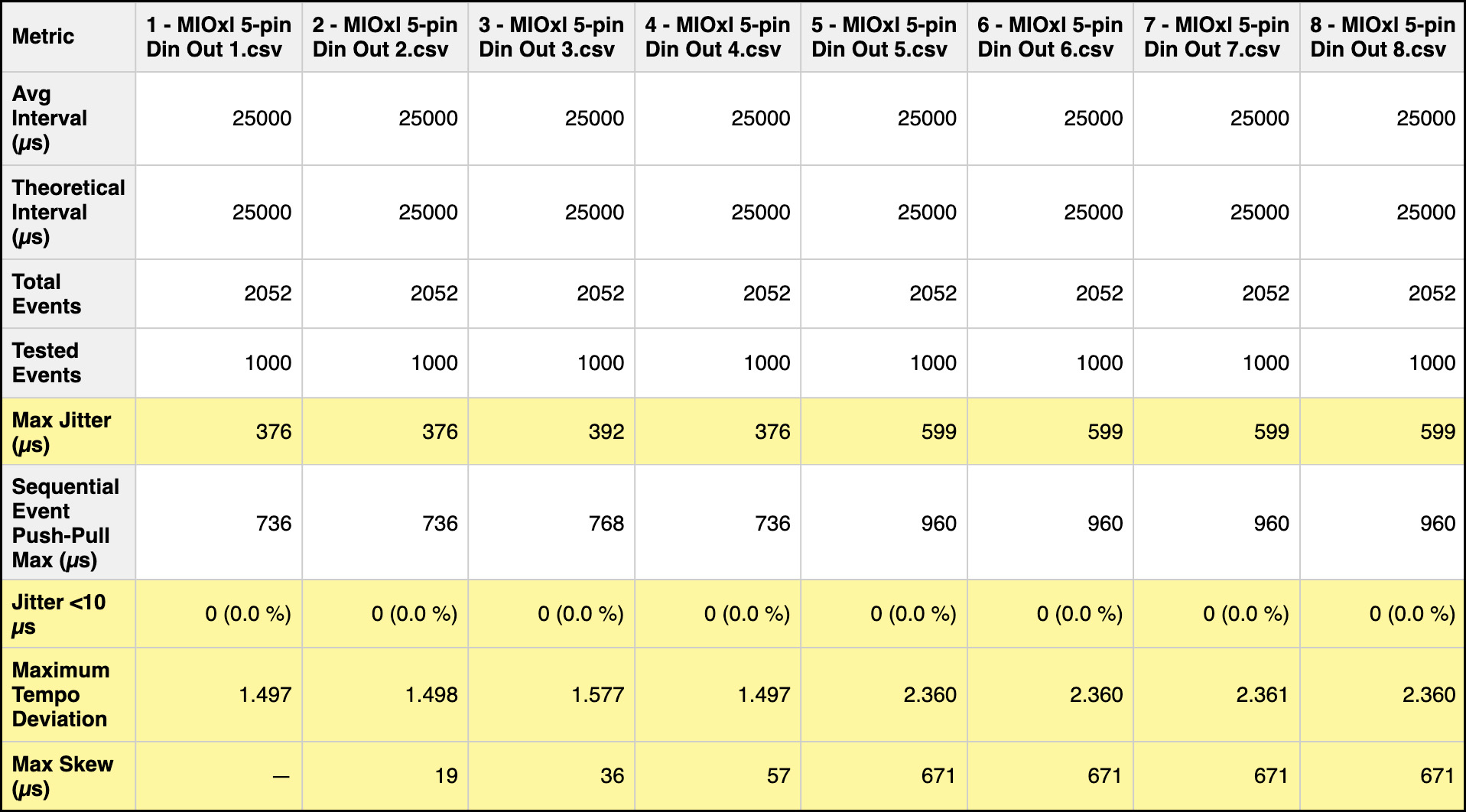
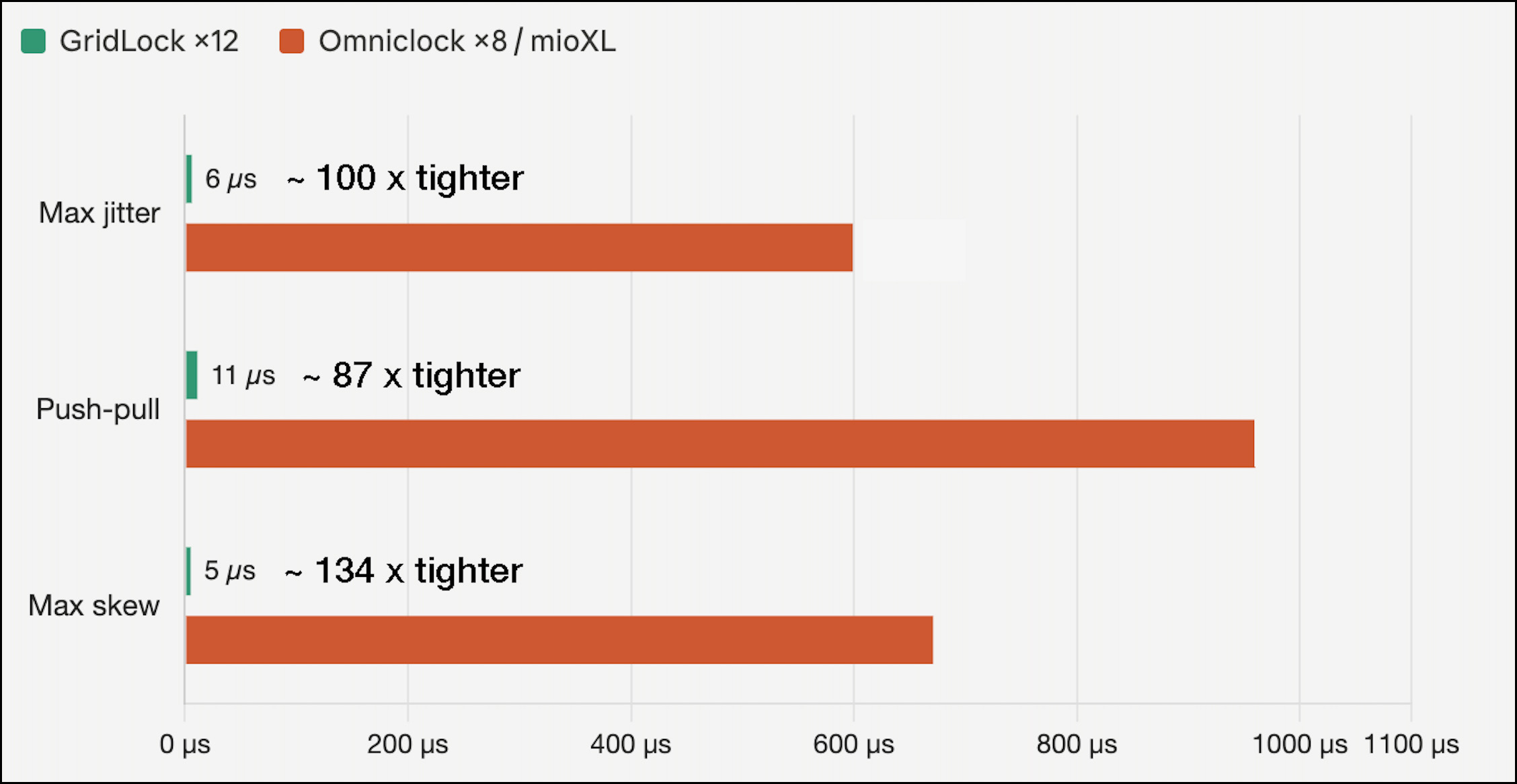
It’s a little disappointing to see a thread that was started specifically to discuss Omniclock gradually become a vehicle for demonstrating the value proposition of a competing product.
We have no issue whatsoever with people measuring timing performance. In fact, we welcome it. Timing matters, and objective measurements are useful. What seems odd is using an Omniclock thread primarily to reinforce why a hardware solution costing roughly 50x more is supposedly justified, rather than evaluating Omniclock on its own merits and intended use case.
The interesting thing is that the measurements being presented actually reinforce one of the points we’ve made from the beginning: there is a critical difference between theoretical maximum timing precision and musically meaningful timing precision.
To put this into context, we’re sharing measurements from an original Roland TR-909, arguably one of the most important drum machines ever made and a benchmark sound source for house and techno music.
What These Results Show
The key takeaway is that one of the most iconic and influential rhythm machines ever produced exhibits timing movement measured in milliseconds, not microseconds. (This is the same for almost every other legendary drum machine/sampler)
The TR-909 recording shows:
- Up to 5.175 ms peak-to-peak timing variation in straight mode.
- Up to 5.227 ms peak-to-peak variation with swing enabled.
- Repeated excursions of several milliseconds from nominal timing.
Yet nobody would seriously argue that the TR-909 fails musically because of this. In fact, entire genres were built on it.
If Omniclock—at its most extreme—exhibits timing characteristics that are still roughly twice as tight as the natural jitter of a benchmark TR-909, then from a practical musical perspective it is already matching or exceeding the timing stability of the very hardware machines that define the sound of electronic music. Producers have happily used these classic instruments for decades precisely because those slight variations are part of a usable musical result.
Our position has never been that timing accuracy is irrelevant. Our position is that there is a point where further improvements become increasingly difficult to perceive in real-world musical situations.
Some users absolutely want the maximum measurable precision available and are happy to pay for it. That’s entirely valid. But the data from the TR-909 suggests that great musical results have never depended on achieving timing accuracy down to the microsecond level.
Our goal with Omniclock has never been to win a race for the smallest possible number on a graph. It’s to provide stable, reliable synchronization that exceeds the timing consistency of the instruments people actually use to make music.
Our focus remains on giving musicians a practical, affordable tool that solves real synchronization problems and lets them get on with making music.