As an Octatracker one can read the manual over and over for years and find and explore new things. Having an OT for a few years when DT launched, reading the Digitakt manual I felt like I understood the device in one read. The Model I could pretty much understand through osmosis of the PDF being on my IPad…
Which one of those is preferable is completely a personal decision to make and there’s no right or wrong and certainly no consensus…
IMO although they have certain things in common (especially the sample thing, obviously) these are very different tools for different purposes.
I like the DT as a drum sampler counterpart to my original MD (never did get a UW). But the lack of stereo and my urge for working with some longer material, capturing loops from the modular, etc. has driven me back into the OT’s arms as well. Very different tools.
Every Elektron instrument is a deep and complex tool that rewards an investment of time. Mastering any of these is still easier than mastering the trumpet.
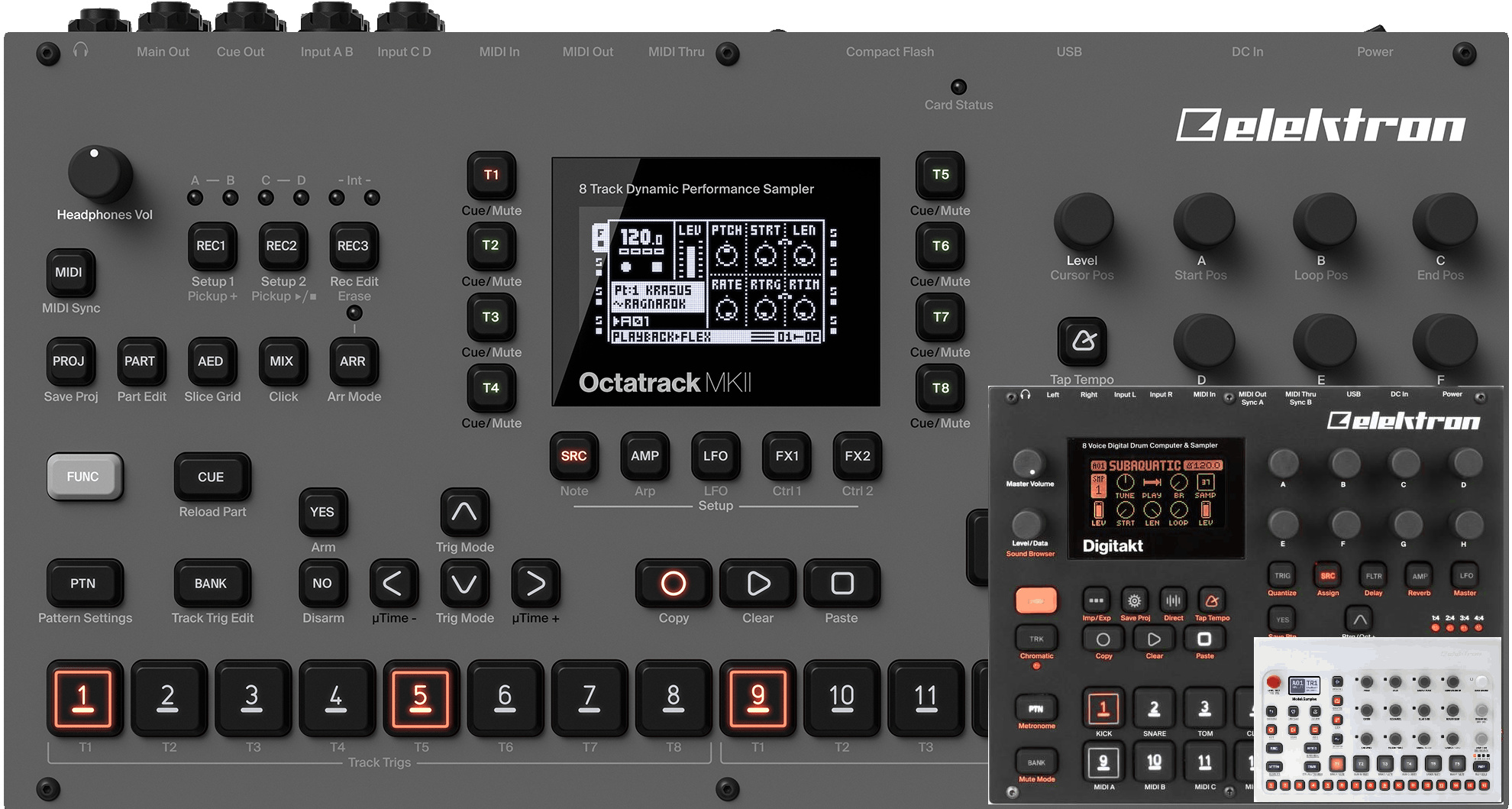
Amazing! With just a couple of things you could picture the 3 machines.
I have a MS and I’m having serious fun AND lots and lots of music made.
I’m considering that one day I may feel curious about getting a DT or an OT.
What I love about the MS is the way the thing can shine with live performance and intuitive composition.
What makes me question if I would enjoy the DT is the lack of one-knob-per-function and the independent track lenghts (which is absolutely my thing). I dindn’t knew it had a LFO controlling sample slots… that must be very interesting… The independent bpm per pattern means that you can change pattern with its own bpm while playing but not that you can simultaneously have different patterns playing different bpms right?
As for the Octatrack it seams really cool to be creative with sound designing and customization (?). It seems that it would be great for live performance but in a different way as the MS, because it lacks the one-knob-per-function which is really effective for improvisation. The 3 lfo’s per track is amazing! And I see myself doing live sampling for live craziness. But it doesn’t have a Ctrl-all? Oh, that hurts. But it also have independent track lengths like the MS, for poly-rhythms, right?
all three machines have independent track lengths. DT has ctrl-all. OT doesn’t, but the scenes combined with crossfader are a better replacement, in my opinion; you have more control over what you’re changing.
The feature I love most about the Crtl-all in the MS is changing all the tracks SAMPLE LENGHT to a minimum and then loop all and change cutoff, for example. And then I can go back to a saved position with FUNC + PATTERN.
the OT crossfader combined with scenes allows you to set values for multiple parameters (I forget the limit of how many) for each side of the crossfader (each side is a scene), and then fade between them. the parameters you’re talking about can be assigned to these scenes and faded between.
they both have trig conditions. I think they have more than the MS, actually.
oh I see what you’re after… no you cannot do that with the OT’s crossfader. I’m not sure if you can do ctrl-all for the DT’s trig conditions, but I doubt it.
There is Probability control all for DTs. No probability at for OT.
Parameters 250. This is much more powerful than control all. Min/Max values, hence much more control.
This, recording capabilities and long files playback are OT main strengths imo. Audio Editor, sample accurate audio editing including slices, usable timestrech…you can cook a lot of things standalone.
I was thinking of compatibility with other Elektrons.
I really didn’t gel with MS. One knob per function, but less functions ! I didn’t find its workflow simpler than Digitakt.
There are independent tracks lengths on all Elektrons.
IIIRC you can control MS start with lfos, but it isn’t precise. With OT and DT lfos on slices.
New gear in the game : DT2.
Better than DT1 on most aspects (no mono recording! ).
And DT1 is much better than MS feature wise.
DT2 can record loops with quantised start, has much more RAM, stereo files, 3 lfos, more filters, machines, 128 steps, possibility to loop pages playback, Euclidean sequencer, Control All tracks selection, Compressor routing (side chain possible), modulations (4 destinations for velocity for instance), more fx…
@entrepassos what kind of music do you make ? Do you use loops, edit them ?
I can imagine the power of applying 250 parameters and crossfade between scenes.
But, the thing is: with the MS I can be jamming and start a drum sequence from the scratch while I’m playing with other musicians, keep playing the music, and, without stoping the music for programming scenes, I can do Ctrl-all and apply the one-knob-per-function to do breaks and sound trips. It’s very immediate. From what I get the OT it’s much more powerful but less immediate, and that should mean not so good at improvising from scratch?
I never tried a DT or OT.
All the things the DT2 have seem really cool! Interesting…
Yes, I use loops and manipulate them. I’m starting this project now: Music | enxara - Both the tracks were created with the MS, but “al” also have a sound from Arturia Microfreak.
Definitely. Unless you use it to record other stuff live. Requires more time to learn compare to DT, the workflow is different, more menu diving, but very precise control and audio editing.
Another OT limitation is PITCH parameter range +/- 1 octave (with an additional RATE parameter to go lower, -6 octaves.)
DT2 is +/- 5 octaves.
The simplest for you is to try a second hand DT1 to get an idea.
If you won the lottery buy a DT2 and an OT MKII.
yeah they all kind of have their pluses and minuses at different things. I love the MS for traveling and quick and dirty sketches. it’s more immediate and there’s less options, so an idea either works and you run with it, or it doesn’t and you move on to something else. the OT is better as a studio centerpiece (and general studio swiss army knife), where you can fully flesh out an idea, interface with and record other hardware, jam with loops, etc. and the DT is in-between those two.
 ).
).