This is good to hear. It must be close to launch.
Maybe. But then when is a better time to announce it ?
Superbooth worked really well for most everyone else. Would you think they’d just delay it a week.
Moogfest would be a great time.
Not happening.
What about Bob Moog’s birthday ?
Wait, that was today.
Ah, the Fourth of July.
Extra fireworks.
The next show is in September. ( post )
Plus it’s not like everybody doesn’t know that it exists. It’s just some detail, the majority of which isn’t going to be a shocker.
The most reasonable thing i can come up with is they are waiting for it to be in the stores.
So it might be a while.
1 Like
On the 30th June the Minimoog made its very first solo performance.
What better day to release it than this.
1 Like
I found a link on GS,
Summary
MOOG MUSE
• Sonic inheritance from beloved Moog designs
— vintage discrete modular-lineage oscillators, a saturating mixer, dual classic transistor ladder filters, and discrete stereo amplifiers.
• Performative controls, intuitive layout, knob per function, and individual menus for every module. A powerful arpeggiator, sequencer and chord memory offer exponential musical inspiration.
• An unexpected diffusion delay effect: a hypnotic stereo processor inspired by golden era vintage digital rack delays with diffusing multi-tap behavior.
• The Modulation Oscillator that gives you a 3rd oscillator or powerful modulation driver, as well as a dedicated Pitch LFO, assignable envelopes, and triggered random generators, all routed via 16 modulation slots per voice per patch.
Polyphonic, Bi-timbral Analog Synthesizer
SOUND ENGINE Analog (Digital effects may be bypassed to maintain 100% analog signal path)
POLYPHONY 8 Voices
KEYBED 61 full-size weighted keys with Velocity and Aftertouch
CONTROLLERS Pitch Wheel, Modulation Wheel, Macro Knob, Keyboard Octave switch, Hold switch, Sustain Pedal input, Expression Pedal input – all pedal functions are assignable
PANEL CONTROLS 44 knobs, 16 sliders, 129 buttons – OLED screen
ANALOG VOLTAGE-CONTROLLED OSCILLATORS (x2) Selectable Triangle/Sawtooth mix, variable width Pulse wave, Octave (16’, 8’, 4’, 2’), Frequency (+/- 7 Semitones), Wave Mix (blends Triangle/Sawtooth with variable Pulse wave), FM routing and amount, Hard sync
ANALOG RING MODULATOR Ring modulation between Oscillators 1 and 2
ANALOG VOLTAGE-CONTROLLED MODULATION OSCILLATOR Selectable waveform (Sine, Sawtooth, Reverse Sawtooth, Square, Noise), Audio range toggle switch, Keyboard tracking, Keyboard reset, Unipolar switch, Pitch Modulation routing and amount, Filter Modulation routing and amount, Pulse Width Modulation routing and amount, VCA Modulation amount, Panning switch
ANALOG NOISE GENERATOR
ANALOG VOLTAGE-CONTROLLED MIXER Independant level control for OSC 1, OSC 2, RING, MOD OSC, and NOISE. Overall OVERLOAD control
ANALOG VOLTAGE-CONTROLLED FILTERS (x2) Moog transistor ladder filters (1 with highpass/lowpass modes), Cutoff Frequency, Resonance, KB Tracking Amount, Envelope Amount, Linked Operation, Routing (Series, Parallel, Stereo)
ENVELOPES (x2) Attack, Decay, Sustain, Release, variable curves per stage, Multi-trig, Loop, Velocity
ANALOG VOLTAGE-CONTROLLED AMPLIFIER Volume per Timbre, Pan position per Timbre, Pan Spread per timbre
DIFFUSION DELAY Configurable stereo signal processor, Delay Time Left, Delay Time Right, Feedback, Character, Mix, analog bypass switches
OUTPUT SECTION Master Volume, Headphones Volume, Low Cut EQ
LFO (x2) Rate, Amplitude, Waveform selection (Triangle, Sawtooth, Square, Sample-and-Hold, User customizable), Keyboard Reset
PITCH LFO Rate, Ramp Down through Triangle to Ramp Up Shape control, One-Shot Envelope toggle, Keyboard Reset, Pitch Modulation routing and amount
GLIDE Selectable glide type (LCR, LCT, EXP), Glide amount
CLOCK Clock rate, Tap Tempo
ARPEGGIATOR Per-timbre with Clock Division, Octave range, Pattern, Direction, Gate time, Rhythmic programming, etc.
SEQUENCER 64 step sequencer with Clock Division, Transport controls, Sequence chaining, Step editing, Modulation capabilities, and memory capacity of 16 banks of 16 sequences
PROGRAMMER Browser via OLED screen with 16 banks of 16 patches, Mod Map, Arpeggiator settings, Sequencer with per-step settings, Global settings, etc.
VOICE CONTROL Mono or poly voice count per timbre, Unison/Mono, Detune, Timbre editing, Voice stealing configuration
CHORD MEMORY Chord memory with per-key functionality
MOD MAP 16 modulation slots per timbre per patch with controllers and mathematical transform functions
REAR PANEL AUDIO OUTPUTS – Main Left, Main Right (¼" TRS)
HEADPHONES – Stereo ¼" (located on the front edge of the Left Hand Controller)
PEDAL INPUTS – Sustain, Expression (¼" TRS; Configurable through Mod Map or for use as ¼" TS CV inputs)
CONTROL VOLTAGE INPUTS – CV IN 1, CV IN 2 (1/8” TS)
CONTROL VOLTAGE OUTPUTS – CV OUT 1, CV OUT 2 (1/8” TS)
ANALOG CLOCK INPUT – CLOCK IN (1/8” TS)
ANALOG CLOCK OUTPUT – CLOCK OUT (1/8” TS)
MIDI – 5 Pin DIN MIDI IN, OUT, THRU; MIDI over USB USB –
USB-A Host Port for system and data backup, USB-B Port for connection with computers, class-compliant peripherals
in the box:
• Moog Muse 8-Voice Polyphonic Analog Synthesizer
• IEC Cable
• Quick Start Guide
• Safety & Warranty Manual
14.55 kg H. 99cm W, 42cm D, 11cm H.
LAUNCH DETAILS
• This product is currently in production.
We are working to get stock into the channel ahead of the public launch.
• We are now accepting orders. Work with your Account Manager on distribution specifics and forecasting your orders. • Launch date TBD – Expected August 2024
The price is in stated as 47 380 NOK* about $4400
*Price is shown if you log in, nothing I have done but shown elsewhere.
6 Likes
Well that looks like a nice and solid vanilla poly, with everything Moog that you can think of. Given their track record, I guess it’s highly unlikely that there will ever be a desktop version. Price range in dollars (without taxes) suggests a 5k+ EUR mark including VAT. So it will be competing with 3rd Wave, P10 and OBX8 keyboard versions.
Compared to a the price of a Moog One its going to sell really fast.
I haven’t really desired any new gear in a while but this could be something I sacrifice for. Dual filters, enough voices, polyphonic ring mod and if it’s based on the Matriarch filters I do like them a lot. I love polyphonic ring mod for getting weird and it’s the one element missing from my Groove 3rd Wave.
1 Like
I am thinking the release date will be Superbowl 2025, on the one year anniversary of the first planned leak.
2 Likes
Digital delays. Good now I know I won’t have to spend $4400 on this.
How much poly does one need anyway? Does it get to the point of too many notes sounding at once creating mud clutter?
1 Like
8-16 voices sounds pretty good to me. If you want a monosynth they sell some of those, too. I don’t think it would make sense to reuse the delay from the matriarch because we won’t be patching it. I have a matriarch and I’m pretty interested in this. I think something that sounded exactly the same with more voices would be a strange product, but maybe they’ll do that anyway and leave it to the HPF mode to thing things out.
A diffusion delay means we can dial in reverbs, too - that’s cool.
1 Like
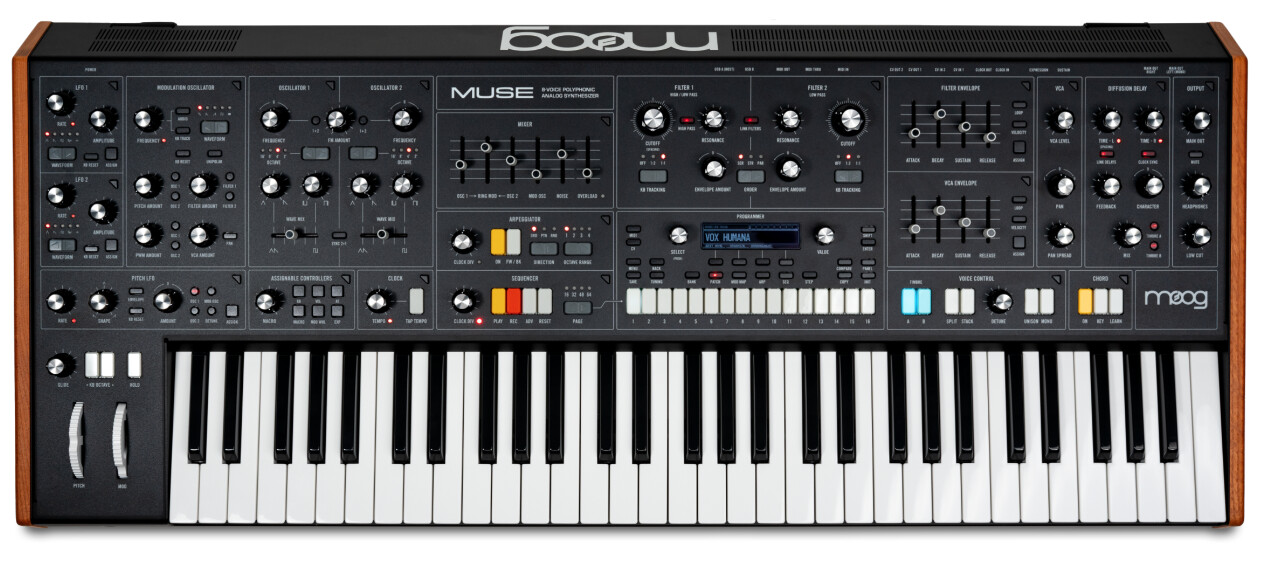
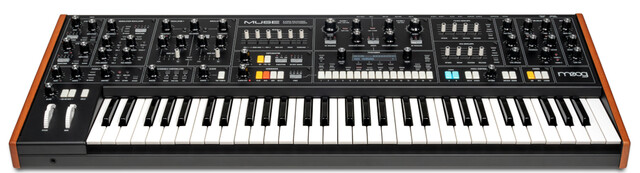
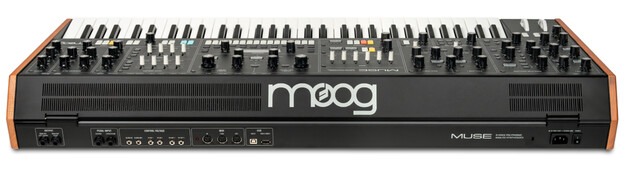
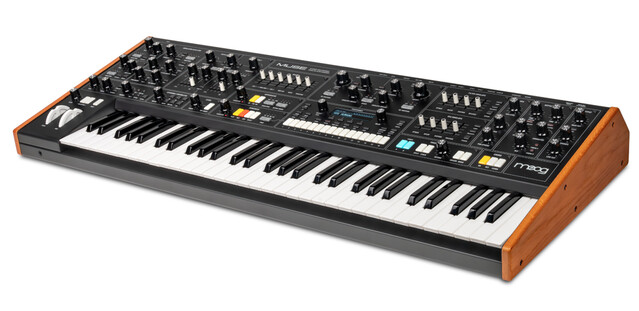
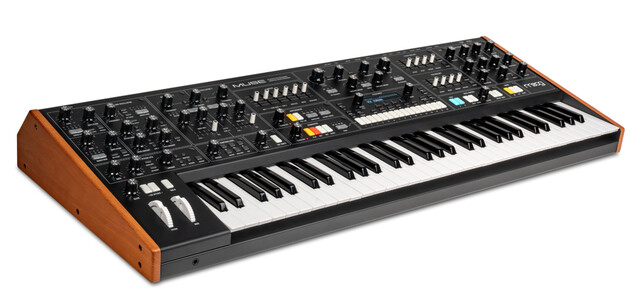
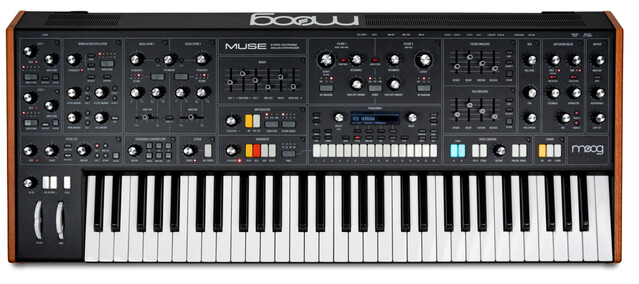
Apart from anything else, I find its design to be very attractive. Really nails a “modern Moog” aesthetic.
12 Likes
Ooooh ! That looks good. It’s very synthesizer, which you’d expect from Moog. The right most fader on the mixer is labelled overload, I like that.
3 Likes
Can we change the name of the thread now?
4 Likes
Intersting. I’m kind of getting a Moog humped a Jupiter 8 vibe. Not bad.
5 Likes
5k+ for sure
1 Like
I have 3 Moog mono synths and a Matriarch along with a Ensoniq DP4 so I pretty much have the Muse covered.
If I’m going to spend that much money, this looks more interesting to me.
2 Likes
Isn’t that going to be around $13k? That’s almost 3x the price.
This thing looks to be in the Gemini/P10/OBX8/Polybrute12 price range.
Maybe each voice will sound just like their mono voices, but it wouldn’t make for a very good poly if they did that, so I am assuming not.
1 Like
for me, with polys, it’s more just a matter of having the notes in a melody decay more (or rather, their release stage isn’t cut off by the next note). but otherwise the melody I’m playing is often largely monophonic, it just sounds different than it would on a monophonic synth. and of course, there’s always times to use chords and pads and such. but I don’t use massive ones, so eight voices is plenty for me. a lot of polys are also multitimbral, so you get more out of it than just the one patch at a time. I think the specs say this is bi-timbral, but of course everything is currently unofficial…
anyway, it looks great! kind of like a modern Opus sort of look. can’t wait to hear some real demos.
2 Likes
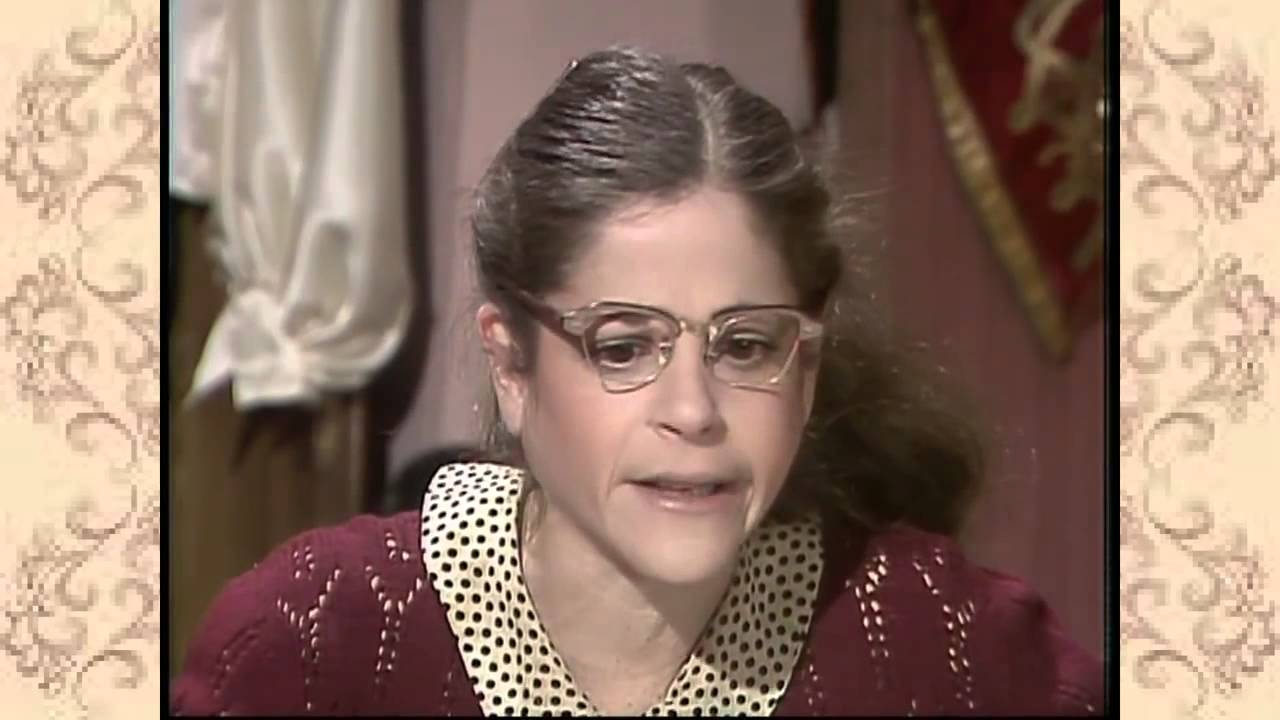
Flag notes; Comparing synths is valid and using comedy by a well know, now passed, artist to convey a mistake (I wasn’t aware the Korg was a $13000 synth) is also valid, IMO.