Haven’t updated yet but figured I’d update the firmware with the old manager first before installing new manager? The firmware patchnotes mention adding support for the new manager so I’ve just assumed you’d have to go about it that way
I thought so too but I can’t find a way to update via the older version…?
I bought my HS with Fw version 2.0 already installed so I’ve never had to update before. Time to contact ASM support.
All good for me when I updated my Explorer via Mac.
2 Likes
In particular the Korg Keystage which just loops you back around, 'cuz it’s the same keybed as in the Hydrasynth.
It only just started shipping in March. Cool thing about it is with their ( extra cost ) CV controller you can play / slide two CV notes simultaneously. If you could do that through a regular expression pedal plug, but you can’t. But you could add a second ribbon to the HSK or Deluxe and have two ribbons. Not tried it but it looks like it would just fit on the little rail under the keyboard. Weird idea to put it there, but otherwise it would be easy enough to attach the ribbon next to that just in below and in front of the keyboard. Easy enough to get your thumb down there, and still have fingers on the keys.
3 Likes
Explorer ? 
2 Likes
I had the same problem updating the DT, solved it by reinstalling the legacy 2.11 firmware updater rather than through the HS or ASM manager.
2 Likes
Polyphonic aftertouch has been in the MIDI spec for over 40 years at this point. Works just fine over standard DIN connectors.
1 Like
Just because a thing is in the spec doesn’t mean it works. You have to do the math.
We make a lot of techno here, which is usually faster than 120bpm.
MIDI over DIN/TRS runs at 31250 bits per second. At 120 bpm, that’s 260 bits per beat. MPE messages consist of six seven bit bytes or 42 bits. At 260 bits per beat, that’s a maximum of 6 MPE messages per beat with no room left for other note messages, CCs, etc. doesn’t help if you use multiple channels since 31250 is the entire wire speed.
It’s easy to overload the MIDI bus with an Octatrack just sending notes and CCs. Better to keep MPE within the device if at all possible.
USB MIDI can get past this, but then you are limited to USB MIDI or need USB to DIN devices, which add cost and complexity to your setup.
Edit: my bad, should have used 2-byte PolyAT. The rest of the math still holds.
That’s MPE, MIDI Polyphonic Expression.
Polyphonic aftertouch is way older and works just fine over DIN.
1 Like
My bad, Poly AT is two seven bit bytes, or 14 bits. MIDI over wire is still bandwidth light, so if you intend to do anything other than playing keys you will likely run into bandwidth issues.
“It works just fine” in very limited use cases. If you care about precise timing of your beats and have a few active CCs then you won’t have much room for PolyAT over the wire.
Always better to keep as much comm data within the device as possible as the MIDI pipe is very narrow by modern standards. (Unless you are running over USB)
1 Like
Ah, thank you very much that worked for me too.
For anyone else who can’t get the new manager to update on their PC, go to Legacy Downloads on ASM’s website and download Hydrasynth Updater 2.1.1 (Win)
Also, the fact that they are calling the new manager ASM Manager makes me suspect that they have other things in the works too.
3 Likes
Very true, I’m just busting your balls a little over the whole PAT vs MPE difference here 
2 Likes
This is why doing the math and showing your work is so important.
A lot of music making is personal aesthetic judgement. But when it comes down to a limited number of bits and bytes, the math really matters.
That’s payload, three bytes in the complete message, plus the framing bits. Times how many notes you are pressing down, times what ever throttle message rate is set inside the HS. Technically.
Poly-Aftertouch MIDI messages can be turned off, or set to mono in system setup.
2 Likes
At 120 bpm one beat is 0.5s long, that gives you 15625 bits per beat, not 260. A midi data byte might only contain 7 bits, but you need to transmit 8, and then you also need to add a start and a stop bit for each byte, that makes 10 bits per transmitted byte. So an MPE message is a total of 60 bits, and you can transmit 260 of those per beat at 120 bpm. For Poly AT it’s 3 bytes, so 30 bits, 520 messages per beat. Channel AT is 2 bytes, 776 messages per beat.
2 Likes
I will attempt to refrain from posting before the coffee hits in the future. Thanks for the correction!
2 Likes
AFAIK a key pressure message (poly AT) send the same amount of data as a control change, no need to worry about it.
NRPN and pitch bend send more data.
MPE ? depends on what you are sending, if you send aftertouch, modwheel and pitchbend for instance, it is much more than poly AT for sure.
But if you want you can send AT only (you can choose key or channel pressure for MPE), and you get the same amount of data as single channel poly AT.
6 Hydrasynths for 2 keyboardists. Maybe more in the band ?
7 Likes
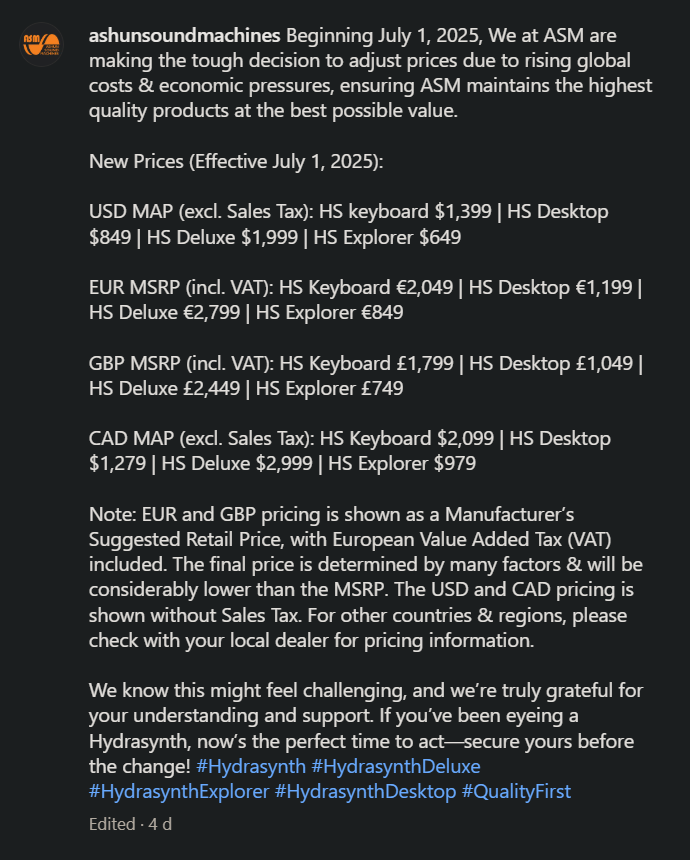
Price increase coming next month
Current prices based off Andertons
Keyboard - £969 > £1,799
Desktop - £649 > £1049
Deluxe - £1,355 > £2,449
Explorer - £475 > £749

1 Like
Just when I thought about selling mine 