I love proper bit and sample reduction. That was one of the things that I was sorely missing. The LoFi unit was ok, but didn’t quite have the range I was looking for. The addition of SRR to the Digi was such a nice addition.
Those stepped envelopes though…. I almost finished my initial design for my 8 stage adjustable window comparator module. I started this morning when I saw the first demos of the stepped envelopes!
Breath control setup with filter cutoff & amp level
Chord rotation with step advancing LFOs detuning the oscillators to rotating intervals
Glissando glide w/ glide legato
Snap to key
This is just the insanest shreddy thing I’ve played.
Trills become arpeggios, legato notes become slides across large jumps, and notes in place become rotating chords.
what an update… sadly i never really got along with the desktop version. i felt like i wanted keys instead of pads… but there is no arguing with what a complete monster this synth is.
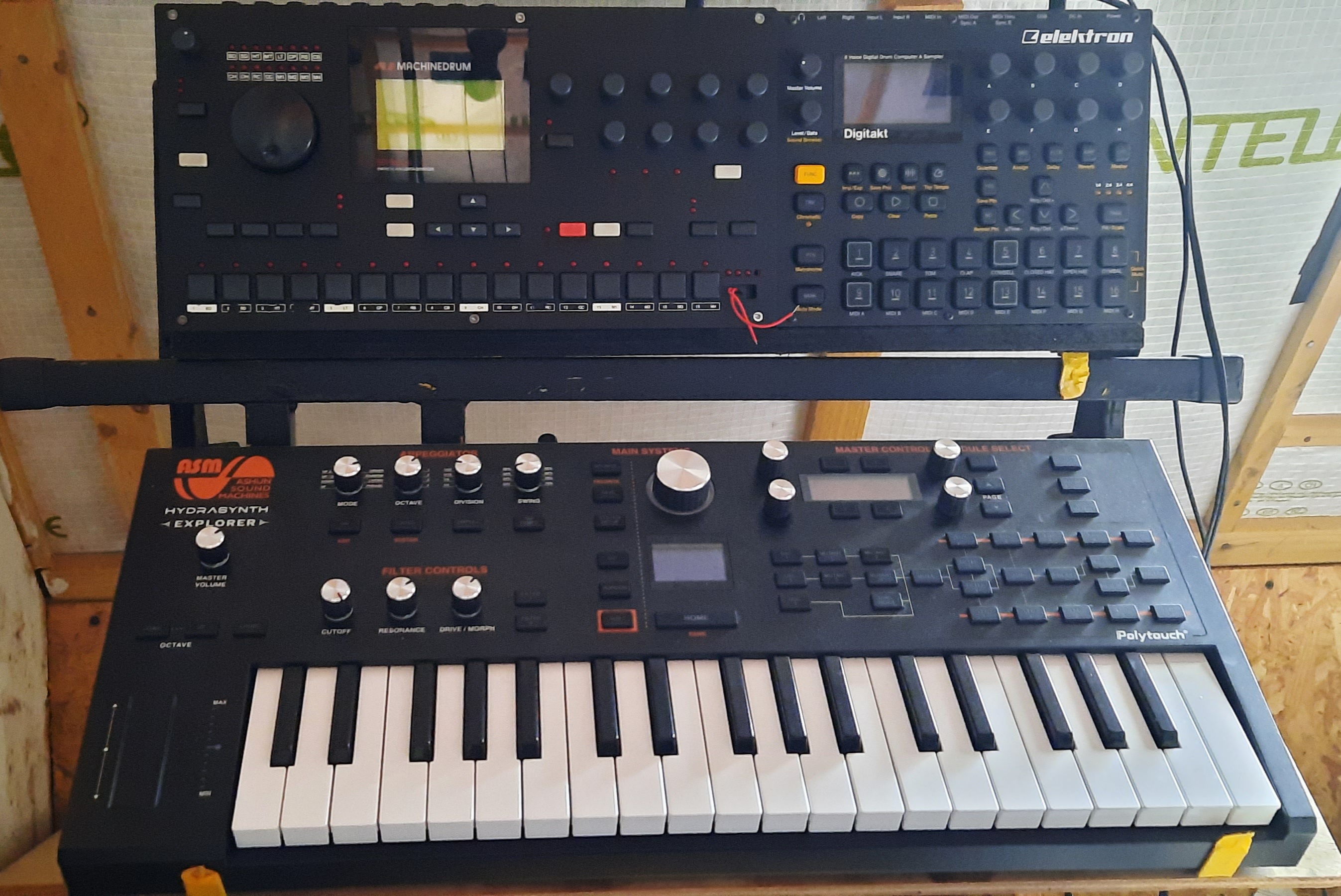
How is the Explorer version. is it ok to program on or a PITA? ive heard the keys are good for being mini keys.
The biggest downside, for me, is that you only have 4 Parameters (instead of 8) on the screen and the placement of the knobs compared to the other versions.
Yes good minikeys with aftertouch. I didn’t work on aftertouch settings, I’m not used to it, can’t compare.
Not that PITA to program.
Possible confusion between buttons 2/4 and page up/down.
I wish it had 4 more encoders instead of Arp knobs I barely use. I don’t like pichbend and Modwheel ribbon, that’s a general statement.
Main lack is Mod In imho. I really like the form factor, exactly the same width as Octatrack + Syntakt, or Machinedrum + Digitakt (555mm).
I can swap them on my homemade stand.
The CV Mod In which can be used as audio input and the Expression pedal are the other ones I use.
I upgraded from the Explorer to the Desktop and one thing is the Desktop is a lot smaller footprint on my desk than the dimensions indicate because the ports are all recessed underneath vs sticking out on the Explorer. The Explorer power button is easier to access though as a result.
I think if you are really into keyboards the Explorer with PolyAT and ribbons could be better but if you just want a Sound Module for your other controller of choice then the Desktop.
I’m primarily using wind controllers but the pads on the Desktop work great for testing out stuff.
The bit reduction on oscillators is a stand-out feature. This is the kind of thing digital excels at and nobody seems to want to build it into their synth. Good on ASM. I hope they continue this tack.
Speaking of areas where digital excels, I was really hoping we’d see phase modulation mutators by now. It is much better for the sounds I use than linear FM. Having both in the same box would be magical.
Linear FM and Phase Modulation should result in 99% the same output. Assuming sine wave to sine wave. It should be indistinguishable. So if you’re looking for OPL/YM style sounds, there’s no reason that you can’t achieve them with Linear FM. The trick is in the indexing/modulation.
Other waveshapes or Exponential FM will get you into other territory though…
They generate different side-bands and by the time a couple of modulators have been stacked, the sounds diverge quite a lot. But even just one modulator makes a noticeable difference.
Not sure of this was already mentioned here, but Glen Darcey just posted an interesting note about product development over at the official Facebook group for the Hydrasynth:
Here is a post that I hope gives some insight into product development and features.
Features can be a fun thing to think about and dream about.
There is no shortage of ideas, either from our team or from people on forums.
One thing that makes Dom and Ken and myself happy is that we almost never see a feature request that we didn’t already think of during development.
Most of the obvious things, “you should add a sequencer” “I want to put my own waves in” “I want to save pad configurations” “the screen should show XYZ” “oscillators should be mod sources” “you should make a VST” “the patch manger should allow you to audition sounds” “LFOs should have the same waves as OSC” “XYZ should be a mod destination” etc. were thought about and passed on for various reasons. These are all obvious features and ideas we came up with in the initial phase starting back in 2017 and 2018.
But what are the reasons for not doing them?
Platform limitations is always the first one. The platform i.e. cpu choices, buttons, knobs, screens, etc. all have to be thought out with a reference to what is the final price going to be and how many customers are you going to remove by adding cost. Higher cost = less customers.
No matter what, the box is only so big and the box is constrained by cost, availability, and technology limits. Once you have the size of the box, then you have limitations of what will fit in the box.
An example would be a subway train in Japan during rush hour. You see these videos of the car packed with people, they even have people pushing people in to pack it to the max. With it packed, the people are no longer comfortable and other things in your design like AC or seats may not work right. It would take zero effort and be easy to say “you should put a horse in there too”. But the only way a horse would fit would be if you removed a bunch of people or just squash the people but then the goal of delivering live people would be a fail. To say “you should put a giraffe in there” or “you should put live cod” in there, would mean that the train car would need a very different design. Building the car would be hard enough but you might also have more pressing issues with height of bridges and tunnels and track widths and all sorts of other infrastructure that make it impossible.
UI is another limitation. When you design a user interface, you build in a lot of logic. It is not just placing knobs and screens and buttons on a panel but there is a lot of If, Then, Else logic that gets placed in the design. Not only does the DSP have to work really fast to generate sound, the whole panel has to respond in a way that limits delays. You have to design things like ‘are the buttons activated on touch or on release’. It seems simple but if you design ‘on touch’ then it rules out things like press and hold because the activation happened on press. If you design on release, then the ability to play things in time can be affected. You can mix and match functionality but then the UI becomes a minefield of logic and it can lose the workflow fast…the goal is to make a musical instrument and it should be a true instrument, not just a technology box.
On one product I worked on at another company, there was a seemingly simple feature “put a metronome on it”. That feature however turned into about 8 pages of UI spec when all the details of it had to be worked out. Due to the scope of the product, we had almost endless “what if this case is met” “what If they set X to Y” “what about, what about, what about…”.
We all laughed because while it seemed like a no brainer, the metronome was one of the most complicated aspects of the project. Sometimes what seems like a simple request, can be really difficult when you have to navigate all the other features and UI.
When someone says “it should be easy” or “it should be a no brainer to add….” It is clear they never designed a product before because even simple things can mean undoing a lot of other stuff. Once you have knitted the sweater, it would often mean pulling it all apart and starting over to add something new to it.
We always welcome feature requests and are not insulted by them in any way. This might give some insight into product development and how things work.