They make a one module enclosure called a Qube that they have some of their 500 series modules in. Including this one. Highly tempting but $1635 CAD + tax. Probably well worth the cost though.
I just saw your post in the recent purchases thread and now I’m wondering how the warm Audio bus comp compares to the Boum. Cleaner, I imagine. Maybe more control over the compression. The frustrating part of the Boum for me is lack of compression controls. Technically, they’re all there but threshold and ratio are combined, attack and release are set in a menu, and I have a very hard time hearing the results when dialing it in sometimes
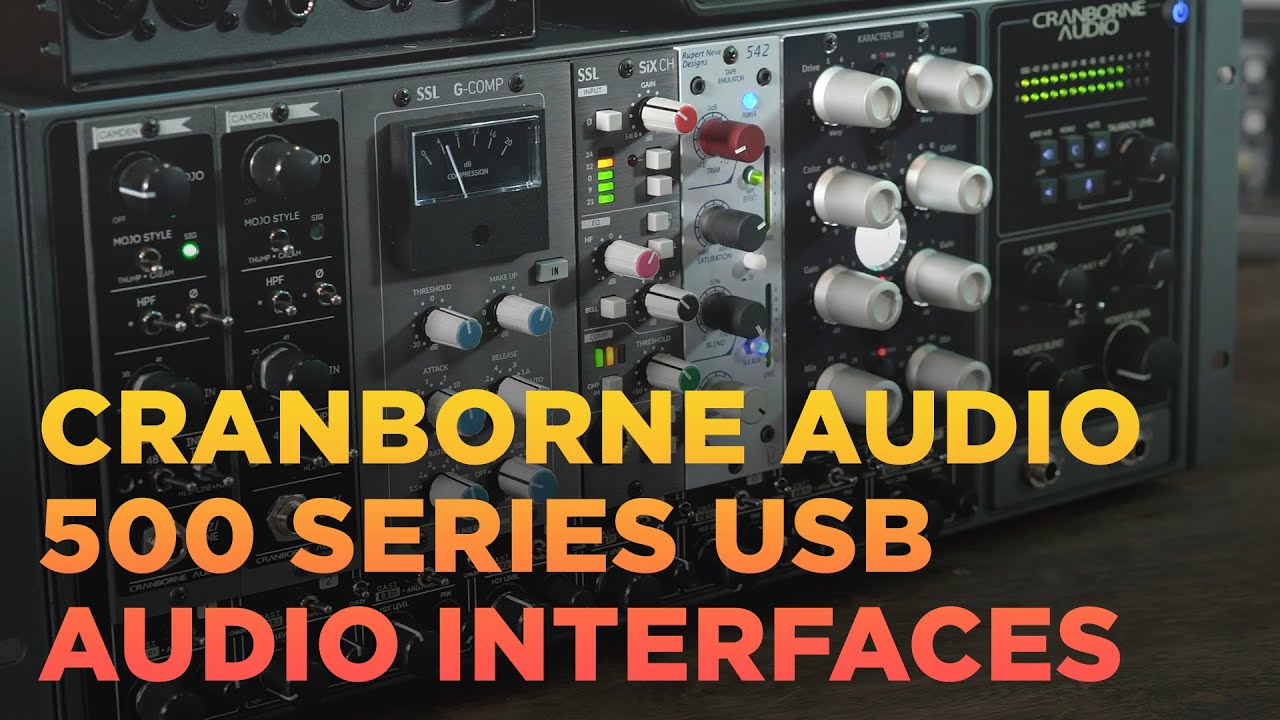
Cranborne has a nice one that’s also an interface. I don’t know how mini it is though
So that Boum is something I was sleeping on, it sounds sick! Just watched a few demos & am impressed with what it does. But yeah, I get its UI might be hard to follow.
Compared to the WA bus comp, it’s a totally different thing:
- The Boum doesn’t seem subtle, the WA is.
- The Boum is very tweakable, the WA has stepped dials so it’s good for patch recall & consistent results but not for experimentation.
Haven’t tried sidechaining the WA, so I won’t comment on that.
While the WA does colour sound, it does so in a very controlled, gentle manner. So I reckon there’s a good use case for using both the Boum & the WA in a single project, they can be used with very little overlap.
The thing about 500 series that appeals to me is that there’s a decent amount of DIY options out there, and because the power and i/o are handled in the rack it should be at least as simple to build (relative to a standalone unit) as Eurorack, probably more so.
Unless you’re using transformers, there’s really not much inside these that’s too expensive, other than panels.
The DIYRE OLA5 (Urei LA-4 clone with some upgrades) is $300 (transformerless), which isn’t an insignificant amount of money but still a steal for what it is, even if you have to do some soldering. You’d need 2 of them for stereo, but that would still only be about the price of one channel of the standalone clones I’m seeing, and DIYRE stuff is generally very nice so a more fair comparison would probably be more like $700-$1200 per channel for a real, late-model LA-4.
It’s the price of the rack that really gets in the way.
It would be a challenging but not impossible first project (assuming you practiced soldering a bit before you started), and looking at photos of the board if you’ve got a few projects under your belt already that’s only going to be a couple hours, maybe three if you’re really being careful.
I have an Elysia Xpressor Qube and am very happy with it. Very precise, yet compact, lots of options (hp sidechain, log release, auto fast attack, neg ratios, gain reduction limiter), sounds very transparent, but also offers a ‘warm mode’ that colours the sound a bit. Excellent build quality with both XLR and TRS ins and outs (which allows to send the out signal to two separate destinations, eg for recording).
2 Likes
That s awesome! Happy to hear it s delivering for you!!
Got a Focusrite Compounder for 169,- €. Super good ! Have it on the Drumbuss, but should work also good on the Master. It has this bass expander (basically HPF +light low-end distortion) with the"HUGE" button and it makes the low-end super nice ! Anthony Child (Surgeon) is using this still in his studio. Highly recommended it if you can get one. Especially for such a good price. Very good for electronic music/drums.
New alternatives : FRM RNC with HPF in the side-chain loop (cheapest good solution), than Oto Boum, than Warm Audio SSL Clone, Drawmer, Elysia.
5 Likes
These were completely off my radar. I really can’t afford one (what spare money I have is slowly going into the ASM Hydrasynth fund) but the SOS review is really making me want one for the MPC.
2 Likes
Interesting comparison with the Culture Vulture and Sound Toys Decapitator (amongst others)

Going by ear is best. I didn’t like the OT compressor too in the beginning and also looked for hardware compressors. Now I’m happy with it. I’m mainly using it as a limiter with full ratio. It’s pretty effective even at subtle threshold settings. I think I pushed it too far in the beginning. I haven’t used it specifically for gluing but I think it should be fine. The great advantage is that you have full control over it within OT and you can set the crossfader to lower threshold when gain is increasing elsewhere in the signal path or have it change instantly from gluing to limiting.
1 Like