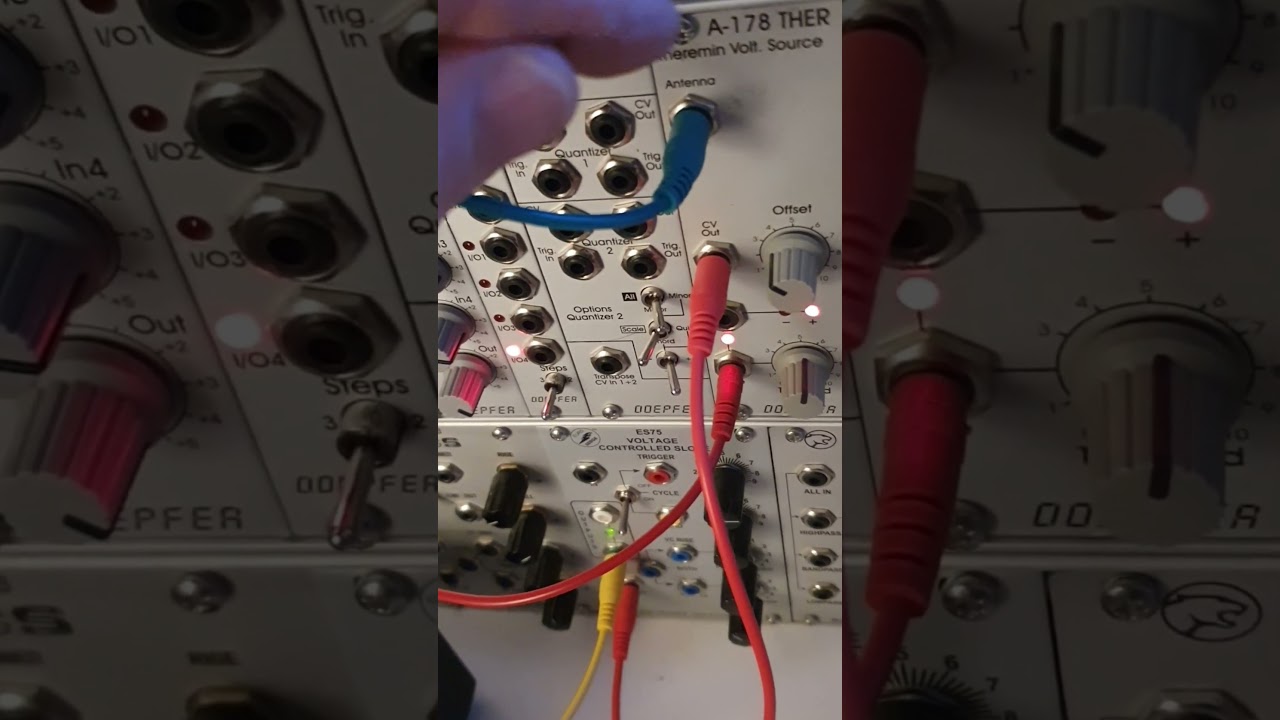
Hey hey, here is a new Schlappy Patching on my channel for those who like breakbeat and filter (and distortion…)
Hey hey, here is a new Schlappy Patching on my channel for those who like breakbeat and filter (and distortion…)
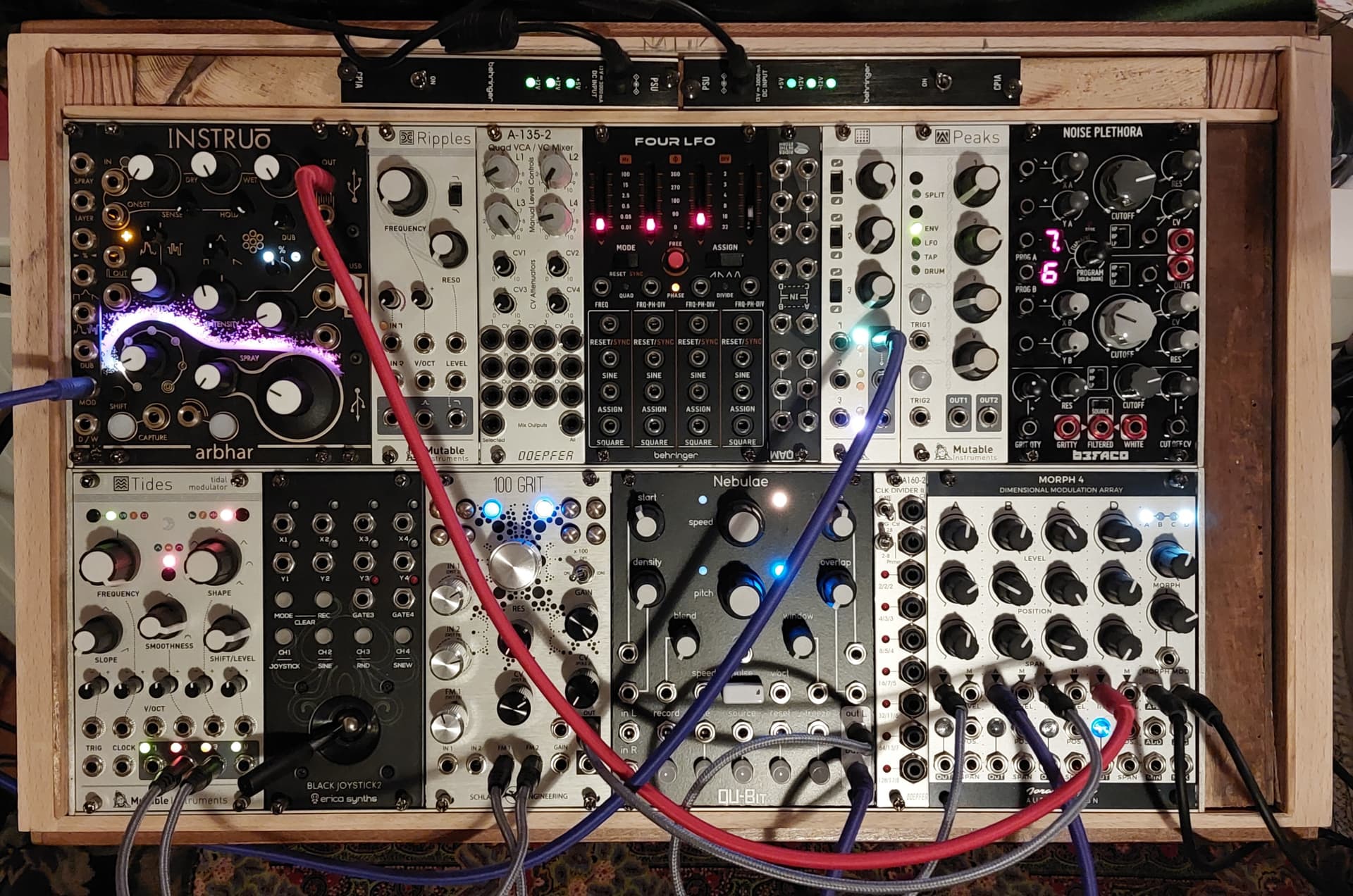
New iteration of my noise case. Considerable gain
After a full day use, i went to conclusion that it was not yet the right configuration.
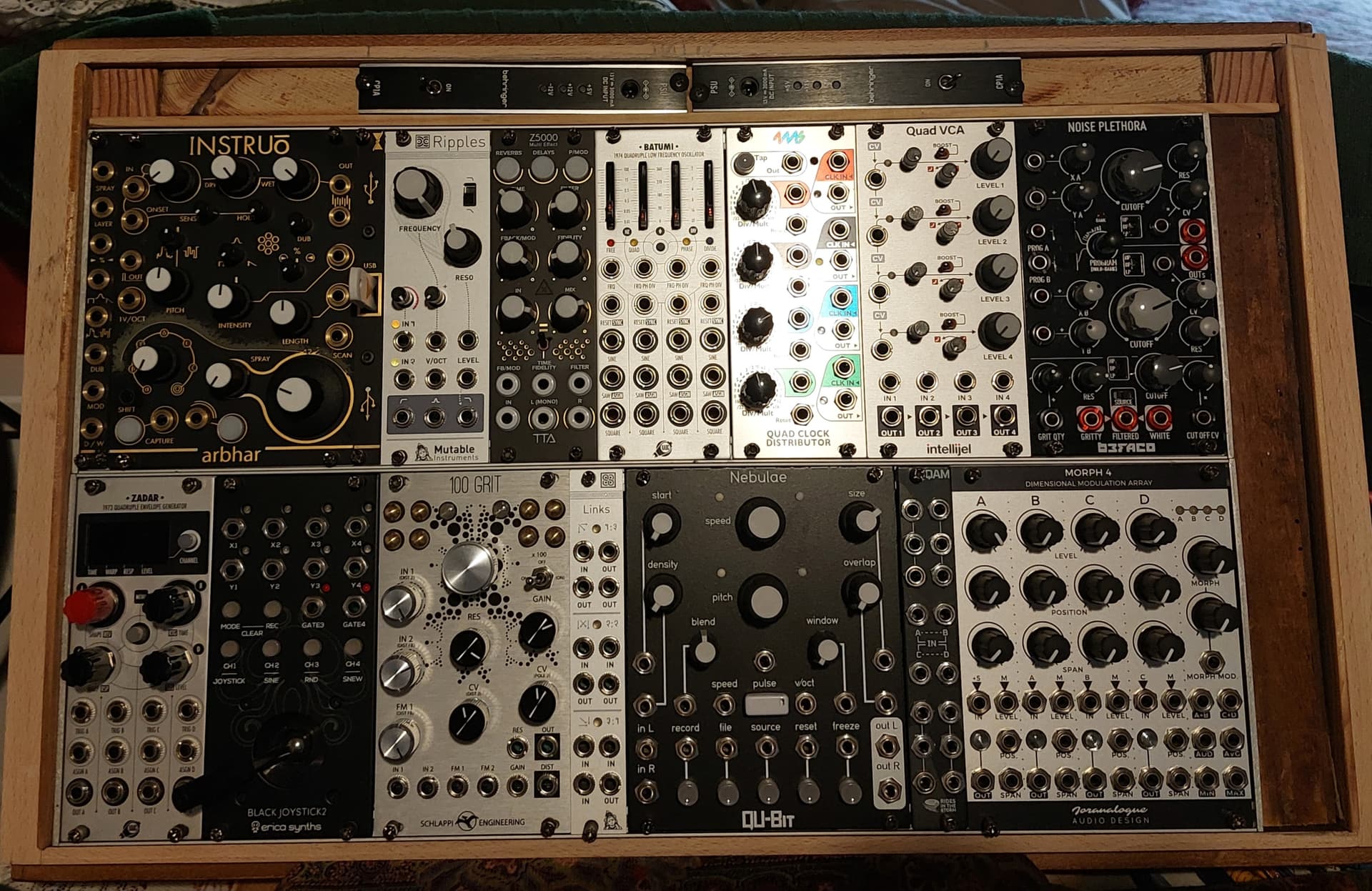
I replace Tides by Zadar, more predictable, for a better mastering of events. But the Zadar needs clock(s). I could use the Nebulae or Arbhar pulse out, but for same reason of hands on events and their occuration, and since i do not wanted to have an external sequencer, i came to include the quadclock.
I have the Peaks and Shades been replaced by Quad VCA and Zadar. Then include the links to have full use of the cv modulations provides by Zadar and Joystick.
I will try this new way of making noise.
Now i can also use Plethora as rythmic generator.
I have great expectation with this new iteration 
I’m sure I mentioned I sold off most of my eurorack and cases recently. At one point my rig was 10 U x 104HP. Not huge, but I just didn’t want it anymore…so a whole new set of problems have arrived. How to get enough functionality from an 84 HP case. I’m spending more time on Modular Grid than I did when I had a larger setup 
I ended up just unpowering everything from rack and did my reshuffle manually. Modular grid sent me down a rabbit hole of configs and it doesn’t account for how it actually “feels” to use my rack.
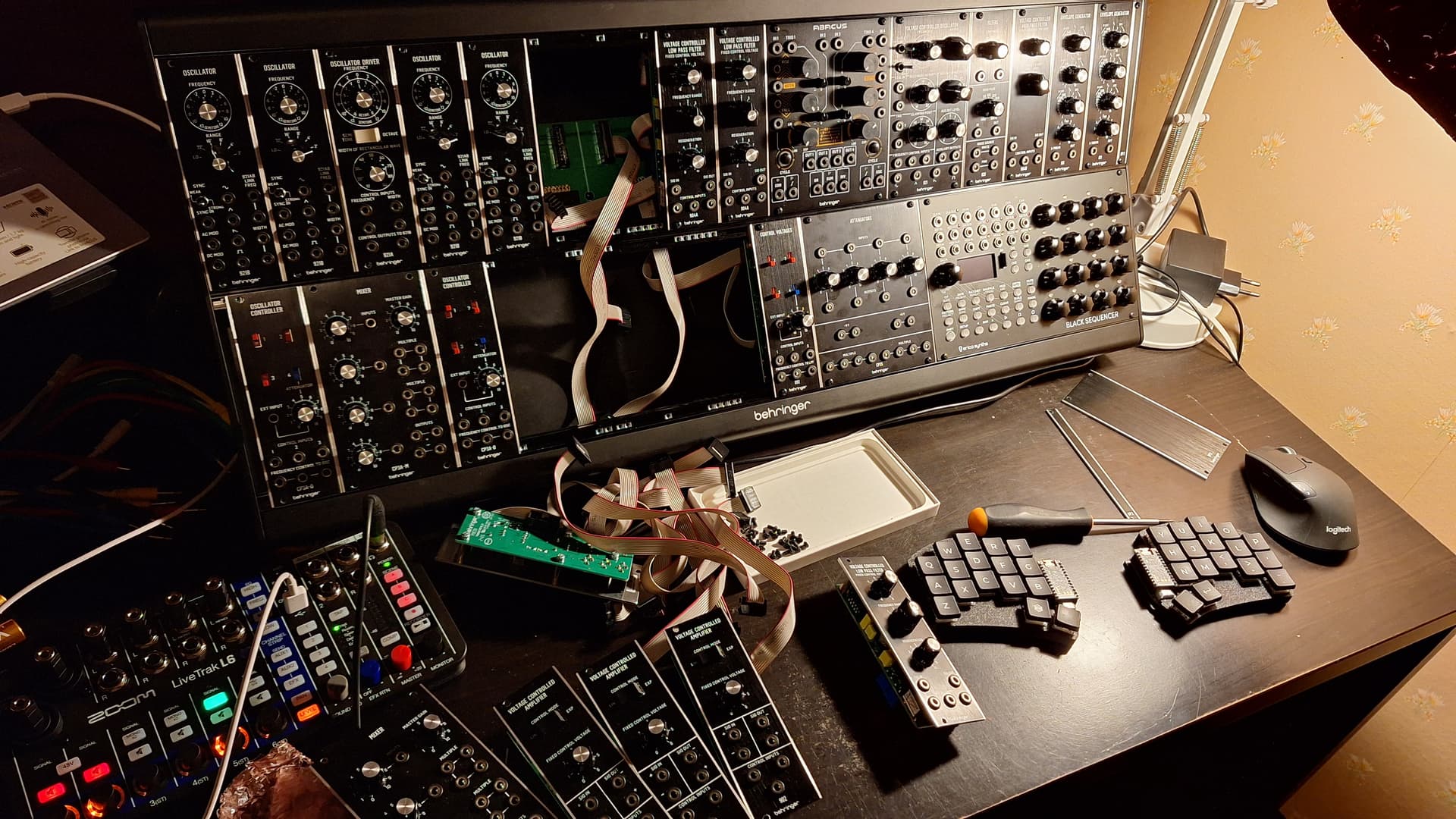
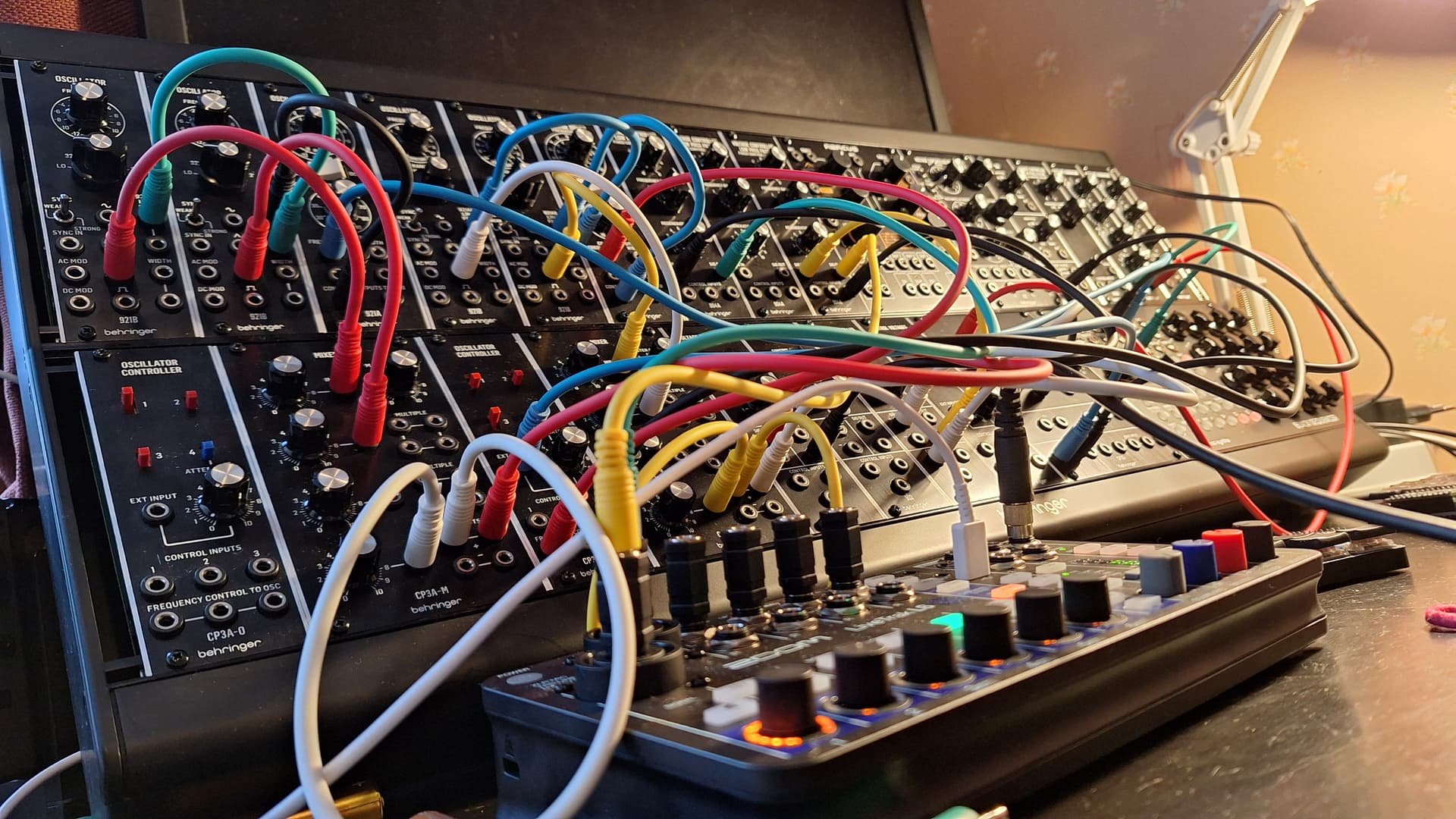
So a couple of weeks ago I bought a Behringer System 35, which was really fun! But I wanted to try to make it more stand-alone friendly, so I ordered a Black Sequencer and a Livetrak L6 (along with a couple of filters and an Abacus). I originally had the sequencer in the middle of the case because I thought I’d hate having it off to one side, but the cables got in the way.
I took out all the modules and started putting them back in one-by-one, then plugged in patch cables just to see where and how they would hang. Once I was happy with the layout, I plugged them all to power and screwed them in!
If the effects on the Livetrak L6 were better, I think I’d be happy recording straight into it. I’m trying to make a template in FL Studio that’ll allow me to use the aux knobs on the L6 to send/return audio through a delay and reverb plugin in FL Studio. Here’s the results of my attempts so far! This was recorded straight on the L6 itself, with the aux knobs sending audio to FL Studio, and only the wet signal of the delay and reverb are sent back to cahnnels 5/6, then everything is recorded on the L6 itself.
Nice system…and as usual, great music. Did you include this module? It’s one of the Behringer ones I’ve had my eye on.
https://www.behringer.com/product.html?modelCode=0720-ACJ
Thanks! That module didn’t come with the System 35, sadly. I’m not sure if it comes with the System 55 either…
This is probably a really basic question and slightly embarrassing since I’ve been doing modular for a while:
Should you tune oscillators before or after patching in a sequencer?
I’ve noticed that if I tune my oscillator before, once I patch a (quantised) sequencer in, with all the pitches at zero, the tone drops between a semitone and a whole tone. Is this usual?
Yes I’ve started using my Korg NTS meter…
Not an expert here, but I think my experience is mostly that my sequencing modules/interfaces can run perfect volt per octaves, so they don’t change my pitch.
What’s your sequencer?
I’m using:
Oct-Tone = -1 Semi- Tone
Varigate 4+ = -1 Semi-tone
Pamela’s New Workout = - 1 Whole tone.
It’s as if quantising the pitch to a scale creates a (negative) offset.
I’ve just been on modular grid and my power draw is under 2000mA, which is well within the 4000mA on the Tip-Top Mantis.
I noticed it more when I got the Oct-tone (for some reason) and decided to check it out with the meter.
I’m using Instruo CS-L & Ts-L as my oscillators.
When I re-tune the oscillator after patching the sequencer in, they seem fine, but it makes it harder to swap things around live…
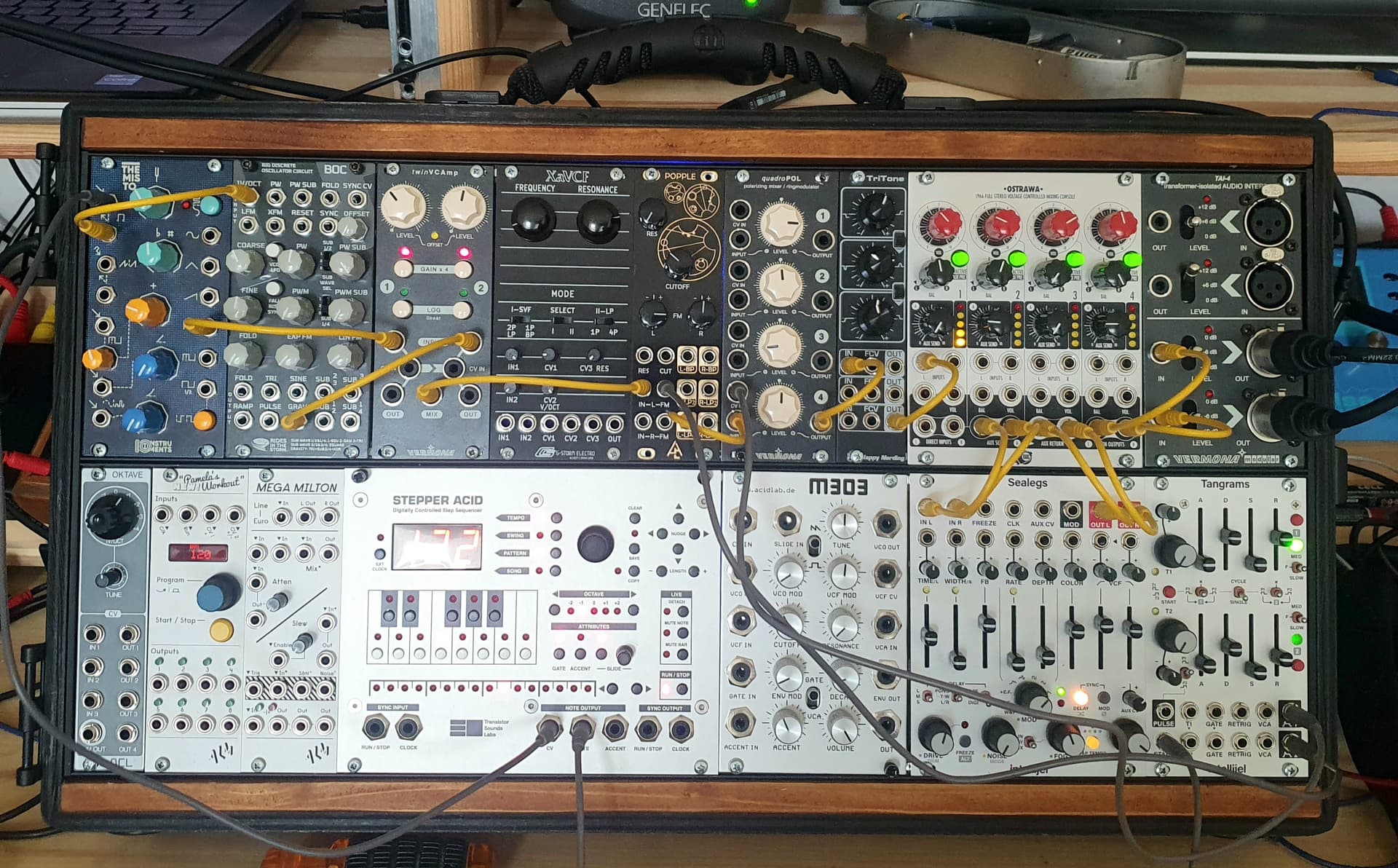
In my case I tune the oscillators after patching a cv note from stepper acid and run the oscillators in a tuner.
That is cool when using a normal sequencer, but if I’m using the Pam’s in looped, random quantised mode for pitch sequencing, I’m not sure how to get the base pitch cv (ie. All steps set to zero)
Sorry for the modular 101 synth questions!
Would quantisation cause the offset, or is this just normal behaviour?
I can’t make any bold statements across the board for oscillators as I’m primarily using Make Noise, but what I’ve noticed is that not all oscillators track the same across octaves.
The tuning will drift more than others moving away from their starting point.
I tune my oscillator before using, but I’ll pick which ones I want for more bass tones vs higher pitched noises.
I don’t start at its lowest point as my sequencers (Rene v2 or even Push 3) can play notes below my starting point.
Yep, that was my thought. Sequencers can go below the starting pitch (ie. From C2 to E-1, where C1 is the starting point).
I thought the idea is that you tuned the oscillator ie: G2. Patch a sequencer to 1v/OCT; set a sequence with a pentatonic Major scale - producing the notes G2, A2, B2, C2, D2, E2 and F#2 (if constrained to a single octave and you like G Major).
I imagine some other sequencers could require something different and it might be a different experience when using digital oscillators?
Otherwise that is generally how I approach it when using Rene.
If I’m using Push 3, then I tune to C to play nice with Lives instruments and choose scales from Push, and will sometimes need to tune to a different octave as needed (if the drift is too much to sound interesting).
Hard quest. The easy solution would be pairing it with a powerful semimodular 
Until I got a Grandmother I would not think twice about this advice, but a really nice sounding semi-modular adds a ton to a modular set up!
Decent guide here from NE: