Thanks ! Seems like it would be a module I can connect with.
More experiences very welcome of course
@Lum back into it since about two years 
Thanks ! Seems like it would be a module I can connect with.
More experiences very welcome of course
@Lum back into it since about two years
I have not played a live set with it myself. However, I have used it for a while at home, and I have watched some videos and listened to some audio of the creator, Eric Schlappi, using it in a live context. He is a performing musician and started making modules because he didn’t trust what he had to use live. He worked on Three Body for almost four years (some of that is learning curve, some chip shortages, some unexpected events like a factory burning down). Most videos crank into noise almost immediately. BRiES has some more mellow videos, and I will post an effort of mine below.
While it is a digital oscillator, and the sound is fairly clearly digital, playing it feels like working with an analog oscillator. There are no hidden states, no abrupt transitions. What you see on the front panel is what is going on. There are fourteen outputs (among three oscillators) and even more CV inputs. The knobs, as @your_lamp says, are lovely, good resistance and ability to fine-tune. You can shade into noise and retreat. I don’t think the playability is matched by any other sound source I have in my 600+ hp.
Phase modulation means there is a lot of subtlety available. There are no normalized cross-modulations for FM, but if you cross-patch two oscillators, you will rapidly get noise, as you will with any other 2-op FM. What is interesting is the quality of that noise. With analog, it is essentially coloured noise (white, pink, etc.) but with the terrific resolution of the internal modulation on Three Body, the sound exhibits distinct characters, and you can dial back into reasonable territory very easily. I would imagine in a live setting you could crank for a bar or two, maybe even less, just for some sonic contrast.
But with phase modulation, cross-modulation is fine (it is normalized), and there is more of a gradual descent into noise. I’ve posted this clip to Current Sounds, but here it is again. This is in a little Pod64x case (gone missing in my recent move, damn) and I am doing nothing more than putting sine and cosine outputs of the centre oscillator through Takaab 2LPG, which I don’t touch, and straight to output; gate patterns from Pam’s, and two pitch patterns, one minor pentatonic over two octaves into the centre oscillator’s V/oct, and another, more restricted, into the transpose input to affect all oscillators. The outer two are audio-rate modulation only, ratio modes. I play with the phase and ratio knobs during the brief clip. I didn’t take it into noise territory because everyone else does that, but it’s as simple as cranking the Phase 1 and Phase 2 knobs past 12:00, and it really is rewarding. But the digital stability at moderate levels is also appreciated. I love my Brenso but I do have to retune after warmup and when I have a configuration on the edge of chaos, I know I can never return. With Three Body, you can go home again.
To summarize, I think you would really enjoy it, and make very good use of it, and I look forward to hearing what you achieve with it.
Here’s my modest clip.
For me it was way too confusing and hard to tame. But I’m also pretty beginner level and basic.
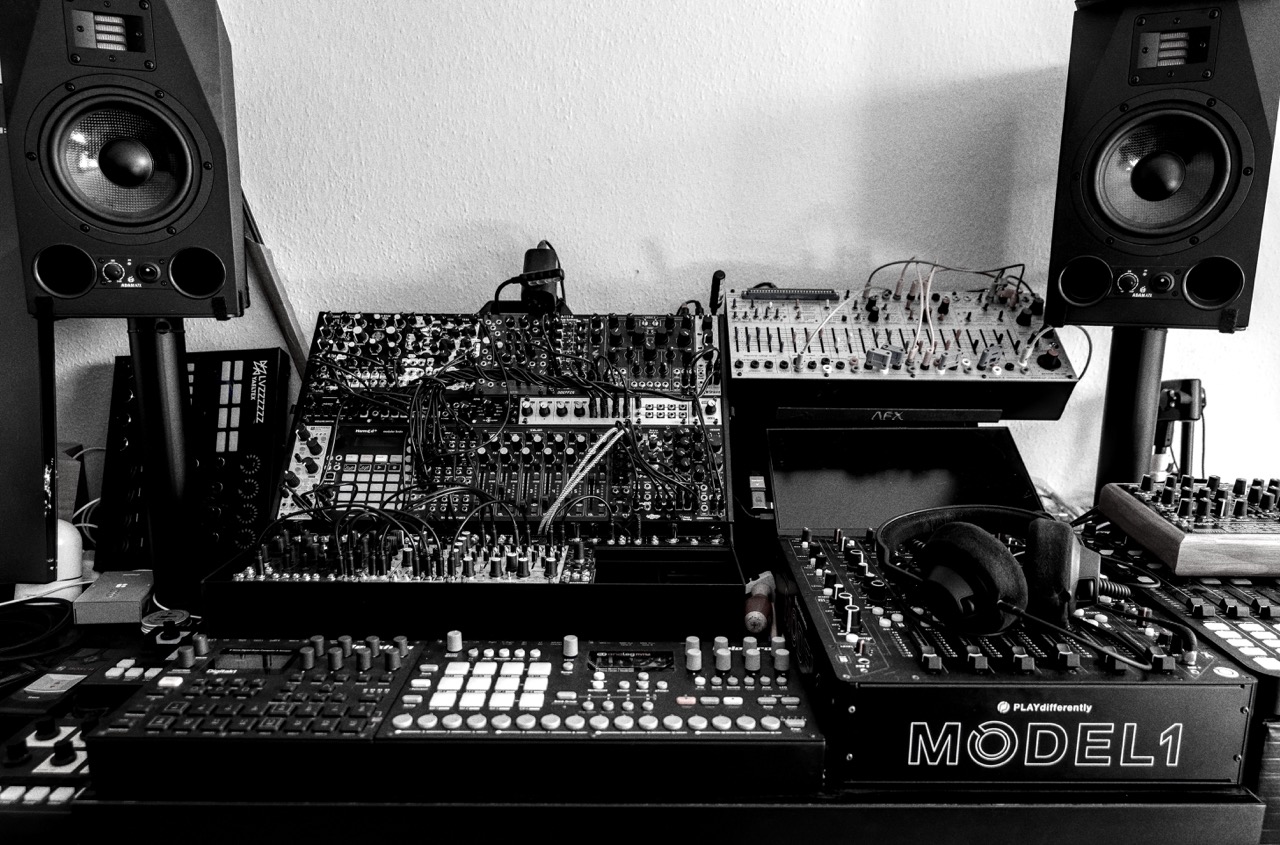
This is my current Techno/Drone setup that is primarily centered around modular. During live performances, the Digitakt and Rytm provide a reliable (and predictable) variety in percussion.
I should add that what sealed my purchase decision was spending an hour with it at Elevator Sound in Bristol, using no external modulation (there wasn’t an LFO or function generator I recognized or could work in that case), two outputs going through an old-school analog oscilloscope (which really helped) and direct to stereo speakers, just drones that I micro-adjusted, in astonishment.
Thank you for this thorough right up ! That all sounds really promising. Exactly what I hoped. The returning home bit especially. I’ve had NE loquelic iteritas in the past and although some of the sounds I got out of that were awesome, the range on everything was just too big to really control it and get back home.
I really love FM / PM and this module does really sound good. And yeah the fact that there are no menus or hidden functions and so on is really a big plus. Lovely little jam by the way. The playing harmonic emphasis is exactly what I like.
Thanks 
Ah cool! Thought you didn’t get back after letting it go on your channel.
Had a better plan this time and now I’m spiraling out of control. Ordered a bigger travel case, which then needs to be filled. So I’m pretty much screwed. But I really can’t wait implementing some of the ideas I have over time and eventually go live with that rig plus an elektron box or two.
I understand the urge to fill a case but it’s something to be resisted, just like spending all of one’s paycheck or the windfall from an event. I think people do this with living spaces as well, because I see so many that are overstuffed with furniture. I have always bought furniture cautiously and after some time living in a space (though one obviously needs a bed, a table, and enough chairs so all inhabitants can sit down). Case space is precious and should be conserved.
I wouldn’t worry! You tend to put your gear to work properly.
Yeah for sure ! Already have 12u 85hp pretty much filled up but currently only use 6u in combination with some other gear. It basically being a single complex voice, and a very playable one. So already quite a good idea where to go next. Agreed though that it’s best to take it step by step
The new case is 12u @104hp. Not that much bigger, but the idea will be to have a live case and (the 104) and a case with more complex and functions to connect to the live case for sound design purposes and studio use.
My path to Three Body is kind of interesting. I follow the discussion of a lot of modules I have no intention of buying (e.g. Make Noise Spectraphon). I was following Three Body from when the first batch was released, and was struck by the quality of that noise, even through YouTube compression, but it was just intellectual appreciation. About a year ago, BRiES made a two-hour deep-dive video on it, which was really impressive, and I posted to ModWiggler something like “I’m not going to get this module, but I really enjoyed this video”. Then @your_lamp bought a Frap Tools Fumana, and asked my advice on a suitable sound source for it. I listed a number of alternatives, most of which I had no direct experience with, among them Three Body. I didn’t push any particular one. It didn’t impress him at first, but at some point it just clicked, and he got one, and raved about it. I wasn’t convinced, though, until I tried it in person at Elevator Sound. (But didn’t buy it on the spot because the UK pricing was wonky; I went home and ordered it from their EU store.)
So what is going to be the live case and what is the studio / sound design case? I have 6u x 85hp and 6u x 104hp (plus a couple of 3u x 104hp), and I think I would find it hard to manage anything much larger than either, cognitively. But I don’t fully appreciate the difficulties of playing live (I have done so only with a Pod64x only in a very low-stakes situation, and could imagine doing so with one of the 6u cases). I would think that 12u x anything would mostly have to be pre-patched with fairly scripted interactions (that is, only selected knobs/buttons manipulated). But of course this depends on particular module configurations and if anything has presets.
Yeah the live case will be the 12u 104hp (amalgamod case). And indeed for the most part will be prepatched (maybe a few multa can be used for live patching for example) when playing live. But it will be a living creature like my current 6u live case. I currently have pretty nice patch that I can take to many different places so I’m going to leave it as is for now. But eventually I’ll start experimenting again with some different routings / modules. I don’t necessarily have a fixed set of controls that I use. Of course some controls are used more than others but it’s set up in such a way that there’s a lot of room to experiment live. Just a matter of getting to know the ranges and interactions and how to get to a save place when things go a bit out of hand.
This case is accompanied by the perkons and push for percussion and layers. And this is then part of a setup together with a mate of mine.
For the new, bigger case I’m going to expand on the idea but additionally I also want to use it for solo sets. So it will become a bit more flexible. The general idea is to have a pretty symmetrical build ao that it really becomes a structured setup where I’ll be able to mix between and layer a few voices. bit difficult to explain but once I worked out the idea a bit more I’ll share what I have in mind.
Simply put, say, 2 oscillators that split (different outputs used simultaneously, and/or split through mixers). through various filters, shapers (frequency shifters etc), FX, to split them into multiple layers of related sounds that I can then mix and layer together.
Even with my smaller low-stakes (i.e. just for myself) cases, I understand the need to practice and to develop certain physical patterns that one can rapidly deploy. I think modular offers a huge range but that can be a drawback compared to more limited devices with a lot of pattern/preset memory. In a world where performers just hit play and mime, and audiences don’t seem to notice, it is a gamble to work with a complex instrument, but I think a performer who cares would want to (I certainly would, not that I have the ability or opportunity to do so), and I heartily endorse anyone who tries.
Looking forward to seeing what you develop.
years back, percussa had that smaller version of their processor on kickstarter with a plan to make it and an editor… sadly it never met the goal. the idea of patching on the module itself never appealed to me but making something interesting on a computer then dumping it on there as a preset was massively appealing at the time.
did they end up making an editor for it or is that in the works? is the patching experience on the module as cumbersome as i imagined it? how are you getting on with it?
put this together to potentially replace the octatrack for live effects processing of the syntakt and digitakt.
module is a wonderful time and money sink. But to my nerdy brain its still the most fun way of making music
intersting, did you make the case?
short answer is
the mSSP was not going to have any editing on the module, so the desktop editor was the ‘compromise’. whereas, the XMX has full patching on the module itself (like the SSP)
Ive never had an issue with patching on the SSP, and the XMX has a more refined/simplified patching workflow.
(Im not saying its perfect… but its never been an issue)
as for desktop editing…
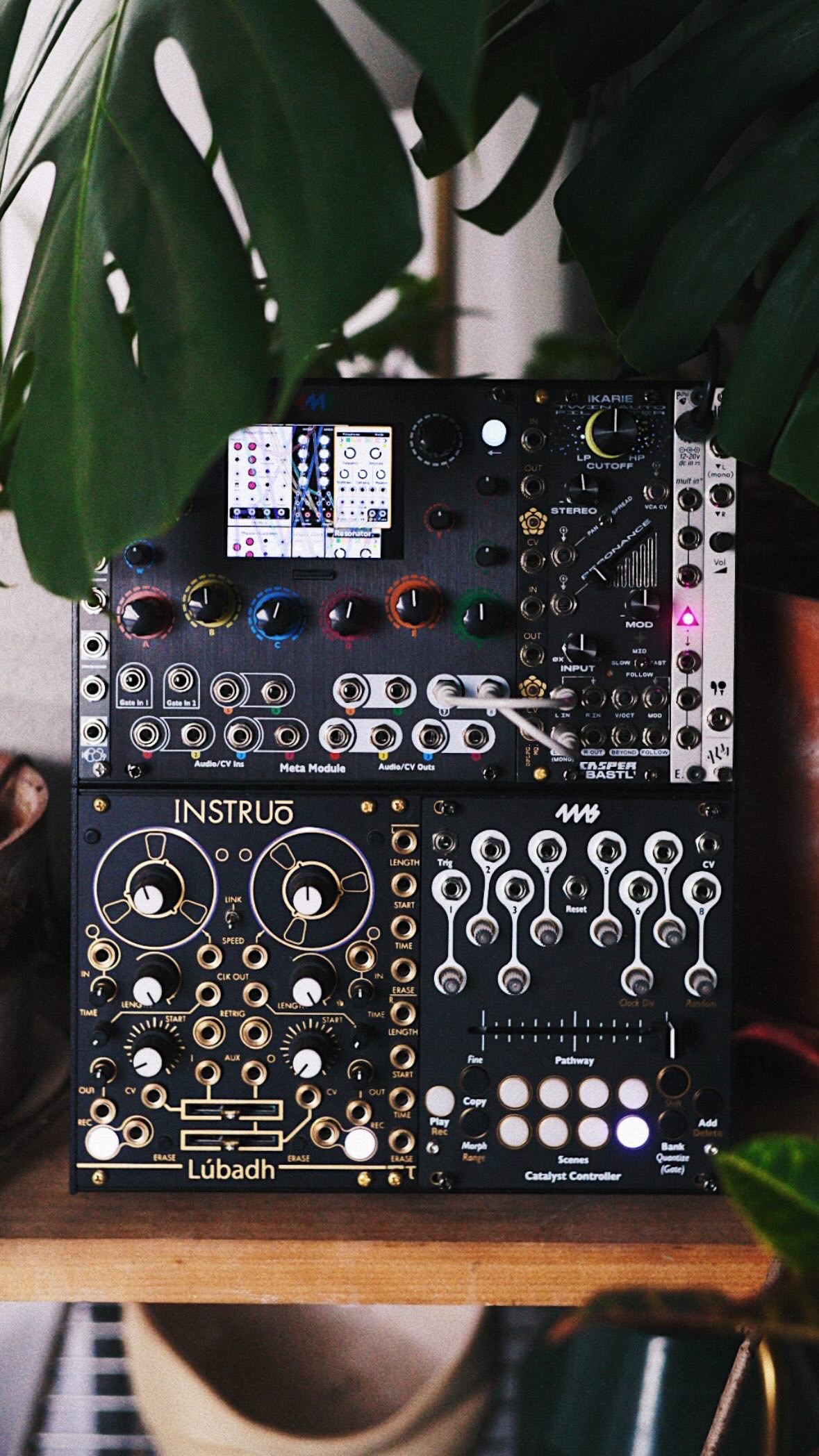
we have this on the meta module (via vcv) , and frankly, Im not convinced,.
it got old real fast transferring patches between vcv -> mm, and they often don’t run quite the same.
so far I’ve ended up doing more patching on the meta module directly than via vcv.
(hopefully some of this will improve with time)
ofc, this is personal preference - I know others would prefer to patch away from the module, and I can see why on the surface its appealing. (and ‘additional options’ are always welcome)
that said… what I would much prefer would be ‘live’ patching.
this is where you connect your pc/mac , and its edits the patch running on the module itself. this has the advantage of using a big screen, but your patch is still running in the modular context.
this is how it works on the Eagan Matrix (and things like axoloti), and I really like it - feels like best of both worlds. esp, if you can still patch ‘on module’ too.
its actually very interesting patching the xmx and mm side by side, as their approach and functionality is actually quite different. each has its own pros and cons.
I might do a video comparing/contrasting in the future… and show what they can both do, in the future. but I want to leave this until, Ive got a bit better feel for both modules.
also both are new, so deserve a little time to let the dust settle etc.
e.g.
4ms are putting out fixes to firmware and modules, and have the wifi module coming.
Percussa are working on a xmx firmware update that’ll include i2c and usb audio support.