I’ve updated but will keep the below beta link separate until it’s passed all the tests. Use at your own risk (but it should be fine)
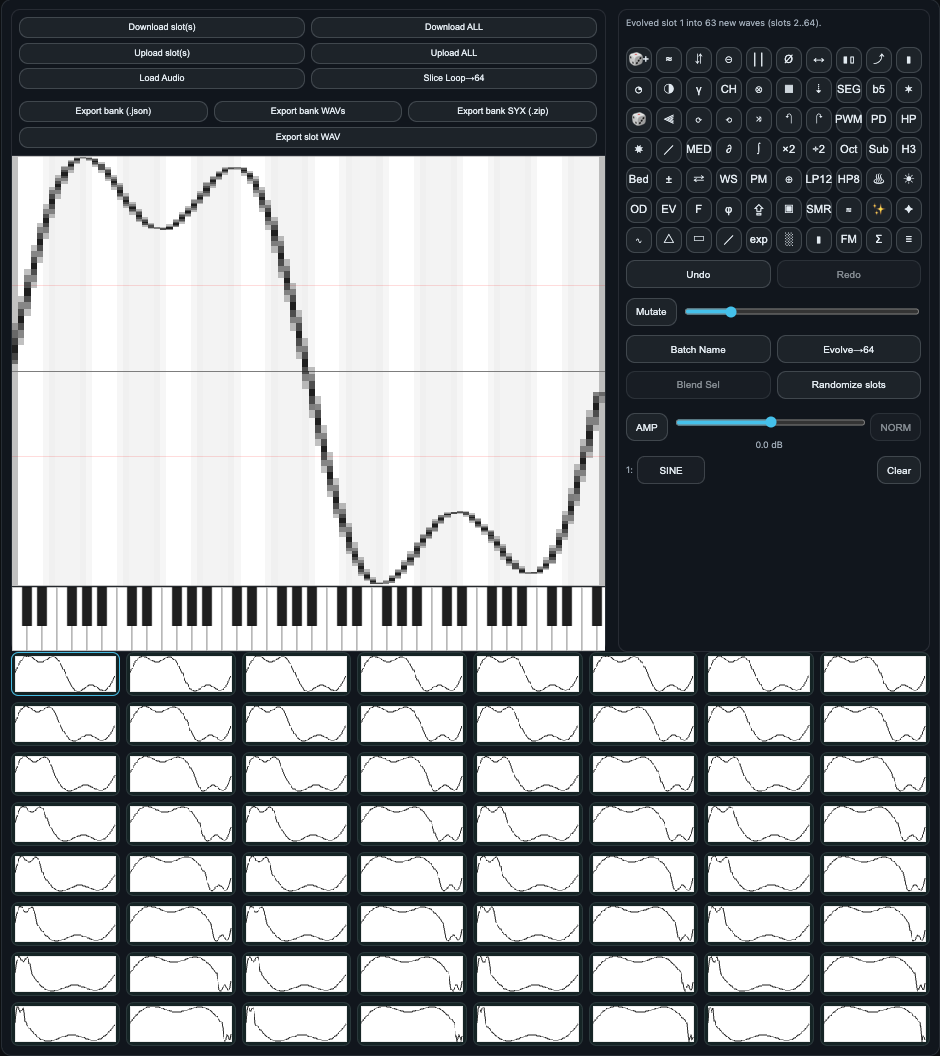
Update includes new evolve processes, finer controls. Also added a preview wavetable button in the export wav menu @michaelliuzzi
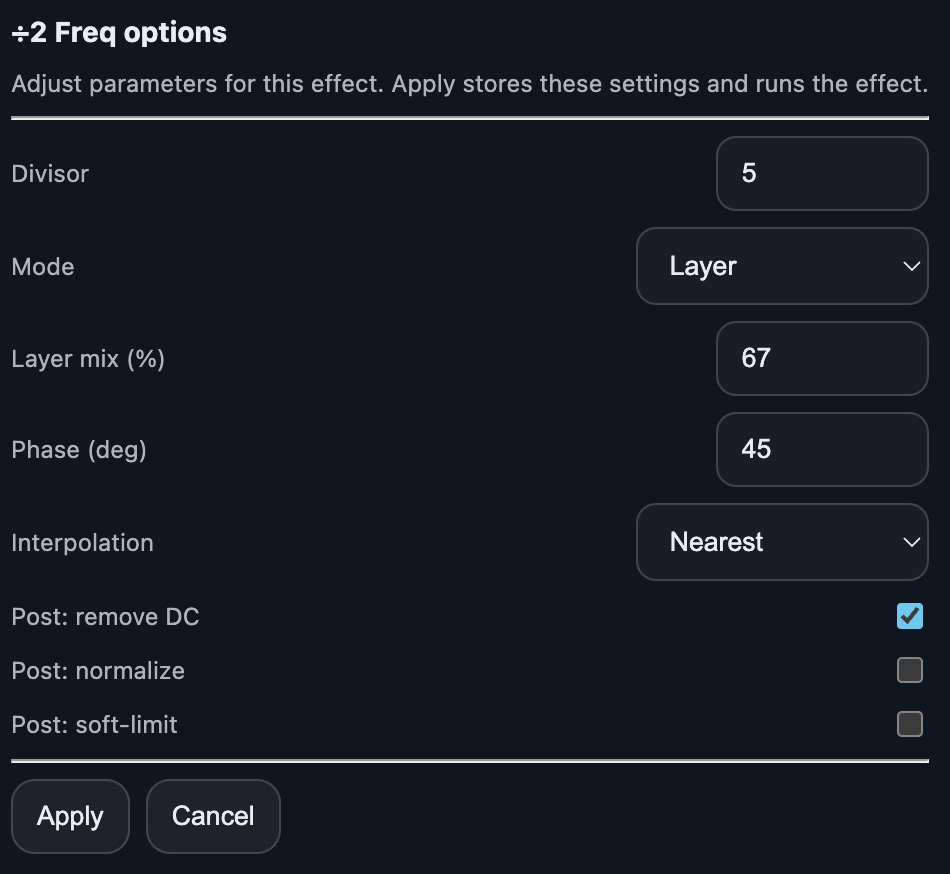
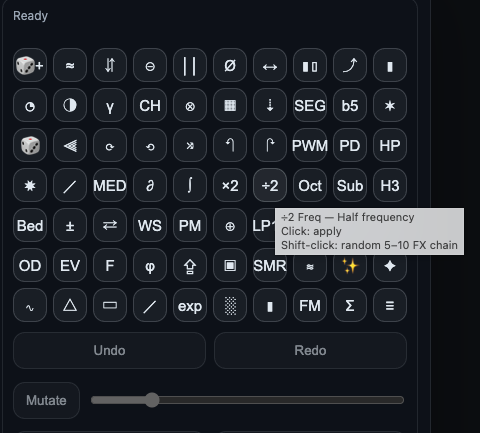
Don’t think i’ve stated this explicitly but every button has a hover over tool tip detailing primary purpose and hidden access functionality.
Most of the main buttons have extra menus accessed with SHIFT held + click. Which seems to be a hangover in most of my apps from Elektron’s FUNC button being burnt into my brain.
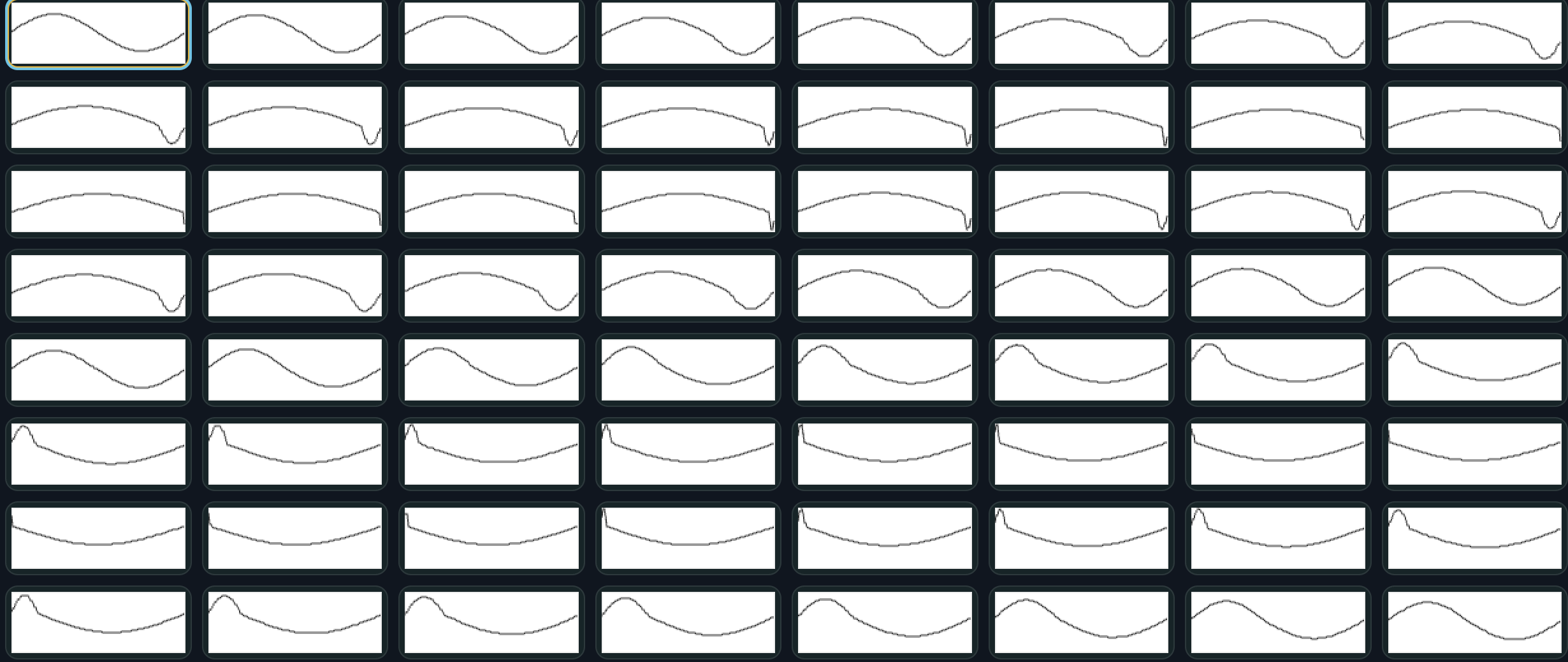
Veets’ bank looks different to a straight Waft Wave PWM sweep because it’s not ordered as a simple “min → max PWM” progression.
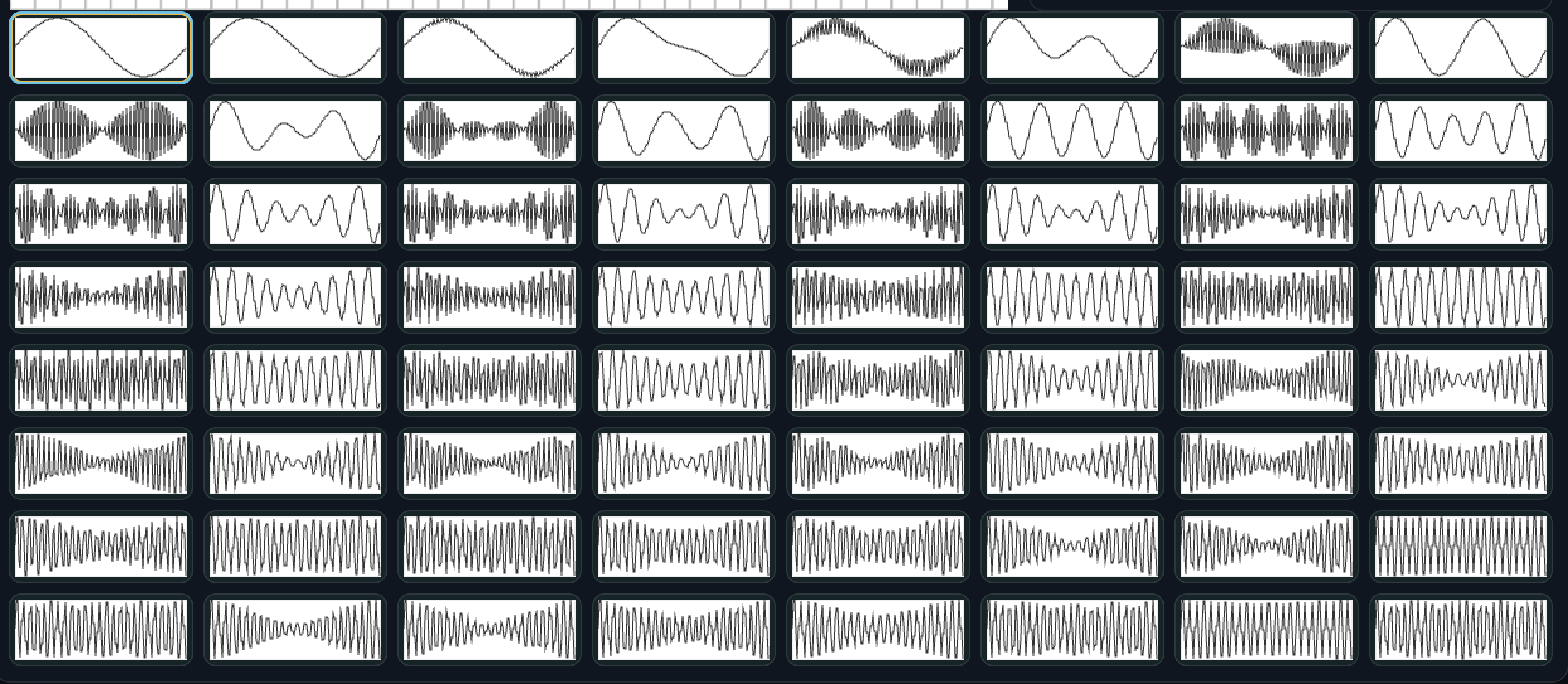
This is because (he also says in the video) he got tired of cutting up sine waves! Hahahaha. So he stopped after 11. So out of 64 waves, you’d get 11 different widths, with the first being neutral 50/50 sine, and the last one being the narrowest, and then the 12th position in the bank is the same as the 10th, 13th is the same as the 9th, and all the way up to the 20th which is be the same as the 1st, and it keeps looping forward and backward like that with only one slot for each endpoint.
Funny I think you may have entered this into an AI prompt to get that answer, but its response in which it was trying to guess at gave me an interesting way to think about taking this concept further. So instead of doing one that alternates in each direction, I’m thinking you could also have one that changes widths in one direction for the first 16 slots (wider top, narrower bottom), and then the other direction back to neutral for the next 16 (17-32), then continue in that direction so it sweeps to the other side (narrower top, wider bottom) for the next 16 (33-48), and then finally sweeping back from there to neutral with 49-64. I’m curious what that would sound like. Gonna have a play with this!
@warrenlain That’s exactly right about the 11 waves. Just leaving this here for posterity but IIRC the way I set it up is there’s a midpoint wave and then an equal number of waves on each side. Then you program the LFO using triangle (for example) centered on the midpoint wave but have it go to slots on “the left” and then back and then slots on “the right”. So this 2N+1 set of waves minimizes the work and the number of waves. (Here N=5). You can also get more variety in your slots. So after using your 11 slots for sine, you could use another 11 slots for some other XYZ-width waves etc. Or you could change N to get finer resolution (or coarser). For example you could probably take my 11 waves and throw out Wave 1, 3, 5, 7, 9 and 11 to save some space but still get the gist of the sound. This would give you 5 waves which follows the 2N+1 idea but with N=2. Basically this was for laziness sake, ahem I mean efficiency This means some of your patches can be some sine-width, some can be XYZ-width, some could be wavetable, some could be single-cycle, etc. Switching banks is usually a minor flow interrupter for me but YMMV.
Did any of other cool ones people discussed get turned into new DigiPRO banks? Like the Triangle Width Modulation which becomes a Saw at the extremes? Suppose we could generate them very easily now with WaftWave!
@warrenlain Love this piece! I don’t usually get synesthesia but listening to this, I mentally saw myself going to pick up someone at a yoga studio who I had dropped off earlier. I walk in and this is playing and I’m like “wow this sounds like a cool place”. Kind of random but it was a fun mental journey for a bit.
How would I go about adding a fifth up to a sine wave? I’d like to try this alt skew mode but with the original waveform as a power chord, would make the DDRW engine even more powerful in terms of chords.
Edit: Is it the H3 button for the third harmonic? I have never worked with a waveform editor before so I am barely grasping the theory of it right now. Haha
H3 = 3rd harmonic (3× sine), not a fifth. It doesn’t pitch the wave, it layers an integer harmonic.
Waft Wave can’t do per‑partial pitch or a true 3/2 fifth inside one cycle. Alt‑Skew just alternates the morph direction; it doesn’t retune. But i think you’ve realised this. You’d have to experiment to get the sounds you’re after, some of the spectral processing i’ve found most interesting for layered tones.
I was able to export a set of wavs (and the single file with the 64, which is great for the Octatrack) and got it going with no issues.
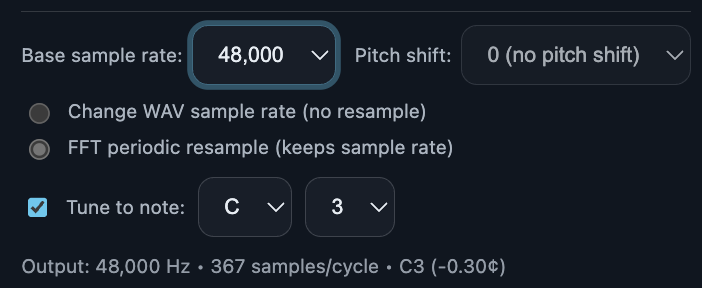
The pitch seems centered around Bb. I thought this might be a sample rate thing (Octatrack is 44.1), but the files look like they are 44.1 kHz. Is this just an artifact of the length of the cycles? Is that adjustable? Maybe there’s a batch conversion tool I can use?
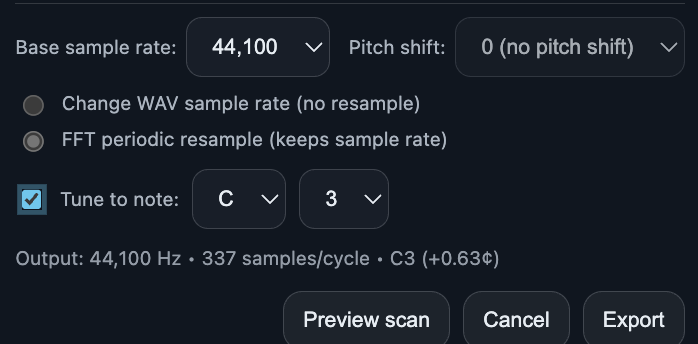
Shift+Click export (Export slot WAV or Export bank WAVs).
Enable Pitch/tuning options.
For Octatrack, it auto uses FFT periodic resample (keeps sample rate) + Tune to note to target the note you want.
this is “ok” but there is some cents drift and i have experienced issues with loop precision for the chained wave when tuning. if you’re happy to keep the solid Bb wav and fine tune in OT to taste you might have a better quality of cycle life.
clear browser data for page and reload, @Bryan_T you’re not dumb, opposite, i updated after you suggested this as it’s a great idea (please suggest more feature requests!) to allow more user control.
 This means some of your patches can be some sine-width, some can be XYZ-width, some could be wavetable, some could be single-cycle, etc. Switching banks is usually a minor flow interrupter for me but YMMV.