VORTESSA nonlinear generative system for unstable percussion, feedback & dissipative synthesis

Hey everyone,

some of you here may already know my previous environments like Endogen, Orbit or Interfera.
Over the last months I’ve been working on a much larger system called VORTESSA.
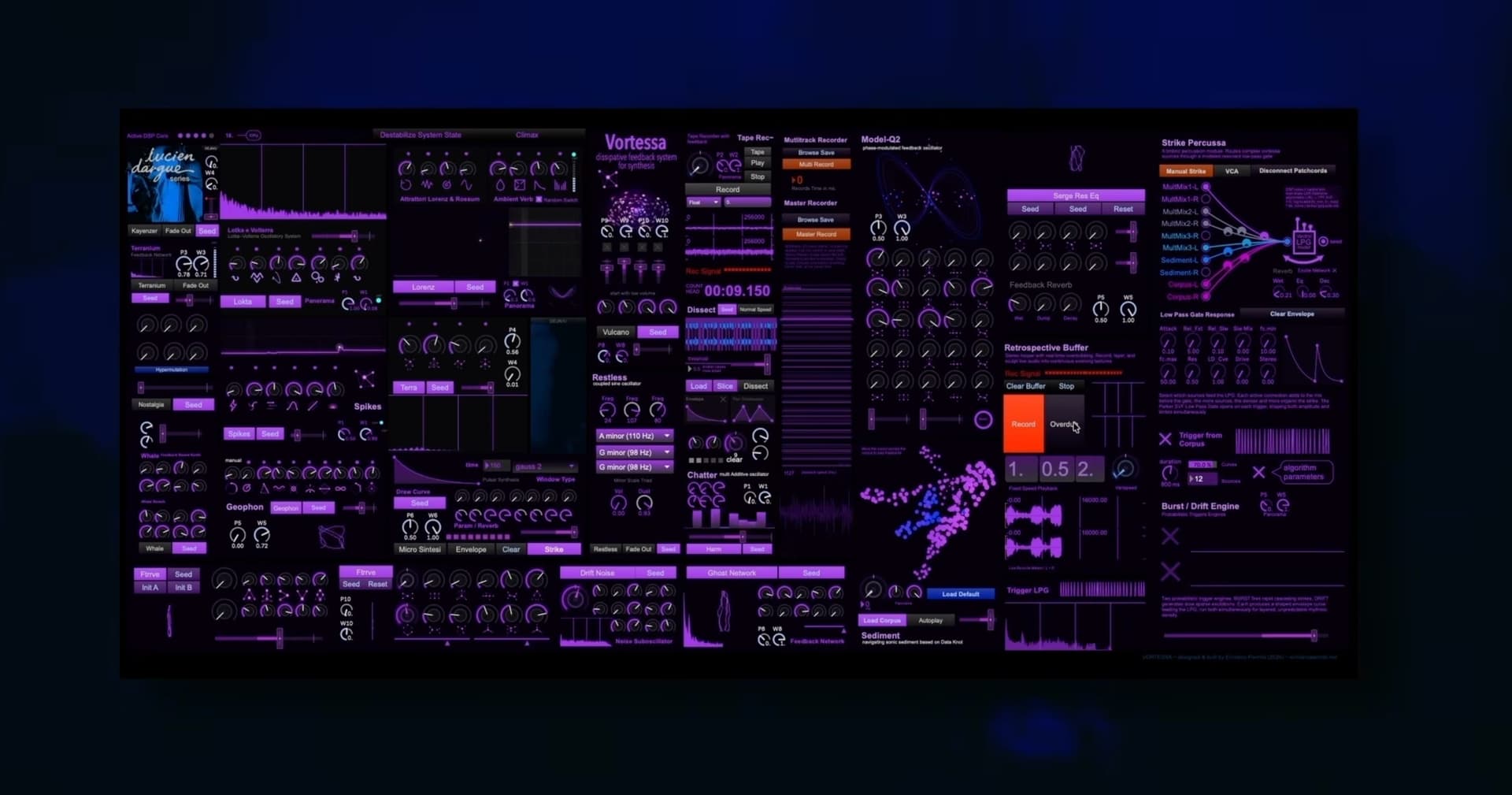
It’s a Max/MSP based generative instrument built around chaotic attractors, feedback structures, nonlinear modulation and unstable synthesis behaviors.
Rather than behaving like a classic synth or groovebox, the idea is closer to an evolving ecosystem where sound continuously reorganizes itself.

Official youtube playlist

The system mixes together:

  • chaotic mathematical models running at audio-rate
  • self-modifying feedback networks
  • unstable percussion engines
  • corpus / microsound exploration
  • multichannel recording workflows
  • organic low pass gate behavior inspired by vactrol circuits
  • slow-form evolving drones, noise structures and fractured rhythmic material
  • a descriptor-based corpus sampler system built with DataKnot
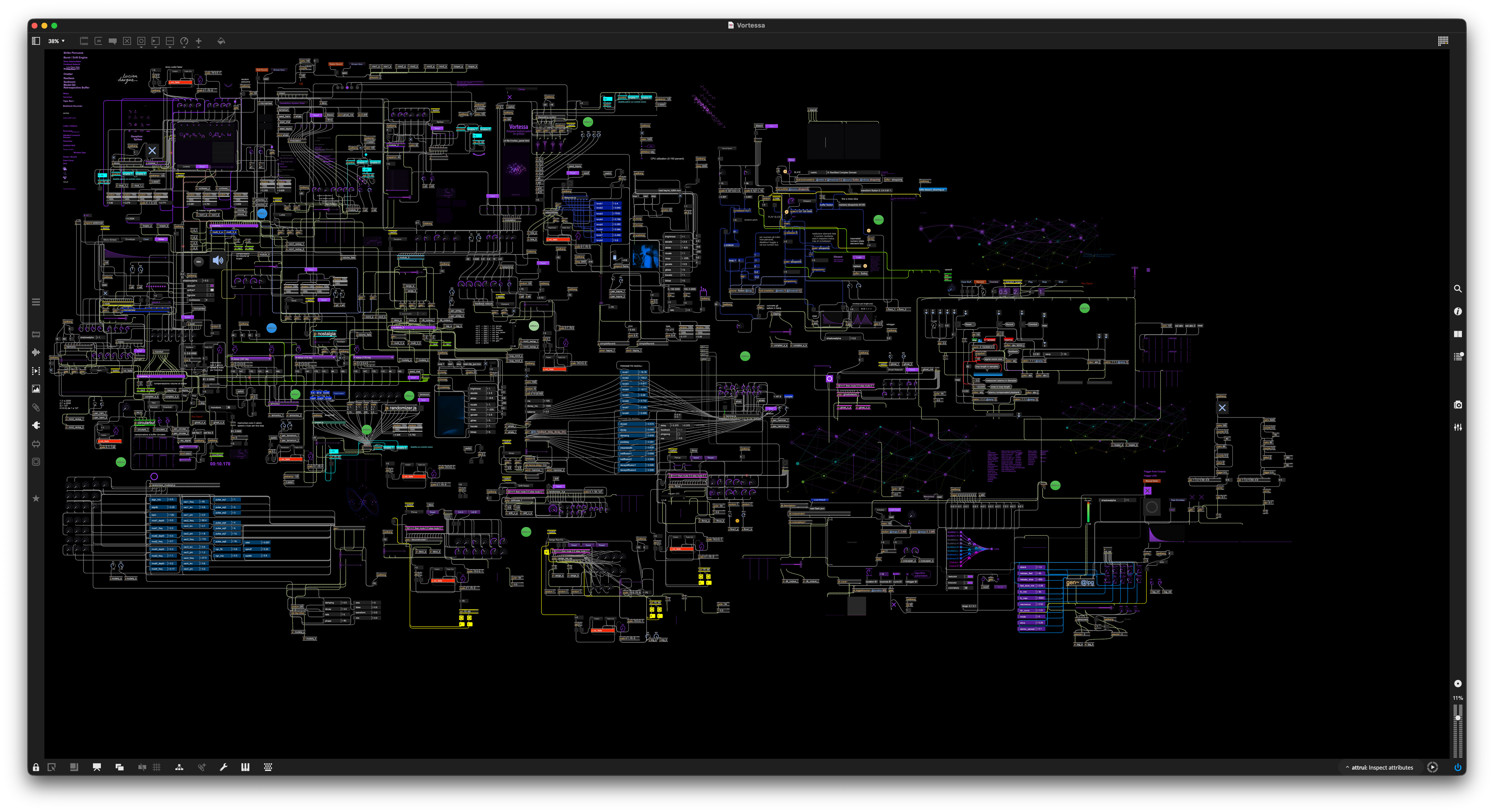
  • routing system. Matrix routing via patch chords.

One thing I’m particularly interested in is the idea of dissipative synthesis:
instead of precise linear control, the system works through interaction, instability, bifurcation and emergent behavior. Small changes can completely reshape the output over time.
Recent versions also introduced STRIKE, a physically modelled low pass gate/percussive system that reacts differently depending on the complexity of the incoming material. Complex feedback textures or corpus fragments become highly organic percussive articulations once routed through it.

Another important aspect is recording.
VORTESSA can internally capture up to 40 mono stems simultaneously, making it possible to later reorganize and reuse fragments, textures and accidents as compositional material.

Runs on macOS & Windows (also works with the free Max demo/runtime).
No Max license required just to run and record from it.

Some videos and details here:

https://www.peamarte.it/lucien_dargue_series/vortessa/vortessa_landing.html

Would love to hear thoughts especially from people interested in experimental systems, generative composition, feedback music, electroacoustic work or non-linear sound design workflows.

Happy sound exploring
Emiliano

47 Likes

Shiiiiiiiiiiiiiit.

This is exactly what I would be building in Max/MSP if I wasn’t an idiot with too many other things to do.

As soon as I’ve finished my band’s album I’m downloading this and making a whole new album with it.

12 Likes

Looks a lot like the 2020 beat machine.

4 Likes

Thanks, I think Max/MSP is still one of the few environments where you can build everything we usually wish existed in hardware, but with huge flexibility. Of course, like anything else, you need to patch every day almost like practicing an instrument.

You’re very welcome :slight_smile:

6 Likes

I know the 2020 Beat Machine, yeah there are definitely some similarities, but Vortessa uses feedback-modelled voices, so it works in two ways: open gates and evolving envelopes. It’s more like a kind of soundscape assembler.

When the voices are routed into the low pass gates and sequenced through shift registers, they become very organic percussive hits. The core of the timbre is heavily shaped around vactrol LPG behavior. I did a lot of benchmarking on the frequency response of dedicated hardware like the Make Noise QMMG, Natural Gate by Rabid Elephant, and the Doepfer A-101-2.

1 Like

This is my trouble.

Very little time for patching these days, but what you’ve built here is inspired.

And inspiring.

3 Likes

Thanks so much!

1 Like

Another clip here: https://www.youtube.com/watch?v=Cc5PC5cPg-g

Rungler vibes. interesting patches. liking the ideas. i like big churning system full of discoveries.

1 Like

outstanding!

this is my new sample fodder for tonverk now

1 Like

yes! The interesting thing is that you can actually create entire sample packs of hits made with these very unstable percussion sounds. Try it, I already use them extensively in my hardware environments.

3 Likes

woow this thing is amazing, the Model Q2 osc alone is something else

have you considered translating some of your synths designs in hardware? with stuff like rnbo, rpi compute modules etc seems quite achievable, and with your taste and sound design approach could be something special

3 Likes

Yeah, seconding the hardware question. When I see on your site that you first developed this in daisy I wish I had some of your work in a daisy based desktop piece!

2 Likes

Thanks! Yeah exactly, Daisy was actually a very important phase for me because it forced me to think about DSP, instability and sound behavior in a much more physical and constrained way compared to the computer. A lot of ideas that later evolved into Vortessa were born there, especially around chaotic modulation, feedback structures and unstable percussive responses.

The reason Vortessa itself remained inside Max/MSP is mainly because the architecture became extremely large and multichannel over time, especially with corpus systems, internal routing matrices, multistem recording and the whole dissipative synthesis side. But I absolutely agree that there is something very exciting about having these kinds of unstable systems living inside dedicated hardware.

In fact I’m becoming increasingly interested in smaller standalone instruments focused on a single behavior or sonic ecosystem rather than giant environments. Daisy is still one of the platforms that interests me the most for that direction because it has this nice balance between raw DSP freedom and physical immediacy.

1 Like

I have been trying to remember that name for the past couple of years… thanks :slight_smile:

1 Like

Sorry for the delay in replying. Yes, I’m working on it, but it’s a fairly long-term roadmap. At the moment I have a couple of hardware and Eurorack manufacturers, as well as DSP engineers, proposing different directions to me. But honestly, translating one of these software systems into hardware the way I envision it doesn’t seem easy at all.

Of course, I’m thinking about prototyping some of my sound modules on Daisy, Pisound, and Organelle, but with every platform I’ve found certain idiosyncrasies that prevent me from reaching a truly precise result.

A future move could be a hardware version of Endogen, but I would also want the whole fetching side included, with query systems capable of interrogating Internet Archive as well. Or even turning my latest program, Vortessa, into a highly organic drum machine, essentially a drum machine built entirely around low pass gates, which is what I’m currently working on.

I don’t know, I probably need a bit of multidisciplinary support for this. Maybe someone will step forward more decisively and convince me. But yes, that’s definitely the direction. Thanks for the question.

1 Like

Some things just make more sense staying inside Max.

As happy as I would be to see more hardware based on these sorts of chaotic principles, as well as the fact that exploring such things obviously allows you to reach much more people, I think Max is the perfect ecosystem for this sort of thing.

Fair play to you though.

Can’t wait to finish this fucking album so I can get cracking ruining people’s lives with what you’ve built.

5 Likes

Very interesting work. The landing page mentions 36 modules but only five are described. Is there anything written on the others, even just a name and a few words for each? I was trying to zoom in on some of the videos, but with not much success. I understand that documentation naturally lags behind development.

(I know nothing about Max/MSP.)

1 Like

Thanks for the comment. So, the five elements you see described are not really “modules” in the traditional sense, but rather five macro engines. The system works more or less like this: there are 5 engines controlling 36 core modules. The engines are essentially feedback networks and chaotic attractors generating different procedural behaviors.

For example, in the case of the Lorenz attractor, the system genuinely operates through mathematical equations. The Lorenz attractor is a system of three differential equations describing the chaotic motion of a heated fluid. Even starting from nearly identical initial conditions, the trajectories rapidly diverge, the famous “sensitive dependence on initial conditions,” or butterfly effect. Despite the chaos, the system does not explode; the trajectories remain confined within a double spiral shape, almost like butterfly wings. It is order and disorder at the same time, deterministic chaos.

There are two coordinate points wandering probabilistically inside this system. These two values continuously trigger a matrix where all the other voices are referenced, including the parameters of every voice, essentially a massive JavaScript modulation matrix. These two points select a module at very high speed, latch onto it, and randomly modulate its parameters. So even I, as the developer, cannot know exactly what is being modulated at any given moment. It is a form of modulation without conscious intentionality.

I built it this way because for too many years I worked with the classic paradigm where “LFO 1 modulates oscillator 2 frequency,” and over time this created an emotional and mental barrier for me. Every time there is a fixed source and destination, my brain, and probably everyone else’s, reconstructs the same timbral expectations. I wanted to find a more irrational and unstable path toward sound generation, and maybe I finally arrived there.

All the other modules are also based on feedback, dissipation, and bifurcation processes, but that becomes far too much to explain here. I’d recommend looking into Ilya Prigogine, there’s all the theoretical background needed to understand what I was trying to achieve.

Sorry for the long explanation.

7 Likes

Thanks so much, and yes, I partly feel exactly the same way you do.
There are certain things that can remain incredibly alive inside Max/MSP precisely because they still don’t have to submit to the physical limitations of hardware, especially once you start working with dissipative structures, multiple feedback systems, unstable matrices, and self-modifying behaviors.

Paradoxically, what interests me is not so much “controlling” sound, but building ecosystems that develop almost autonomous behaviors, where even I lose precise control over what is happening. In that sense, Max is still one of the last environments where you can truly think about sound as a complex system rather than simply a linear chain of modules.

I’m deeply fascinated by hardware as well, especially for its performative and physical dimension, but the moment you start bringing these kinds of chaotic structures outside the computer, enormous compromises begin to emerge, both in terms of DSP and interface design. Still, I’m definitely thinking about it.

3 Likes