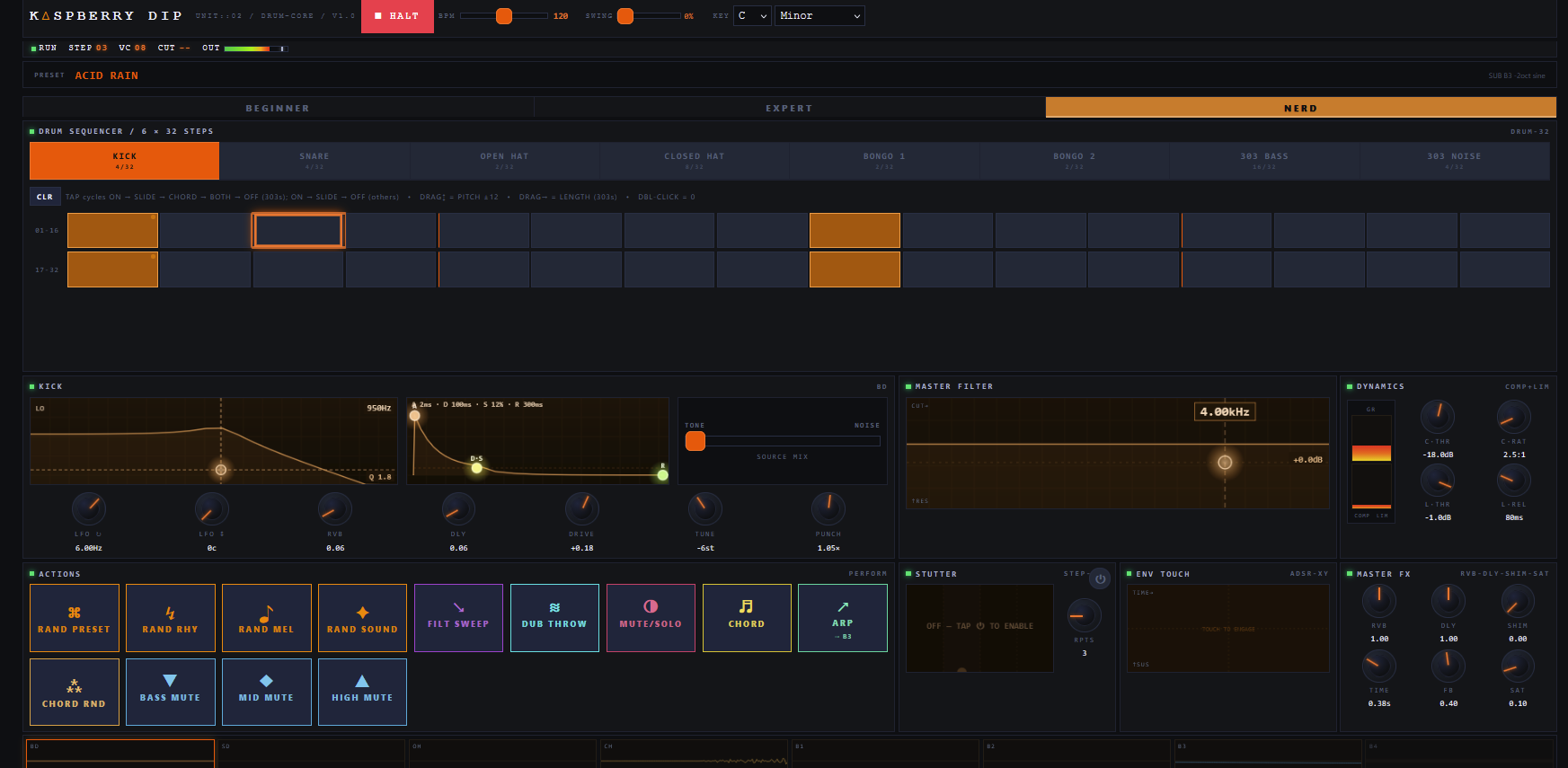
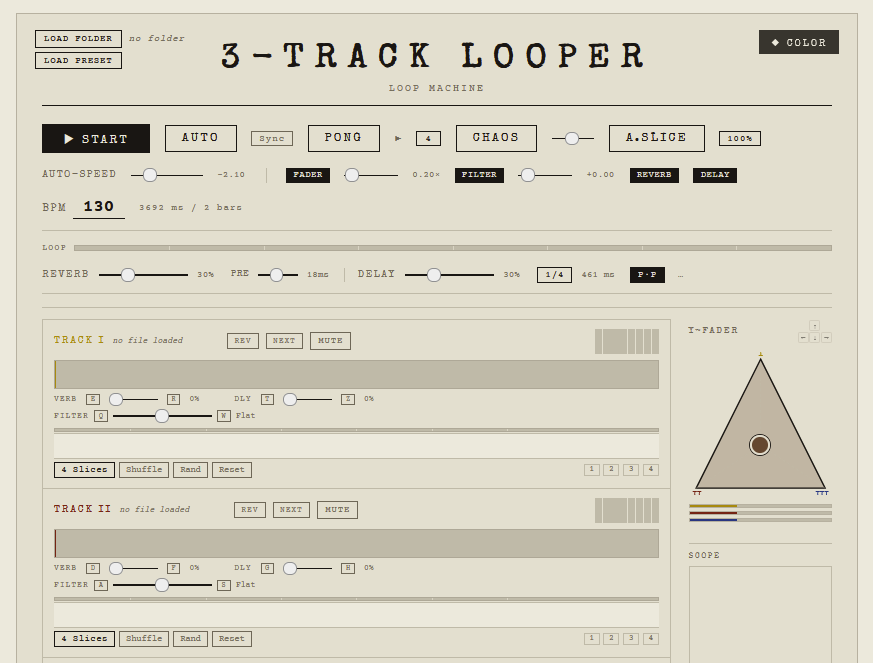
(Un)popular Vibe coding…
I originally had a loop project: I split all my recordings (mainly Elektron, but also a few Volca/Electribe sounds) into 2-bar segments using Audacity so I could mix them like a DJ using the Octatrack or DVS.
It’s a lot of fun and feels pretty next-level.
Then I set up a website for it and uploaded everything to Bandcamp for free.
I needed a few tools for the website because I wanted to show what loops are good for—I’ve been out of the HTML and C++ for 25 years, but I still have some basic knowledge.
But programming it myself?
No time. 40 hours of paid work, kids, and another festival on my plate → so Vibe coding with Claude.ai. —Works well for testing out ideas too before buying the right Eurorack modules.
The code is surprisingly good. And you can actually read and understand it.
(Assuming you have a basic understanding of programming languages and are willing to consult a reference book from time to time…)
Then I had an artifact programmed that runs in a sort of phone booth with a touchscreen.
Festival-goers can now make electronic music themselves—I don’t need expensive instruments, no MIDI controllers, and I can have the device built exactly the way I want it.
(It’s about participation; about breaking down boundaries between artists and guests in a festival context.)
All I need is a free AI account, patience (LOTS of it!), a mini-PC, and a touchscreen.
That one’s supposed to go in a phone booth too, but it’s not ready yet.
Fun fact: Whenever I have someone program something using samples and I come up with really good ideas, I end up realizing:
My Octatrack can already do that better.
Why I’m posting this: These days, I only make music with Elektron gear. I’ve sold everything else. It fits my workflow best—I can’t find any other manufacturer that satisfies me this much.
And when I come up with projects like the one above, I unconsciously end up putting together something that could—and probably does—stem from Elektron’s conceptual mechanics.
Seems like a perfect use of vibe coding – you’re not writing a banking app, something that harvests personal information, or code for a self driving vehicle…You’re not manipulating social interactions for your political or financial gain, or firing a team of humans based on ill-considered “AI is the future” tech bro vibes…
Instead your using AI and vibe coding to realize your own creative vision and allow other humans to express their creativity too. More power to you!
I mean this with love, but as a general observation, it feels to me like a lot of people are pretty much addicted to Claude Code. A lot of stuff out there now that isn’t particularly useful or well thought out in a musical context but … well they kinda work. For now. Until something goes wrong and nobody has any idea how to fix it.
But definitely delivers a dopamine hit spending tokens and seeing what comes out, functionally equivalent to gambling in a lot of ways.
I think that the big change is going to come when these companies start charging something that’s more in line with the insane amount of resources they’ve been burning to get to the point of … it’s ok, I guess.
It’s perfectly possible to vibe code apps that are outside this paradigm. I co-maintain an app that was vibe-coded from the start. Neither I nor the co-maintainer (originator) touch the code. Yet, whenever something needs doing, Claude always surfaces exactly subset of the info I need to do my work. ‘Subset’ because the apps domain is insanely complex and my brain (in contrast to the originators) won’t hold the whole thing at once.
I had near-zero handover. I’m sure we could onboard another coder the same way. Pretty sure the app won’t die. It can be picked up
Nope. But Elektron maintains very precise MIDI timing over long periods of time. (Endlessly?)
I wrote a script—it’s relatively easy to do in Audacity—and cut off two bars at a time from an audio file, normalized them, and brought the start and end volumes down to zero within a 2-millisecond window. I then saved that as a file and repeated the process with the rest until the original file was empty. It works surprisingly well and automatically.
Not going to name particular examples in the music tech space here, but I have knowledge management app where the developers went through a run in the last six months of pushing update after update and feature after feature and generally making a pretty good app at base level worse in fundamental ways, introducing bugs and things that half-work.
Was at the point of cancelling over it, but I think they’ve come out at the other end now, release schedule has slowed way down and things are getting fixed. But I feel like they were just doing it because it felt like they could for a while and surfing on the buzz of more new stuff more quickly rather than thinking about whether these things are necessary or work well. Possibly changes to pricing for Claude Code also made a difference, although still nobody’s paying anything close to what this stuff actually costs.
Bluesky is another example that I’m familiar with, although for course some people try to argue that there’s no connection between pushing vibe coded features at speed and how the site was breaking all the time.
Rightly or wrongly I feel like I’m seeing what looks to me like an addiction to burning tokens in a lot of contexts right now, not just coding.
Can confirm - and while I am trying to make something stable and maintainable with Schwung, I’m fully aware (and try to be up front) with the fact of the project’s origins, methodology, and risk.
I remember before you could use these tools with a subscription, paying per token, and the feeling is exactly like a slot machine. “oh yeah that time didn’t work but if I just put in another $1.57 of tokens, then maybe… maybe this time, I’ll get lucky”. It’s dangerous.
Don’t think there’s anything inadvertent about this either, these companies know exactly what they’re doing. Especially at this stage of the cycle when they’re trying to maximise the amount of usage by whatever means necessary in advance of IPOs.
Software companies release buggy software. Both human and ai written … I think vibe coding is helping people put together small apps but certainly anything complex ideally has people who know how to read the underlying code or understand how to be specific when describing the issue …
I’ve made a few apps in the last week , none of which I could’ve coded … none of which I’ll release , but I’m getting more familiar with it
If left to its own devices ai seems to vastly over complicate things.
I know a lot of game designers who have notepads full of ideas and mechanics , they’re now trying out prototypes without the need for a big code team and lots of money just to prove the core game mechanics … it’s helping to prove if they’re fun or not … the upside being less wasted money before a team of developers work on it .
I did use it to discuss my options for a battery solution for my house … I explained my bills , energy usage , likely devices plugged in and it was like speaking with an expert… I told it the make of my tv and it instantly knew the power draw etc . Ultimately I could make a well educated decision .
Alternatively I had it make a bit crushing plug-in for me to learn how to make a vst , it added many features I hadn’t ask for , the ui was too complex , most of the ‘work’ was trimming it down .
Whether it’s ai / ableton sdk etc it’s all helping me make small utils that I’ve not been able to make before .
I ‘made’ a version of jira ( bug / task tracking software many developers use ) … just to see if I could , though it helped that I understand the requirements of a complex app like that … it made many wrong decisions with lots of bugs .
Yes … good for tracking usage metrics , sticking points etc
But qa needs structure , insight , test plans , regression , … it’s harder than many think … and that’s before any sort of public beta .
I’ll stop there …
looking forward to agent/personal assitant functionality that does NOT depend on any cloud tokens…
pretty confident, next year i can just tell my macs to turn up the kik half a db and nudge the low cut just a tiny little bit…open that plugin…gimme triplets…slim out the swing…save that project…oh wait, do another mix down first…this time in lossless 48k…thanx.
and while we’re at it…i could really need some new phase wobbler plugin and meanwhile please check on the latest festival ticket pre sales, since all sorts of live entertainment is THE only non ai domain left out there…see u tomorrow.
There’s a guy who vibe coded a studio app that will basically gain stage your mix and do the prep before you come in and do all the creative processing and tweaking. Not sure it’s released yet but that’s a pretty nice application for AI. It’s basically doing the grunt work.
And the thing is that in reality the friction involved in getting from idea to execution - like learning how the underlying concepts really work, what’s been done in the field before, etc., are all pretty vital in determining whether it was actually a good or useful idea in the first place. Even aside from having the ability to critically appraise what the LLM has actually cobbled together and whether it’s really doing what was intended.
Aside from all that, I really worry for people getting into LLMs at this point, they are obviously not what their boosters claim they are and they haven’t been able to secure uptake / enthusiasm that way, so they’re going down a much easier route, coincidentally just saw these two stories since posting that:
When I was doing a quick search to see if there had been any recent research / reporting on addictiveness by design or the gambling analogy in the context of LLMs, interestingly enough the top results included hysterical reporting of a “study” claiming that in fact LLMs are prone to gambling addiction. Because apparently we are to believe that in fact the probability engine is basically a person. Very convenient on all fronts that, lol.
There are lots of arguments on both sides regarding ethics vs productivity etc as well as regarding code quality. I’m a lifelong professional coder and I have many colleagues using AI tools heavily and they generally agree that output is up in the short term but that bugs and problems are being introduced longer term and many of them openly admit they are actually down-skilling (if that’s a word) because they are forgetting how to write code by hand, forgetting key skills that are being automated etc. It’s not a good look. Bugs get picked up in human code review and the original coder can’t explain what the code does, even though they wrote it yesterday. Imagine picking up old code (which we all do) that was written years ago and nobody understands it.
Code in banks, health systems, government systems, security etc that nobody understands. Suddenly doesn’t seem such a great idea.
Unfortunately, the one thing that isn’t really up for debate is that the economics of the whole situation simple aren’t sustainable. The companies are charging a fraction of what the running costs are and they are all starting to introduce new tiers or lock features away, which is absolutely predictable and inevitable. Most are likely to have to go back to a per-token or per-usage model of some sort and there’s going to be some very unhappy people (not least the management of companies that have gone all in) when they do. The costs have the potential to absolutely rocket.
Also, the surge in demand and uptake of these tools is so massive that they can’t build the infrastructure fast enough. The electricity and water usage is insane. I’m afraid it’s the usual “pretend the problems aren’t there” gold rush and there are going to be a lot of losers in this thing in the next couple of years. Even the compaies that build these tools have done studies showing that people become less skilled as a result because they are replacing real learning with a crutch.
I’d like to make it totally clear that I don’t blame people for being interested or excited. Building stuff with software is fun and addictive, that’s why us coders love it in the first place. But this AI rush isn’t the magic solution it appears to be and I’d suggest people tread lightly if they actually want to learn something and not just end up being reliant on tools that could disappear (or become inaccessible due to cost etc) just as fast as they appeared.
EDIT - @mfk Nothing against you personally, you’re just being creative and doing something for other people.
The thing is those are mostly tasks that take 2 seconds. I’ve noticed this a lot at work with people just finding ways to use AI and automating things that a person can already do quickly and easily. In a field you’re already skilled at it becomes a lot harder to see the use case.
Like my to-do lists are more like “retrack that bass line” “edit those vocals” “figure out what’s happening in that middle part”. And those aren’t creative decisions that I would want to give up to the AI. “Turn up the kick” is just something I do immediately when I think of it.