I’m a sucker for the Oberheim Xpander/Matrix sound which is a bit different than the OB sounds.
Hopefully this means something like that is on the horizon.
I’m a sucker for the Oberheim Xpander/Matrix sound which is a bit different than the OB sounds.
Hopefully this means something like that is on the horizon.
Andersons price now up to £999! A few luck early adaptors good a good price assuming they honour it!
Yeah WTF? Thought that seemed too good to be true. Should have jumped on it.
No worries, I have no room for it, I don’t want to be a first adapter and I’m kinda waiting on the module at this point unless I cave for an OB6 before then. Different, I know, but something about the OB6 appeals to me a bit more for some reason.
But looking forward to seeing these in the wild. Good on yous whoever scored the Andertons 899.
OB-6 is a more aggressive sound imo UBXA would be more usable, but the build quality visually just looks a bit cheesy.
I found this more entertaining than expected
these are so good
in love with #3
This is simply amazing.
The problem i have is i’ve got these sounds and more already on my GForce Oberheim OB-X Plug in… Damn they did a good job else i may have bought this
You mean you would have bought this if they did a bad job ? 
G Force. Not Behringer
ah I see now 
Has anyone heard news about the desktop version?
The keyboard looks lovely but I have another poly aftertouch keyboard in mind.
I just posted in the gear in progress thread about the speculation made by the “editorial team” at amazona dot de. They placed the UB-Xa D pretty high up the list. So i’d say it’s reasonable that it could be forthcoming at any time. That’s just speculation, but they have been paying attention.
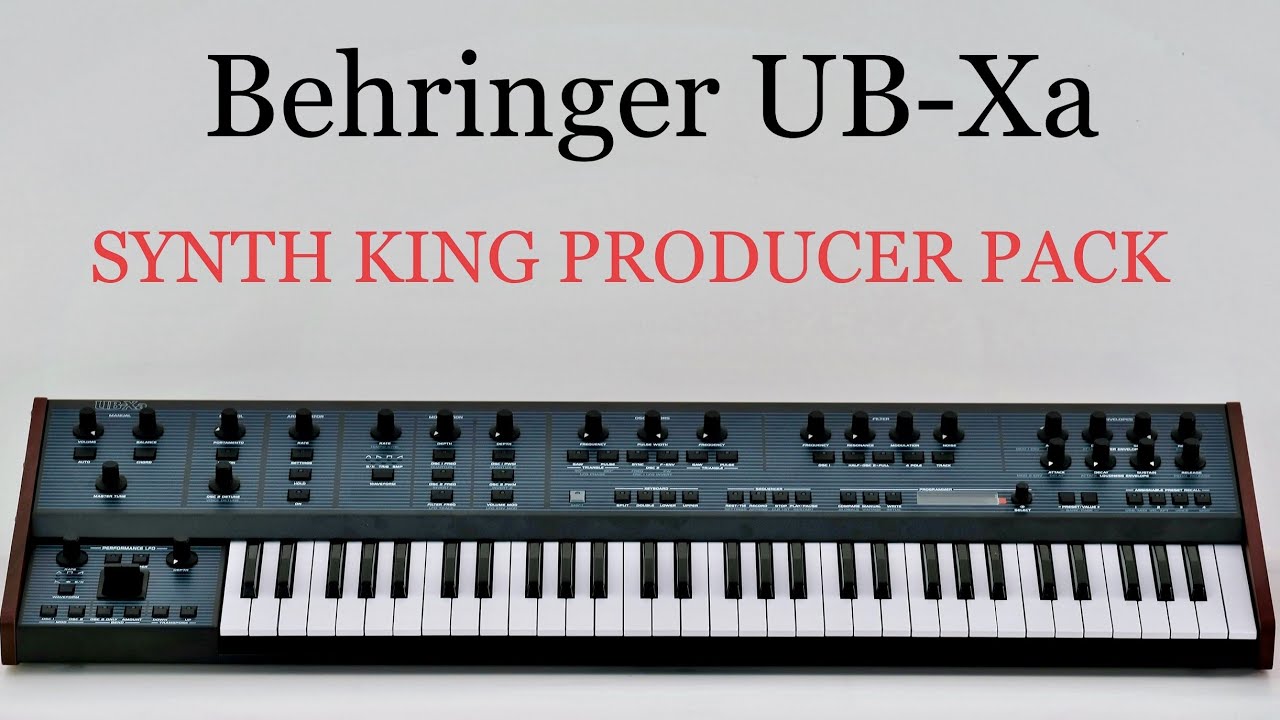
Pretty sure in the SynthKing video that he is using the poly-aftertouch for some of his playing, and it seems expressive, and natural to use. I’ve not come across an independent review yet of someone with the experience with some other poly-aftertouch keybeds, who could compare the action, and comment about how the Behringer keybed feels.
It’s difficult enough technically to make a very good poly-aftertouch keybed, so i am waiting to hear this spoken about.
ADDED : I saw a video where Jack Duxbury of Andertons says the keyboard is “very responsive”, for all that is actually worth.
judging from the videos and reviews from people who have given input and sound design for this synth, it seems like it’s of a much better quality than the typical behringer synth. maybe closer to the arp-2600 than something like the pro-1.
i think all of their synths are fine quality, but the knobs on some of these are obviously cheap and overall the thing feels much less sturdy than a typical synth. i’ve never played a behringer keyboard but i dont remember people being happy about the poly-d or deepmind keys. if i were going to spend over $500 on a behringer synth, i would hope it doesnt feel like a behringer synth.
any idea of the build quality and the programming worfklow (mod matrix assignments, menu diving) on this one?
the cherry audio emulation of the ps-3300 had me dreaming that behringer would recreate that one. i need a resonator circuit like that on a polysynth asap
I did the old coin trick on the keys on the Poly D and the black keys required 1.5X the force of the white to register. As a player this is unacceptable. Doable but really poor.
The knobs are meh and give you no tactile sensitivity inducive to wanting to play with them much once a patch has been set.
My main concern atm is the filter on the UB-Xa. One video has highlighted a major difference.
The manual is on the Behringer Product Page under Documentation.
As a handy reference here is the ( processed ) text version of the info in the Mod Matrix. It is long because it’s extensive and has many sources and destinations. You might need to look elsewhere in the manual to completely understand some of the detail.
Modulation Matrix ( 8 Channel )
The modulation matrices allows any available source to be routed to any available destination with a depth of 0 to 127 (normal) or 0 to -127 (inverted). Each patch has eight matrices available, which can be selected when in the menu by using the +/- buttons.
Sources
Can be selected by scrolling through the available options using the rotary encoder (62) then pressing enter, or by moving/pressing the relevant control on the top panel where available.
Enter cycles through Source; Destination and Amount. A matrix can be cleared by selecting it then pressing and holding the rotary encoder for one second.
Available sources are:
Empty (no source selected)
ATMono (monophonic aftertouch)
ATPoly (polyphonic aftertouch)
Breath (Incoming Continuous Controller #2 (Breath))
CH1 Env (Modulation Channel 1 envelope)
CH2 Env (Modulation Channel 2 envelope)
CH1 Mod (Modulation Channel 1 (frequency))
CH2 Mod (Modulation Channel 2 (pulse width modulation))
Express (Incoming Continuous Controller #11 (Expression))
Filter (Aggregate of all filter controls)
FtrEnv (Filter Envelope)
KyMono (Monophonic keyboard tracking using last note played)
KyPoly (Polyphonic keyboard tracking)
LdnEnv (Loudness Envelope)
LFOMod (Modulation LFO)
LFOPrf (Performance LFO)
Noise (White Noise Generator)
ModLvr (Modulation Lever (74))
OSC1Fr (Oscillator 1 Frequency control (23))
OSC2Fr (Oscillator 2 Frequency control (29))
OSC1PW (Oscillator 1 Pulse Width depth)
OSC2PW (Oscillator 2 Pulse Width depth)
PchBnd (Pitch Bend Lever (75))
Resnce (Filter Resonance control (33))
Portam (Portamento control (6))
PerfCh (Aggregate of all Performance LFO controls)
VCA L (Left hand output VCA level)
VCA R (Right hand output VCA level)
Velcty (Keyboard velocity)
Butter (modulation increases in a linear manner per voice. Last voice played gets full level)
#16 (Continuous Controller #16, assignable to either footpedal, or from external device)
#17 (Continuous Controller #17, assignable to either footpedal, or from external device)
#18 (Continuous Controller #18, assignable to either footpedal, or from external device)
#19 (Continuous Controller #19, assignable to either footpedal, or from external device)
MLvrUp (Modulation level upward motion)
MLvrDn (Modulation level downward motion)
MPETbr (MIDI MPE Timbre (up and down action))
MPEPb (MIDI MPE Pitchbend (left to right action))
MPEPrs (MIDI MPE Pressure)19 UB-Xa User Manual
8L*8R (8 voices are panned hard left, 8 panned hard right)
Flip LR (Odd numbered voice pan left, even pan right)
Spiral (voice alternately pan L/R with each new voice panning further from centre)
Destinations
These destinations can have a modulation source assigned to them:
Empty (no destination selected)
Churn (multiplies the Butter modulation)
FltrAttk (increases or decreases the filter envelope attack, in conjunction with Filter Attack control (41))
FltrDecy (increases or decreases the filter envelope decay, in conjunction with Filter Decay control (42))
FltrFreq (adds or subtracts from the filter frequency as set by control 32 and selected modulation sources such as filter envelope and LFO)
FltrMod (increases or decreases the amount of filter modulation, in conjunction with the Filter Modulation control (34))
FltrNoise (increases white noise content to the filter input, in conjunction with Noise Level control 35)
FltrRels (increases or decreases the filter envelope release, in conjunction with the Filter Release control (44))
FltrRsnce (increases or decreases the amount of filter resonance, in conjuntion with the Filter Resonance control (33))
FltrSust (increases or decreases the sustain level of the filter envelope, in conjunction with the Sustain control (43))
LdnssAttk (increases or decreases the loudness envelope attack, in conjunction with Loudness Attack control (45))
LdnssDecy (increases or decreases the loudness envelope decay, in conjunction with Loudness Decay control (46))
LdnssRels (increases or decreases the loudness envelope release, in conjunction with Loudness Release control (48))
LdnssSust (increases or decreases the loudness sustain level, in conjunction with Loudness Sustain control (47))
ModCh1Amt (increases or decreases the depth of Channel 1 modulation (frequency) in conjunction with the depth control (15))
ModCh2Amt (increases or decreases the depth of Channel 2 modulation (PWM) in conjunction with the depth control (19))
ModLFOPhs (changes the phase of the modulation LFO) ModLFORte (increases or decreases the rate of the modulation LFO in conjunction with Rate control (13))
O1 PWAmnt (increases or decreases the amount of Pulse Width Modulation to Oscillator 1, in conjunction with the depth control (19))
O1 Trnsps (transposes Oscillator 1 in conjunction with Frequency control (23))
O2 Detune (increases or decreases the detuning of Oscillator 2 against Oscillator 1 in conjunction with the Detune control (8))
O2 PWAmnt (increases or decreases the amount of Pulse Width Modulation to Oscillator 1, in conjunction with the depth control (19))
O2 Trnsps (transposes Oscillator 2 in conjunction with Frequency control (29))
Panning (the modulation source controls the panning of the voices from left to right)
Porta (increases or decreases the Portamento time, in conjunction with control (6))
PrfLFOAmnt (increases or decreases the depth of the Performance LFO, in conjunction with Depth control (72))
PrfLFORte (increases or decreases the rate of the performance LFO, in conjunction with Rate control (69))
Tuning (raises or lowers the Master Tuning of the UB-Xa, in conjunction with Master Tune control (5))
V Detune (increases or decreases the amount of voice detuning, in conjunction with Voice Detune control (Shift & 8))
Volume (increases or decreases the overall level of the UB-Xa)
That’s quite a scary mod matrix for this kind of user interface. Kind of makes sense for MPE control though.
Interesting to see that MPE-Y relative seems to be missing as a source. MPE-Y absolute (centered) is there. On the other hand, with cc 16 to 19 being available as source and with MPE-Y not being available as a physical on-board source anyway, that should be a minor problem in most cases.
I’m hoping the keybed is all new (given the poly AT) and is an improvement on their earlier efforts. I’ve got the Oddy and MonoPoly and neither are stellar in all fairness. Regarding pots I recently got the Kobol and I’ve no complaints in that department. They feel positive and absolutely fine. It’s all relative tho and quite personal to the end user. For me the worst I’ve come across in recent times are those on the Modal Skulpt but I’ve seen others say they’re fine. I’ve not tried one of their keyboard synths but I’d deffo have to try before I buy in case they use the same pots/encoders. It’d be a deal breaker for me but that’s just me so I know what you mean
The panning LFO on the first patch felt jarring