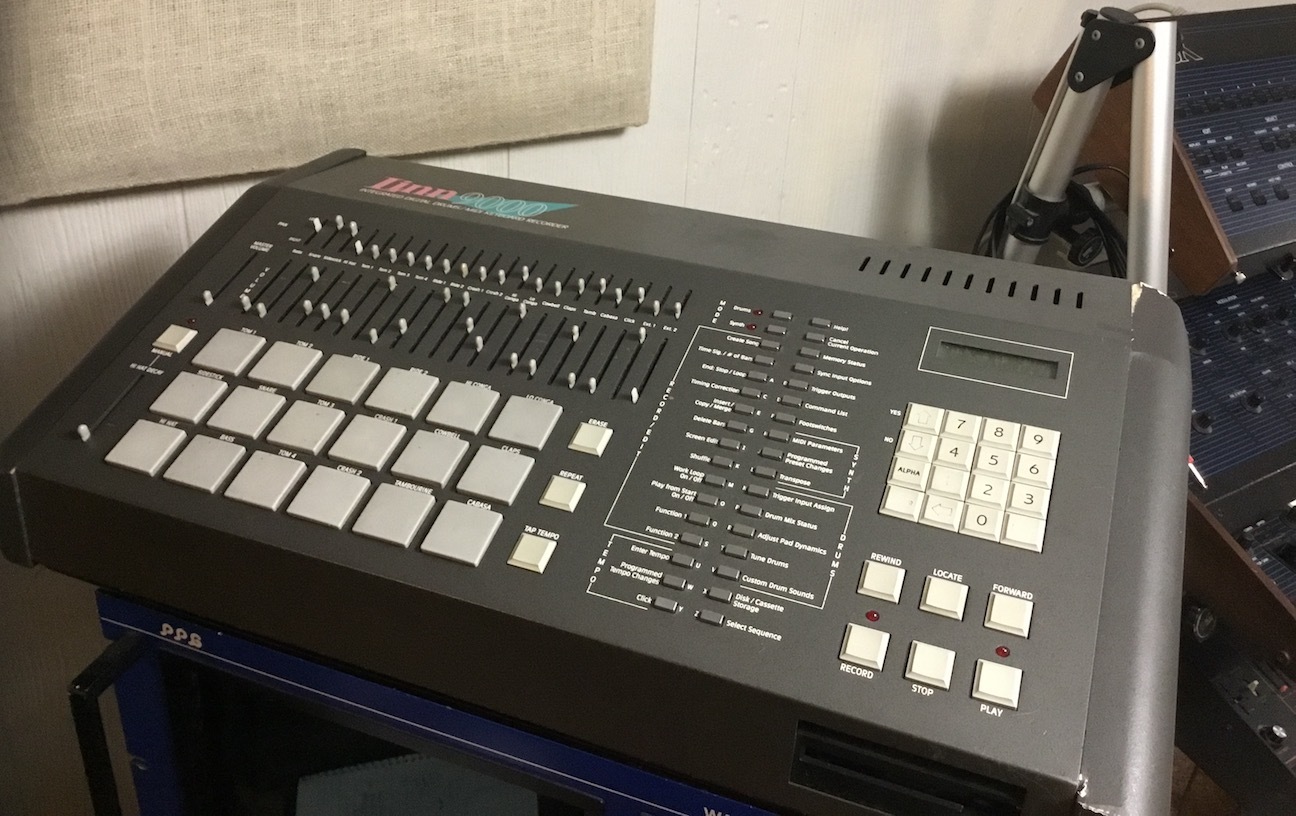
This showed up on my doorstep yesterday. It was a gift from a complete stranger, arranged by two dear friends of mine (such kindness there is in this world!)
I haven’t been able to try it out yet, as it needs some work first - nicad batteries need replacement and I need to clean up some minor leakage from the old ones. Power supply tests out okay, though I’ll probably rebuild or replace it. I’d like to fix the damage to the right wooden end-cheek, too (or replace both end cheeks altogether).
The Linn 9000 is an historic piece of equipment - the first machine to combine drum sequencing, sampling and MIDI sequencing - sound familiar? It was also a buggy mess and was a key factor in the demise of Linn Electronics. However, Roger Linn refined the design for his next groovebox, Akai’s MPC60.
Here’s a link to some samples/slice grids/chains made from some glitchy broken sounds that it was triggering in one of its stages of disrepair (scroll down for more details): http://www.theelectronicgarden.com/Scot/Glitch9k_2.zip
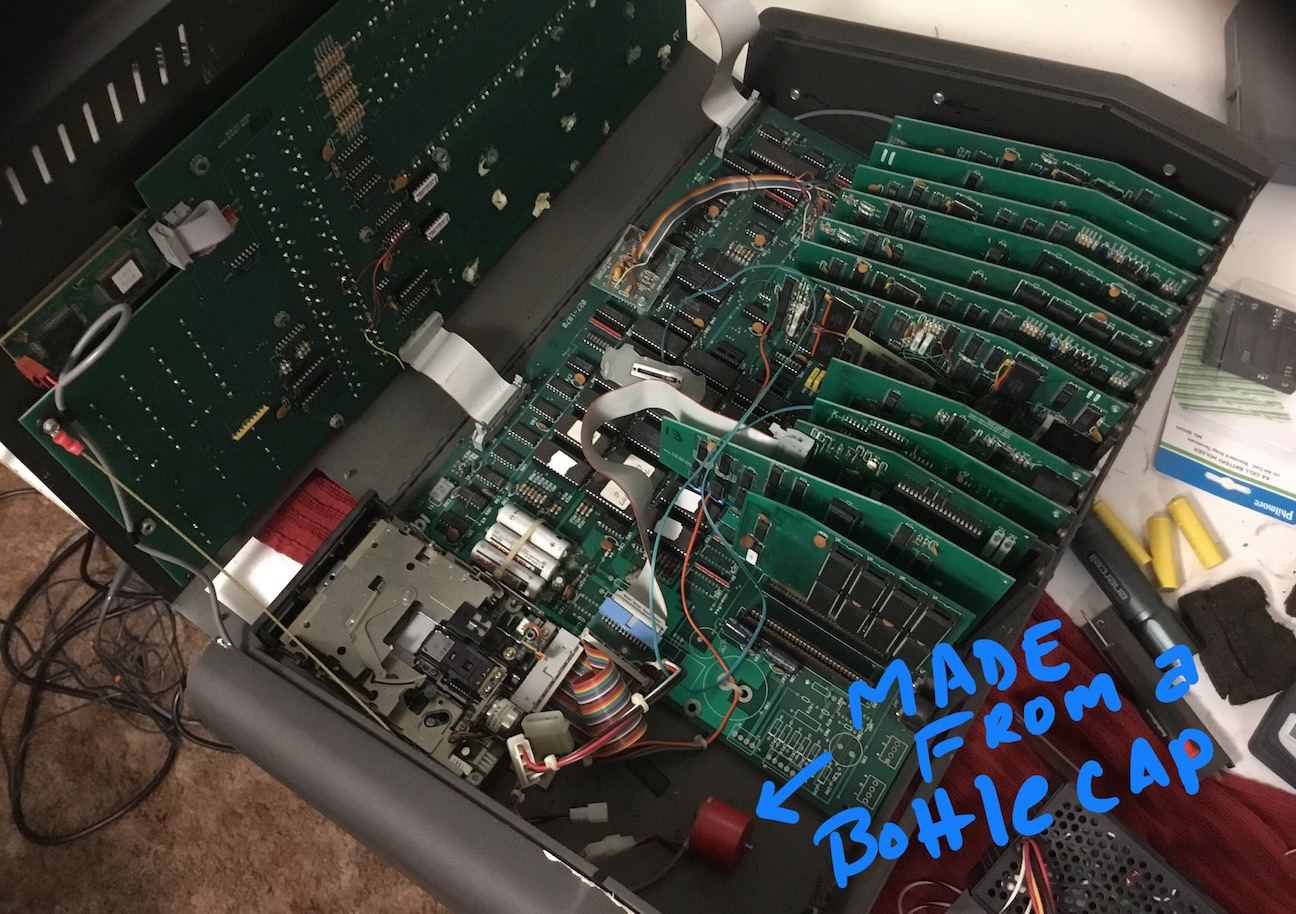
I’m sure we’ll get it up and running. There aren’t any custom-made components, everything is off-the-shelf (circa 1984) aside from a coil they made from a bottle cap
It’s in pretty good shape, overall. I can’t wait to get it up and running (though I’ll enjoy getting there).
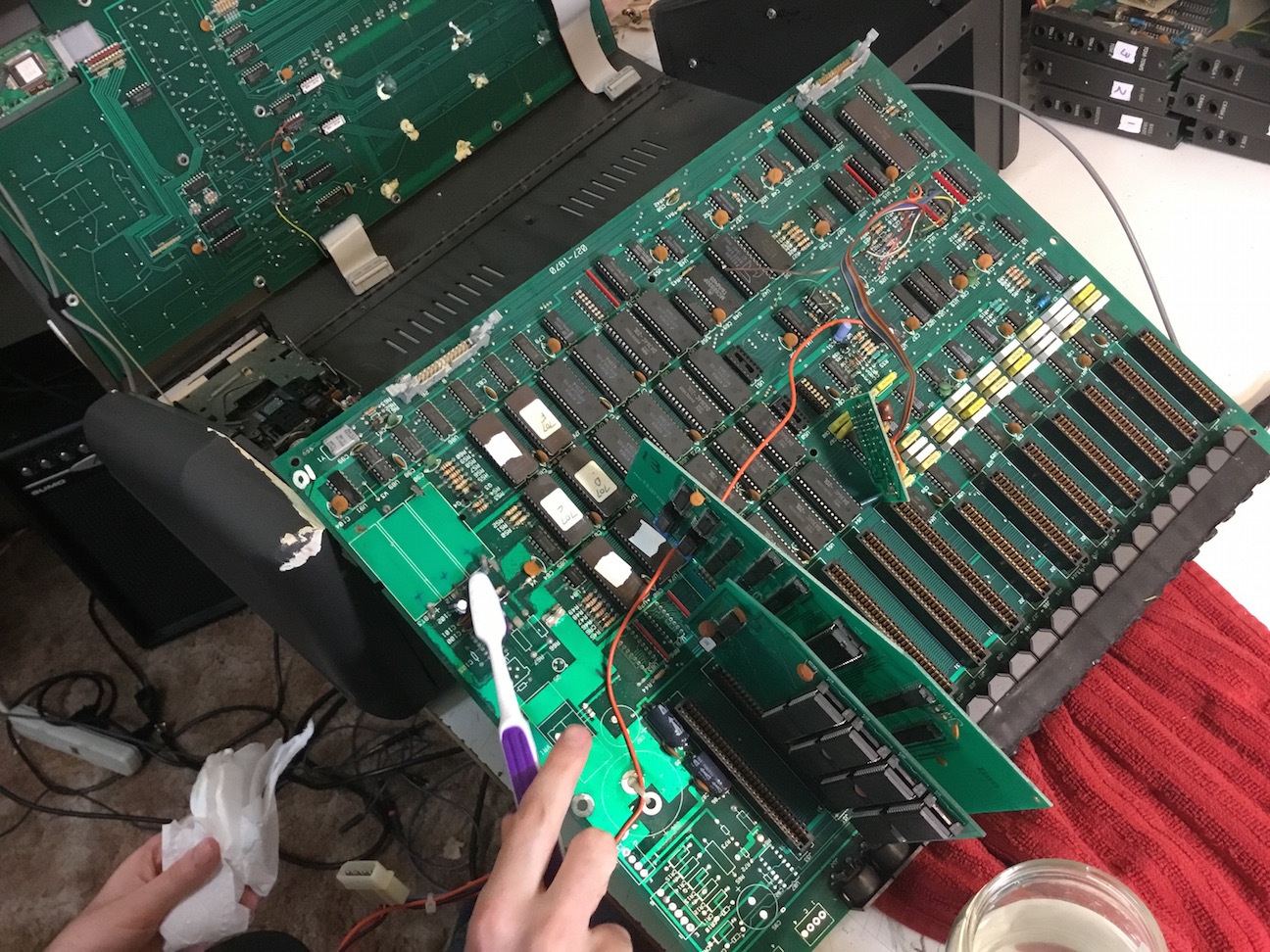
We’ve got the Linn 9000 opened up and are working on cleaning it up. It’s crazy how DIY some of of the design and construction is. The coil that powers the LCD is made from a bottle cap! The nicad batteries have leaked a little potassium hydroxide onto (and into) the surrounding board, as I’d expected.
Here is a photo of my son Nigel cleaning off the battery leakage, followed by one showing insides with the motherboard and daughter cards still in place. It’s a cool peak into the past!
Thanks! We’re really enjoying digging through it. Nothing in here is custom made (other than that coil). It’s all off-the-shelf components (albeit circa 1984!) so in now which way an impossible task.
An update on our progress: When I first received the Linn, it didn’t boot up at all. No sound, no LEDs, nothing - just dead in the water.
My son cleaned up the corrosion from the dead nicad batteries and re-tinned some suspect traces on the main board. New nicad batteries were installed (this time with a DIY battery holder so we could more easily swap them out). We put it all back together and… no dice. Still nothing.
However, once we removed the disk drive and associated microfloppy controller card, it showed the first stirrings of life - the LCD sprang to life, informing us that this was OS 7.07 (the last from after-market Linn service masters Forat). It hung there indefinitely, though.
Still, it was something!
Next I pulled out all of the cards except the SRAM card. I tried it again and it actually booted! The front panel LEDs came to life and the buttons seemed to be working. Next, I stuck the bass/snare/sidestick card in and rebooted. Again it came to life. It wasn’t out of the woods yet, though. A quick test of the associated pads revealed that they worked, as did the volume and pan sliders. However, the sounds were very strange and glitchy - though they were consistent and responded to velocity and such. I then tried recording a quick pattern with the glitchy sounds - and it worked!
After replacing the remaining cards, I found that all of the drums were plating back in this odd, distorted manner. I am thinking maybe the sample playback clock is too slow.
It froze up on me a couple of times, but a reboot fixed it each time. So, though this big, broken piece of history isn’t up and running properly yet, I am pleased that some progress has been made (and I will likely try to sample those glitchy drum sounds before attempting to work on it again - watch this space!)
Yeah, there’s definitely been some Forat mods on this thing. The OS is 7.07, which isn’t the last Forat OS, but almost. The Disk drive has a signature and says “Forat” in Sharpie on the top cover. There is a SMPTE mod, but I don’t know if that was Linn’s or Forat’s, as it still says Linn Electronics on the SMPTE board (however, I seem to recall that this particular unit had that installed by Forat in the early 1990s).
Alas, we’ve taken two steps forward and one step back. We had OS booted and working pretty well, though it only played back glitchy sounds. However, now it’s hanging on the OS version screen again. Still, it gets us closer to knowing what’s going on. At a guess, I think the sounds I was triggering may be played back at the wrong rate, with all of the aliasing and artifacts that might cause. In any event, I sampled them while I could, trimmed them and converted them into a sample chain for Digitakt/Rytm users and a sliced file for Octatrack users. I tested them on all three machines and they worked well. If you want to have a play with them, you can download them from this link:
I included one-shots, too. No editing - these are just the raw sounds as they were spit out of the broken Linn 9000. I tracked the Linn through a spiffy Chandler Limited/EMI Abbey Road REDD.47 pre-amp - though that probably doesn’t matter much in this case!
Yes, thank you for sampling…
Warped sounds from a classic vintage drum machine’s failing circuits sounds very appealing…
Sneaky almost, in a “this track has heritage but you’ll have no idea why” kinda way…
I’ve added an OP-1 drum kit version to the zipped file, hence the altered name of the file in the link above. If you have an OP-1 and want to use those samples you can re-download the zipped folder.
For the OP-1 users amongst you: I’ve just re-uploaded the zipped file with a new OP-1 version of the kit. I had made a sort of pitched sound out of one of the samples to play melodically with the top six notes of the OP-1, and realized that it may have been tuned too low for the notes used. There is now a version with pitched notes that match the actual note values on the keyboard.
Nigel (my son) and I have been building and repairing gear for nearly a decade. He is very smart - he could read a schematic at the age of 10. He’s now a young man (21) and knows far, far more about this stuff than I could ever hope to learn. A couple of years ago, we built an entire modular synthesizer from the ground up as a gift for a friend. His DIY analog sampler module was the crowning piece in the cabinet - really special (unfortunately the sampler module was also really difficult to design build and he has steadfastly refused to make one for my own system).