I’ve been tempted by it, surely worth it, but I preferred Tempera form factor. Not sure if the GR Mega has 8 tracks (samples) as a mod destination…Can play 64 notes on the Tempera…
2 Likes
I also looked at it, powerhouse for sure. I also preferred the form factor (and price) of the Tempera, I really enjoy the touch interface for playing, it really effective (and fun) for granular playback…makes it more tactile, more of a live instrument…it’s pretty unique in that respect and will probably be the desiring factor for most (to program or to play!). Great user community with Tempera canvases and computer editor etc…
2 Likes
Thank you both for your opinions, much appreciated.
My use is in the studio, i don’t care for performance/playing but i do care about being able to program and record into my DAW.
How is it when used with a DAW?
It looks very fiddly compared to the GR-Mega.
It is pretty much designed to be sequenced with a DAW (having no real internal sequencer) and the midi control is excellent, full CC over pretty much everything including midi control of emitters positions even on different channels if needed that way)
Good overview here: MIDI input — Tempera Owner’s Manual
- you get the Poly AT playing and recording experience built in!
If you are on a computer anyway, browser based tool like this are also helpful
3 Likes
Tempera isn’t really MPE, but it is multitimbral, so you can use each Emitter channel as an MPE voice, hence 4 MPE voices max.
16 voices, Poly AT, velocity mod and key tracking suffice to me.
(Anything multitimbral can be used with MPE. Possibilities depends on specs per channel like pitchbend, channel aftertouch, modwheel, filter CC, etc)
Exemple with Linnstrument set to 4 channels max :
1 Like
Yup- sorry- confusing the PolyAT/MPE, I have never even connected the Tempera to my Osmose to try the MPE hack, the Poly AT cells are pretty playable IMO!
1 Like
Can you select number of midi channels used on Osmose ?
Yes, but it should be better with Osmose (I mean, with Poly AT, I guess Osmose also have it !).
Tempera’s cells Poly AT isn’t immediate, compared to Hydrasynth or Linnstrument.
From memory there is an ‘External MIDI’ menu that lets you select the number of MIDI channels used etc, I have been lazy so far as its all just set up for internal sounds and VST configured Osmose pre-sets (there are a lot of those!). I recently bought an Redshift 6 (which I am loving) and its also MPE, so I really need to start mastering my Osmose (and Push3) with external synths!
I have mainly been using my Tempera with a Digitone 2 midi sequencing and sampling bits from my modular (or as a real-time fx), I probably need to change it up a bit I guess!
1 Like
I’ve owned both Tempera and GR-Mega at the same time - currently only have the GR-Mega.
While I like both instruments a lot, it felt like overkill to have both. Ultimately, I meshed with GR-Mega a bit more - I was also a longtime user of GR-1, FWIW.
Tempera is indeed very playable and fun. Sounds great, tons of polyphony and grain polyphony, lots of modulation options, decent sounding effects. The concept of emitters reminded me a ton of the Borderlands iPad app, which I was stoked to have in a standalone hardware format. I really enjoyed how small and portable it was.
One thing I struggled with was having to have a single sample per column. I very rarely loaded 8 samples at once - this meant I often had unused space on the grid or space I would have to try to avoid with the emitters or my playing. I often found myself wishing for longer sample lengths than 11 seconds.
To be fair, GR-Mega might be in a different category of instrument, especially taking price into consideration. Beyond granular, it also does spectral processing, as well as plain old sampling (with options for slicing). It also integrates with a DAW pretty well - should be noted that it has USB audio (including the ability to be a USB host, which means you can send/receive USB audio directly from an Elektron machine for example). Samples in the granular mode can be ~3 minutes long, while samples in the other sample modes can be up to ~60 minutes. It’s only 4 channel multitimbral, but each layer is truly separate, including the filters and effects. It’s much larger in size, but I find having dedicated panel controls makes it quicker to work with. Tempera has macro controls, which helps.
I also really appreciate being able to see the entire waveform on GR-Mega. The visual feedback is very helpful for being able to hone in on what you are doing. Lastly, I found the live granular mode to be more my speed on Mega. The visual feedback really helps here - there’s a few other bells and whistles like being able to set the recording buffer length and being able to add feedback to the recording.
The menu system on GR-Mega isn’t my favorite (though it’s improved A LOT from the GR-1). The external audio inputs expect balanced audio - so if you send unbalanced signals to GR-Mega, you may get unwanted noise or the signal might sound too quiet. I ended up having to get an unbalanced to balanced line level convertor (ART Cleanbox Pro) in order to integrate it into my unbalanced patchbay). That was a little disappointing to find out considering the price of the instrument (no such issue with USB audio). I’m also not the biggest fan of the built in sequencer. It’s a pretty basic step sequencer, though Tasty Chips has improved it a bit (it can do parameter locks now).
Apologies for the wall of text.
11 Likes
Thanks so much for your detailed reply!
I’m more sold on the GR-Mega.
2 Likes
I think that is Tempera main strength compared to other hardware granular gear.
2 dimensional tape principle.
Not truly separate on Tempera indeed. In that concern I’ll add the Tempera fx are common, filter type too, fx send can be set per channel (emitter), and the filter modulations are per voice.
Having a lot of interest in granular stuff using Lemondrop, I was about to buy GR1 (monophonic filter, mono samples), then I saw GR Mega specs ! Then someone reminded me about Tempera, having a new Live Grain mode I needed (I excluded it before that).
Thanks for details !
Visual feedback and samples length are a big plus of course. I think I can’t regret my choice, second hand GR Mega should be more available if I change my mind…
1 Like
It is great just as a real time granular FX, I use it that way with my modular a lot.
If you can afford a GR Mega you cam probably afford a Tempera as an FX unit  Tempera a very good granular synth- the X/Y granular with polyAT playing surface makes it quite unique and the live granular FX is a cherry on top…fortunately I have never been hands on with a Mega or I would probably want one as well!
1 Like
Ah man, after watching more videos, I’m liking the idea of the Tempera more and more.
How well implemented is it’s key and scale awareness? Does it accurately detect the key of samples when imported and recorded?
With any gear, better to know what key or bpm is orginal. You can tell what key or bpm is a sample to tempera. There is auto detect I don’t use.
By defaut, it is 440 hz, so if you play an A scale, it will use same root key.
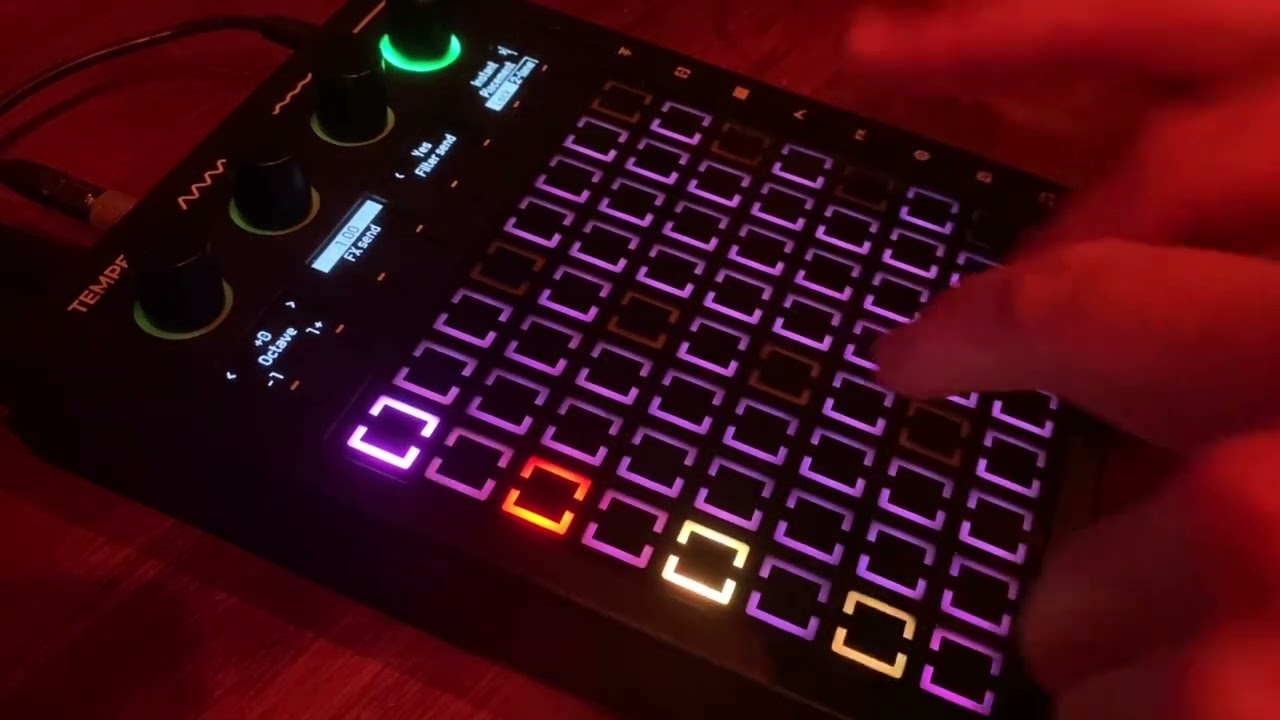
Another approach is to use Keytracking to control slices you made. Up to 100 slices in 11s !
Can be drum kits
2 Likes
Here maybe but I saw a few on french 2nd hand market.
This device makes me really curious, and @sezare56 's demos are really appealing.
there is a stereo input, but does the recorded sample really stays in stereo or is it then played in mono ?
I read a review where the owner says globally that depending on the sample you load into, it can be great or a big mess, and he is really happy with it because he owns a huge samples bank carefully sorted … in my case i don’t have sample bank, i almost never load a sample, i record everything, each one of my track are made with a bunch of newly recorded sample especially for this track, (this workflow is slow of course but i feel good with) does the tempera suits that kind of use ? is it easy to record samples ? to chop them ? (i mean without a computer)
1 Like
I don’t load sample into it, I only sample stuff coming from other gear and it works great for that ! As you can get external clock and transport from other gear or the other way around & recording is pretty easy (never more than three clicks away) it’s a breeze. The slicing is not the best feature though, as I understand you can only create same length slices
1 Like
I beg to differ, before Tempera I rarely needed to know the key or BPM (even less the Hz !) to work with a sample. Of course it’s useful but at worst there is a pitch up/down to work your way on a warping feature.
With the Tempera you need a maths head, if you don’t have sense of engineer logic, you’re in for headache.
It’s the least you can say, slicing is… handcraft on Tempera.
The device is IMHO largely unfinished. The logic of it can be disturbing, lots of prep needed unlike the touching surface seems to promise. Most of the features are complicate to apply if you don’t get the logic of it, I think it’s important to warn eventual users. For instance I struggle much more with Tempera than with OT, especially because Tempera is forcing its logic on you (where the OT has different ways to achieve things). And it’s a convoluted one.
Mind you, I don’t doubt it can achieve great results but for the price (I get it’s a small company though) the box feels underwhelming (you can have a second hand DN2 for that price!).
1 Like
Depends on what you use it for I guess ! I use it for weird textures, spontaneous events, ambient pads … And it’s pretty fast to get something weird & unheard ! However I spent quite a lot of times building Canvas thay I can use all the time to record new stuff in, and I never tried to use it for drums for example
3 Likes
No need to if you leave default 440 hz tuning and play an A to play original tuning.
Generally samplers use C as reference. Not a big difference.
Concerning loops, with any sampler, unless having timestretch, you’d want to know og bpm, or their length if you want to match them to a sequencer. You can do it by ear with pitch though. On tempera it is simpler to set og tempo, but you can also do it by ear as it stretches the loop to tempo using pitch.
Different approach, unusual, but I can’t see a major difference compared to regular samplers if you want to vary or adapt pitch, tempo…