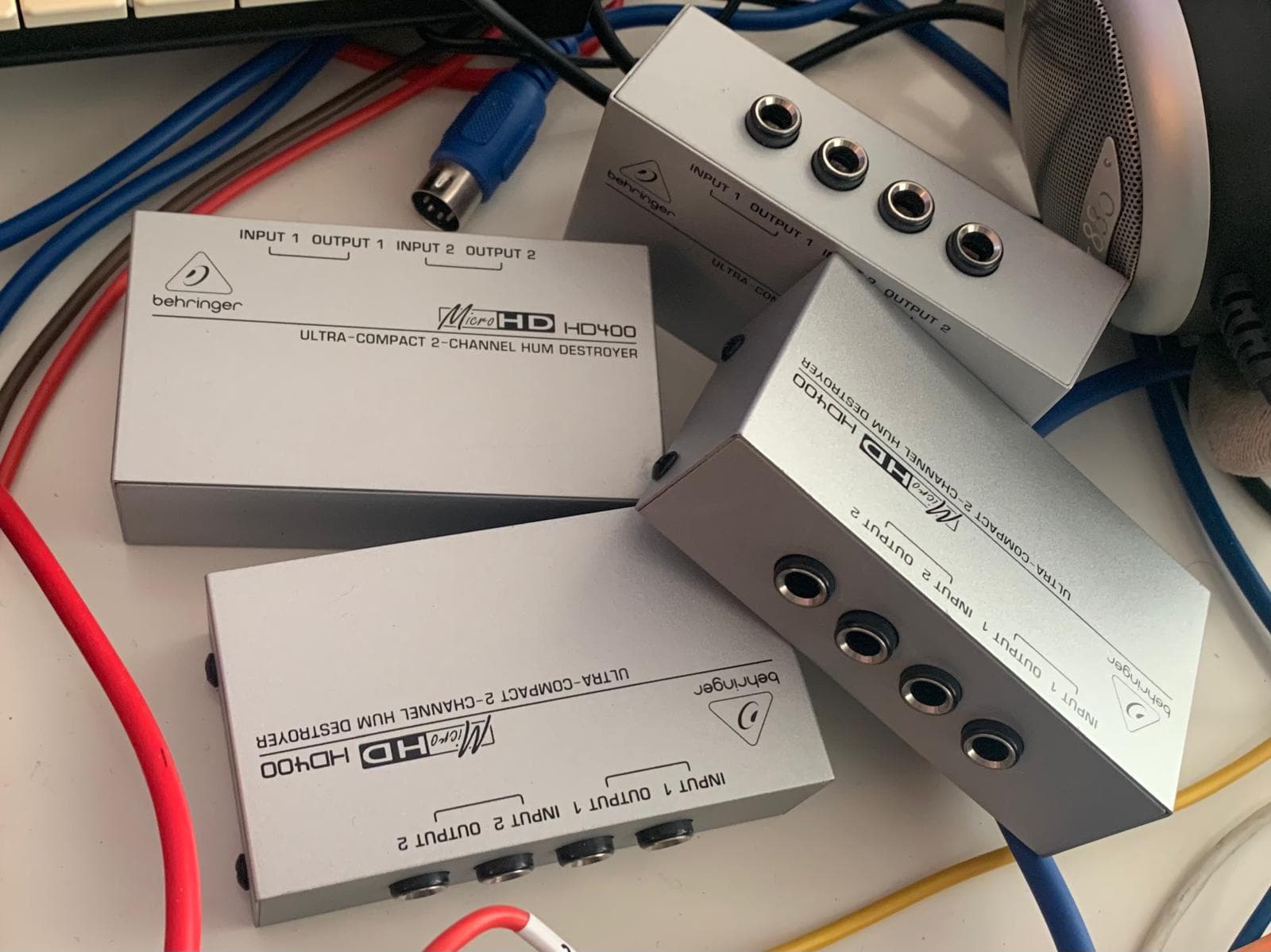
Solutions for eliminating street-based power line noise

I recently re-arranged my studio against an outward facing wall, on a floor that’s parallel, vertically, to the street’s power lines. The lines are roughly 2 meters away from this wall.

The electrical ‘field’ (or whatever) that comes off them is quite noticeable so I moved everything a few feet away and it’s ‘mostly’ gone, depending on time of day and how much power is presumably going through them, or something (not an expert here).

I’ve noticed I can stand in various places between the outward-facing wall and the equipment and it goes away, and sometime re-arranging, or just touching the cables, also helps.

So I’m looking for a solution.
There aren’t THAT many cables, so suggested shielded cables is quite welcome. Price hinders switching everything, but maybe there are some ‘reasonably’ priced cables that will help.

I don’t know if ‘shielded’ cables shield for this either.

Any other ideas for blocking such ‘fields’ is also most welcome.

Thanks.

It’s not going to be that simple. For a real solution you’ll need conductive paint or maybe copper or other metal sheets (I think the coating on those silver emergency blankets is conductive, for example) and line the walls then electrically ground them to the grounding point of your power mains in order to create a faraday cage and block the electromagnetic field.

The reason it goes away when you stand in certain spots is that the human body makes a very good antenna and much like being struck by lightning, you become the conduit for the electromagnetic field to pass through you, to ground.

Google something like faraday cage and shielding a room against RF or similar.

Conductive paint is pretty expensive, but you can kinda fake it by buying a bunch of graphite powder and mixing with regular paint at a high ratio of powder to paint.

Don’t trust any snake oil solutions, they don’t really work.

Yeah, I’ve been reading a bit since posting.
Hmm. I rent, so I’m limited in a few ways.

It’s almost gone, backing away from the wall but I’m running out of room. If I put it back where it was (the studio) it doesn’t happen at all (but at that point I have room sound-proofing/bass-trapping issues).

This was easier when I had a house. Sigh.

yeah, and there’s a lot of research that speculates long term exposure causes cancer, but not enough for it to overwrite long established zoning laws. In some newer developed areas they pipe all the power lines underground.

Anyways you can experiment a bit with the direction of the desk and where you sit, might help and it might not.

Good luck with your reading, there’s a lot to sift through.

2 Likes

Hahaha. Thanks.
I haven’t tried a diagonal orientation yet. I could give that a go :slight_smile:

My old apartment was closer to downtown and everything was buried. No noise there.

These are just right there; I didn’t even think to check.
Alternatively, and because I’m really, really averse to these kinds of noises, I might move to a different unit off the road. No power lines back there (though a bit more expensive).

You would really have to be very close to be getting that much interference, so you must literally be right up on it (in that room). Can’t say I envy you there :sweat_smile:

Yeah, the only space is the sidewalk sized strip between the windows and the wires. They’re ‘neighborhood’ lines, so it’s like one large primary power… not like those huge routing towers or anything.

Probably healthier to get back to a different unit. Plus, those units have a park/forest/elementary school view (that my kids went to), so mentally better all around.

Plus, the kids in the playground at 7AM can be my alarm clock.
Ooh… and no traffic noise.

I think I’ve come to a solution. Thanks!

1 Like

Do what is within your ability, you can only do so much when it comes to housing. The noise may continue to be bothersome though, unless you get a bit creative. I’d try the diagonal and arrange the room around the noise. You can always buy or build a few of those japanese style folding screens and put some acoustic treatment on them as temporary walls.

Like this - etc.

a couple of those in the middle of the room might help.

In fact for sound proofing a lot of professional installations are like, room within a room, so you could also explore that concept. The airspace between the inner room and the outer walls acts as a sound barrier and helps isolate the noise.

Just some basic info, like I said before, you can probably google it now that you know what to search.

I have a three day weekend. This will be my task I think.

Give an update if you make any headway on it. I’m sure it will help someone here.

What a headache though. Hoping the best for your efforts.

Please take your misinformation elsewhere - there is no mechanism by which power distribution lines cause cancer. If there were, you would expect to see massive cancer clusters among the many people who take electric powered trains to work and back every day. Much higher voltages and frequencies physically closer to passengers than neighborhood power distribution.

Some useful suggestions on how to eliminate unwanted noise from Loopop:

The consensus is not always the whole story but I’m not going to argue with you because neither of us is a scientist or a doctor in the field of childhood leukemia.

Hi @terrariums.in.space, could you be a bit more specific about the problem you’re having?

What exactly do you mean by the powerline noise?

You never mentioned you are hearing a noise. How do you notice?

Assuming you are heaing a noise from your equipment; do you hear them from your equipment headphone outs with a headhphone, from a single device or from all of them? or from speakers connected to an amplifier? or how?

Or are you talking about a hearable noise that’s eminating from the electrical cables outside?

How do you notice the electrical field or “whatever” that’s coming off the outside cables? This statement is a bit puzzling to me.

Assuming the noise is coming from your speakers or your equipment (and not from electrical wires outside), this could very well be a grounding issue. Do you have a way to check if your flat or at least your room has functional electrical grounding? Easiest way to test it is with a multimeter on your AC socket. First check AC voltage on Live~Neutral, then on Live~Ground. They both should read the same value. If not, that might be a major contributing factor for your problem. Please don’t kill yourself while doing this if you don’t know what you’re doing.

The video @obscurerobot shared above seems to be touching on the right points. I haven’t watched it but the thumbnail shows the points I was thinking of making. The easiest thing to try is to disconnect stuff to find a ground loop. Start with your amplifier that powers your speakers, disconnect the audio line going into the amplifier to see if there still is noise. if noise disappears then connect the next thing but nothing else should be connected to whatever that next thing is as in usb, audio inputs, midi, cv, whatever, but just the equipment. Then keep doing the same thing until you find when the noise starts to happen.

However, if your amplifier produces noise without anything attached to it, then try disconnecting its electrical grounding (if your amp has one). If you still hear a noise at this point, you have to try another amplifier because that is quite unlikely :slight_smile:

Now the most likely thing is that you will find the next equipment you connect that causes the noise. If it is an audio line, easiest and cheapest solution is to use one of these passive devices:

But you really should not be needing these devices unless you have a very complex setup.

If its a USB device, remove the USB device or change the USB hub, etc…
Most USB devices are quite noisy anyways.

Anyhow, first disconnect everthing and find what your equipment does and check your electrical ground with a multimeter.

This could be a a house electrical system fault as well. Does your house have a RCD or GFCI (Residual-current device / Ground Fault Circuit Interrupters) If there is none, (or there is one but it is disfunctional or disconnected) then your house electrical system might have some leakage current in the ground line probably from an air conditioning unit. You will discover this with the multimeter test I mentioned. You can check if the RCD/GFCI is in working state by pressing on the ‘TEST’ button on them. It should cut the electricity, if not it means its disfunctional and you might have leakage current in the ground line. For example USA only puts RCDs only to wet areas like bathrooms or kitchens but in Europe you have an RCB at the circuit breaker for the whole house (but it might be disconnected) or maybe you’re living at a place there is no ground line at all and maybe some idiot tied the ground to the neutral line etc etc…

Also, don’t worry about the outside cables or electrical fields. You know, right now, as you’re reading this, there are high-energy muons originating from space, passing through your body at near the speed of light and penetrating deep into the Earth’s surface. Also, we all keep a radiation device that can send high frequency modulated RF signals to great distances in our pockets all the time. I’ll eat those electrical fields for breakfast :rofl: Also painting your walls with conductive paint? :slight_smile: Unless you’re constantly wearing a tin hat, don’t waste energy thinking about stuff like that.

As @Mr.ToR already asked, what kind of “noise” are you experiencing?

Touching a cable or a connector housing and having less noise in an audio signal sometimes points to a bad “ground-connection”. The source may be one device of your gear, a power supply unit in bad condition, a computer or a high frequency emitting device etc.

Noise directly induced from a powerline should be below 60 Hz or 50 Hz depending on the countrywide standards. This would be in the range of deep bass frequencies.

Shielding against induced noise helps only, if everything is covered in a faraday like cage. Cables should have a coaxial shielding, which must be well connected to the connector’s housings and the ground-connection of the device it is plugged in. Just having the coaxial shielding inside the cable doesn’t help too much. If a device has a housing of plastic this is also not protecting against induced noise.

Good protection without coaxial shielding is the use of balanced XLR cables and devices supporting XLR. Noise is not shielded completely but will be minimized.