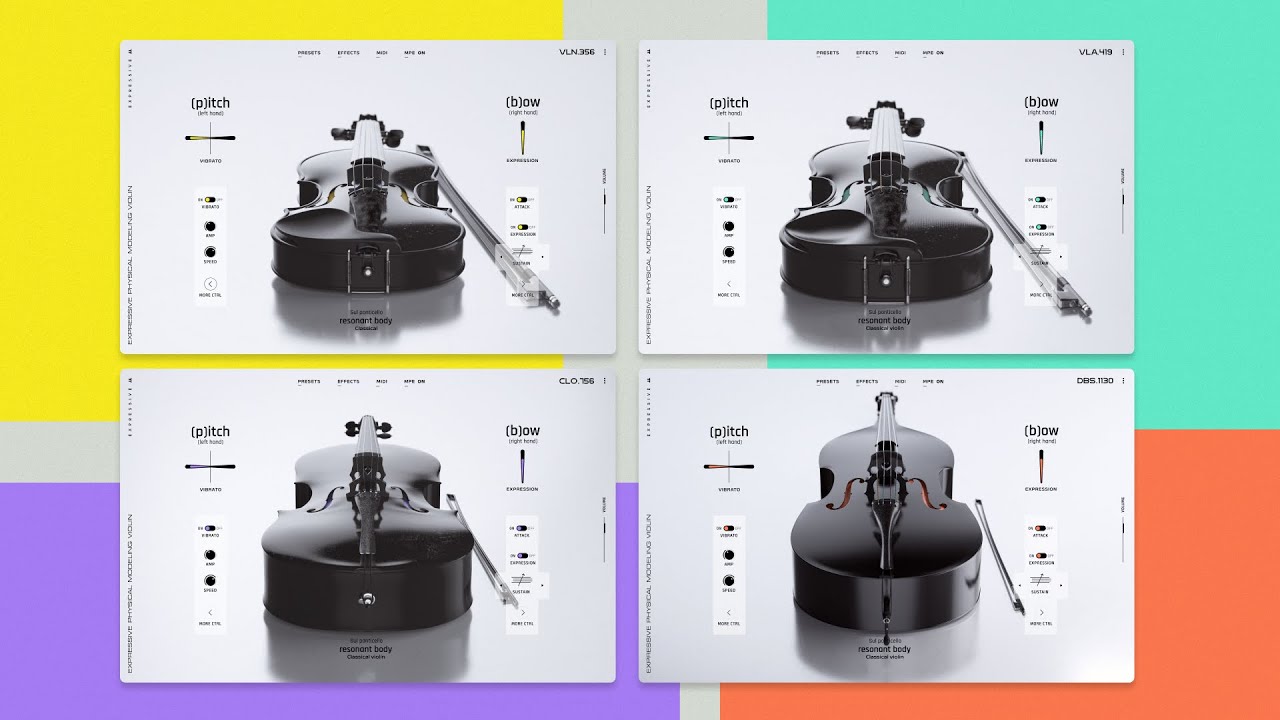
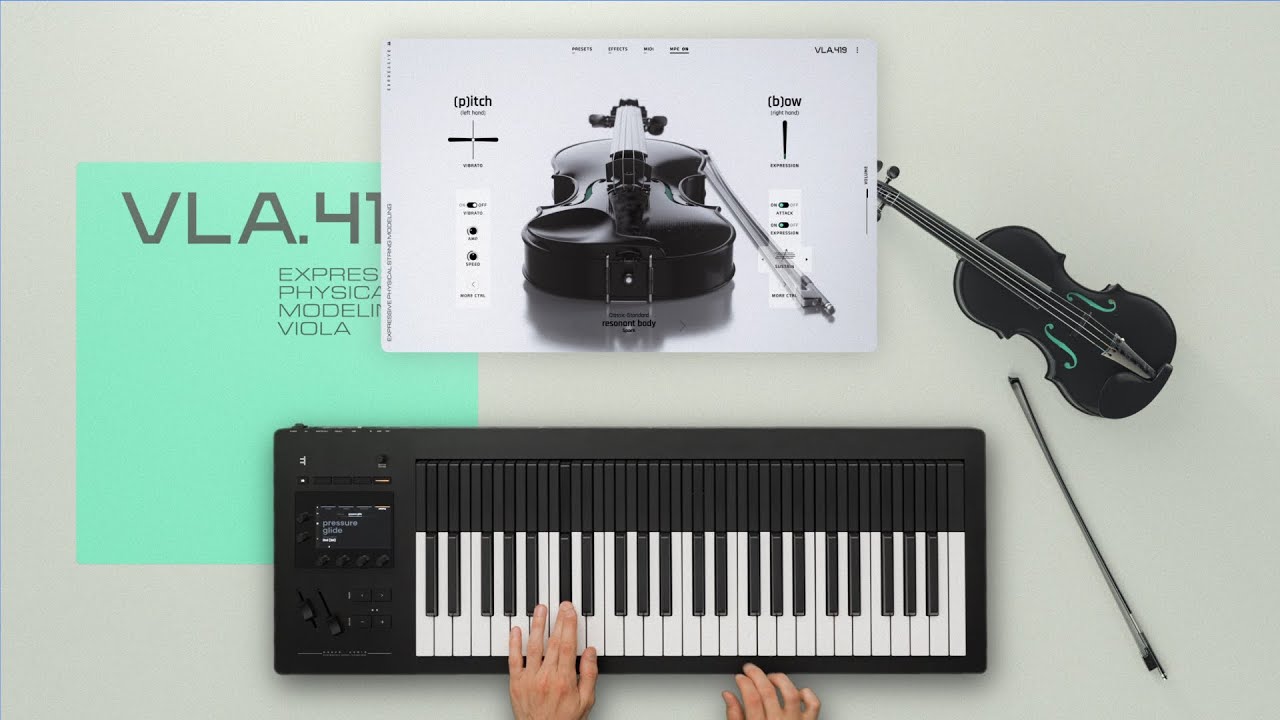
You could always split your controller and run multiple instances. I didn’t hear polyphonic playing in the videos. You’d think it could be polyphonic, at least for things like double stops and pizzicato.
Interesting to consider with the Push 3, and the ROLI controllers, as well as other MPE controller devices.
Yeah — I’m really not a fan of people mapping MPE on to what are inherently monophonic instruments (the “P” in MPE is for “polyphonic”).
There’s zero reason to take up 8–16 channels for this. A single channel, pitch bend, and any form of expression (via aftertouch, pedal, CC fader, wind, whatever) would suffice.
That their marketing frames “Standard MIDI” as a backup option supported if you aren’t lucky enough to have an MPE controller borders on disingenuous to me.
I don’t understand your complaint. Only an MPE controller can give you this type of playable expressive control over the instrument whether it’s monophonic or polyphonic. Sure, one could argue that they could make these instruments polyphonic, but that doesn’t negate the benefit that MPE provides here.
I want to like this more, but that violin isn’t doing it for me in the demos. Still sounds too artificial, especially in the sustains. It’s a shame, because other than SWAM there really isn’t a lot of expressive physical modeling that comes close to sample libraries, at least with strings.
I wish Expressive E would do trials of their software. Especially with something like those, you really need to get it under your fingers to see if it’s right for you
Pits 30 day no questions asked money back if you don’t like it - stick it on a CC and I guess your trying it free for up to 30 days…but it seems like a faff - it’s ilok I think so should be easy to demo!
Still that’s great it bring some competition - as we only have audio modeling in that category.
I guess the monophonic limitation is to limit cpu usage.
What is the benefit MPE provides over standard MIDI? It simply lets you round robin sending notes over 7 channels (plus a control channel) so that classically per-channel effects (like pitch bend and aftertouch*) can be expressed per-note instead. That’s it. There’s no magic “expressivity” there, and it’s the suggestion otherwise that I find disingenuous.
Now, having pitchbend- or aftertouch- etc. per-note is pretty cool — if you can play more than one note at a time. But if you can’t, hopefully its clear how it’s no different from the standard MIDI “per-channel” version. Except that it’s taking up 7 more channels for the privilege. So using MPE for a monophonic instrument is kind of a wasteful pain in the butt for setups with lots of MIDI.
* Aftertouch is a frequently cited example, but perhaps a bad one as every controller I know of capable of sending channel aftertouch over MPE can also send polyphonic aftertouch over standard MIDI
I think you may be missing some crucial functionality here. Did you watch their walkthrough for this? Pressure can be assigned to actually control the bow movement. This is not aftertouch in the traditional sense but instead it’s continuous pressure. The moment you’re pressing a key or pad, it’s monitoring the pressure of that key to inform what the bow is doing.
Perhaps one could argue that this could be handled with a controller that immediately reached the aftertouch portion of the key travel and thus negate the need for MPE from this aspect alone, but like you said, there’s also the sliding pitchbend/portamento.
While the osmose does not support a vertical slide gesture (Y-axis), I would imagine that could also be mapped to something on this instrument, providing even greater expression all from just playing a key and not relying on another controller.
Yeah, I think you’re conflating the controller with the protocol here. Would a controller that offers continuous pressure (Linnstrument, Push 3, LaunchPad, Osmose…) be preferable to one that didn’t? Sure (though worth pointing out that a lot of people who score professionally with stuff like this and SWAM map expression to a CC fader or mod — not pressure — as that’s how they learned).
But: should that continuous pressure (or pitch bend, or CC, or whatever) be transmitted via MPE instead of MIDI? There’s literally no benefit for it to be in a monophonic instrument. In fact, as I’ve explained, doing so is problematic when working with multiple instruments. And some of these devices that are perfectly capable of transmitting continuous pressure (LaunchPad) don’t even support MPE as an option.
This confusion isn’t your fault. It’s the direct result of marketing like this muddying the waters by claiming “MPE” is synonymous with “Expression”. But that’s a lie. Really MPE is just “MIDI, but everything is polyphonic.”
I see your point, and must concede that I’m not familiar enough with the midi protocol, in this regard, to suggest you’re wrong. It’s very possible that a purpose-built controller could transmit this data over regular midi, but when we look at the landscape of existing controllers that allow the type of playable control that Soliste supports, we find that only MPE controllers provide that necessary functionality.
Again, not saying it couldn’t maybe be handled with a purpose-built controller that does not require MPE, but to me, utilizing existing MPE controllers seems to be an appropriate use of existing technology to allow this type of performance expression.
Yeah, maybe familiarize yourself with what MPE is then before making claims about what does and does not “allow this type of performance expression.” Otherwise you’re part of the problem.
Again, MPE is not in any way different from MIDI. It literally is just MIDI. It doesn’t add anything on top. It’s nothing more than an agreement between device and controller that, instead of treating the standard MIDI messages sent on channels 2, 3, 4… as different instruments, treat them as voices of one instrument. That’s it. “MIDI Expression, Polyphonically”
So if your instrument doesn’t have multiple voices, there’s no point in making this “MPE agreement”. Treating a single channel as a single instrument works just fine. Every possible parameter of every controller that sends MPE, from Z-pressure to X- and Y-slide, is expressible in standard MIDI because that’s all MPE is.
And it’s not true that “only MPE controllers” provide the necessary functionality to control Soliste. They show playing along with the Touche, for example. That’s not MPE or purpose-built. The Osmose, as you point out, can’t control all axes of expression, and that works fine. So what are we even talking about when we say “MPE controller?”
But your original point was:
Well, now maybe you do. The conflation of MPE as a magical badge of “expression” vs. what it actually does has led you (and no doubt many others) to feel like you need some special controller with special expressive magic to use Soliste. When, if it’s a mono instrument, MPE is not providing any bonuses. The only thing you need is a controller that has the knobs that do what you want. Maybe that’s just keys and faders. Maybe that‘s pads and 3-axes of pressure. Most people are in it just for the Z-pressure and there are many, many controllers that provide that in the form of channel pressure but don’t support MPE.
Anyway, I promise I’ll shut up now as this is only tangentially related to Soliste and it’s confusing marketing anymore.
I think we are arguing from different perspectives. My point being that an MPE controller allows for more control over expression without relying on faders, knobs, etc.
But yeah, at this point I’m done arguing the point with you.