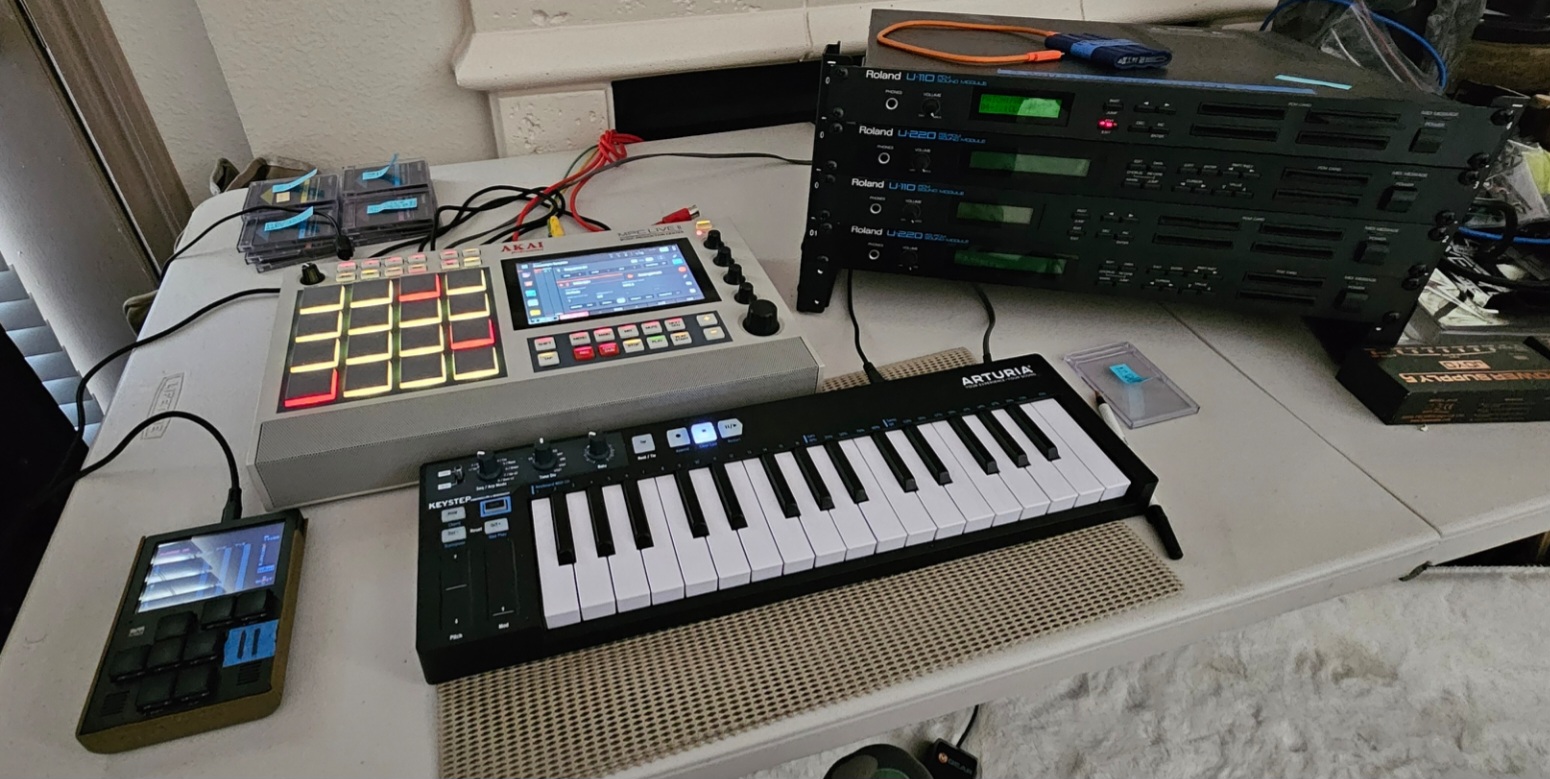
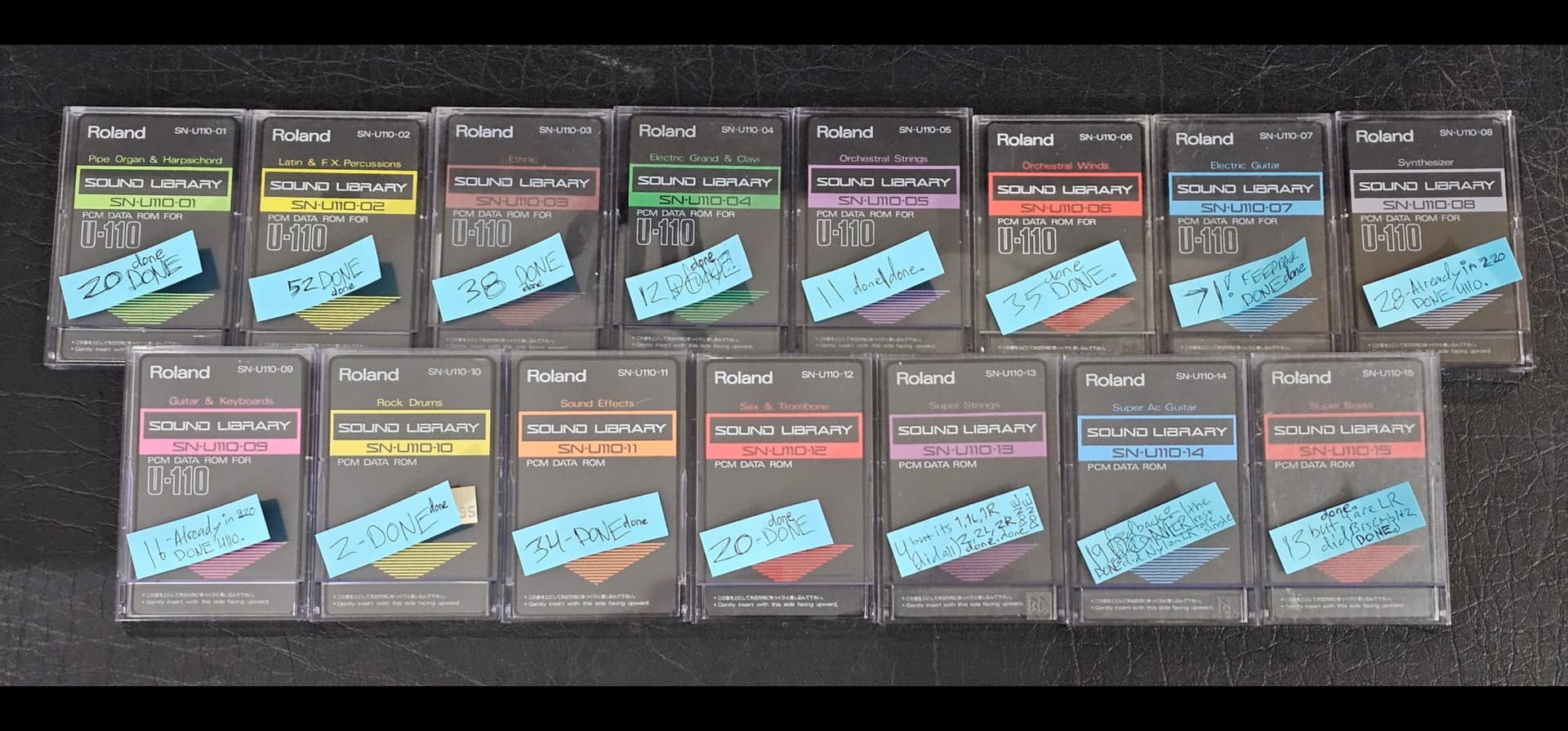
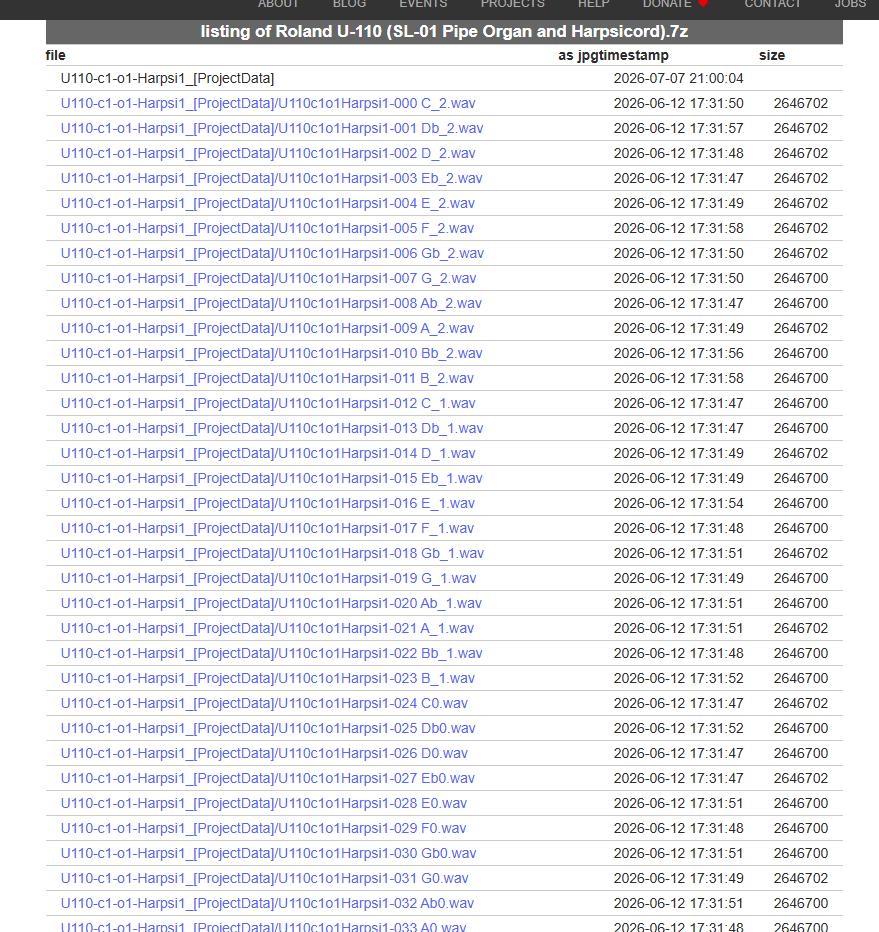
i started on 4 April 2026 to autosample a Roland U110 and Roland U220 internal sounds, along with each SN-U110 expansion card patch, all cards through both machines.
it took 91 days to finish, and i have 371GB of samples in 1050 folders of 128 wav samples each between 6 seconds and 18 seconds long.
at most there are only 2 velocity layers to a patch, both autosampled individually over 128 notes.
the idea was to record these boxes and their sounds across the full range of notes, to archive the characteristic audio signature of the sampling technology of the time, and to highlight the differences between the U110 and U220 technology by using the same data cards through each machine.
i’m writing this post to broadcast the availability of the raw sounds of these now 36 year old devices, and to farm advice on where to initially put the samples on arhchive.org. There is a lot of collections like community data and community audio, but i’d like to get a better idea of where historical Roland community archival content should go.
There are collections on archive.org for Sample CD-ROMs … though I realize that doesn’t quite fit here. There must be some others for Synthesizers and Music Production or something…
They can actually help you move your item into the proper collection if you reach out to them on their forums.
Cool project! What did your autosampling process look like? What drove the choice to do only two velocity layers? I’ve been getting into sample robot myself and never really sure how much is enough, my intuition has been to do fewer notes but more velocity layers. Also, is it legal to share these files publically? When looking for JV samples I’ve heard people talking about copyright issues.
Wow. Epic amount of work grinding this out. Thank you for sharing. There’s a lot of grainy classic techno sounds in those units. You’ve done the world a service. [tips hat]
Also, makes me think I should put my sample libraries on archived.
i made a template project with one midi track to audition the patch and check for velocity layers. i used the M8 to isolate exactly where the velocity layer switch was. Then open autosampler and set note range to max and note stride to 1, then audition the patch for sample length, and if it’s a looping patch, set the loop point. Chose the velocity, note the run time, hit start and set a timer. For patches with long decays of 18 seconds, or loops i wanted to capture as much harware loop character as possible, 128 notes of 18 seconds was about 45 minutes each. i used the M8 with a REP command on pitch +1 and HOP00 to chromatically verify each sample was successful, then save the project as the patch name. The MPC autosampler creates a keygroup when it’s done, which has a maximum of 128 notes mapped out automatically. I have 1050 MPC projects with the keygroup in it, and the samples in the respective project data folder. I didn’t think to save each MPC keygroup itself along the way, since my only goal was to get every note of every patch through each unit in a wav file.
they didn’t have a lot of memory in these, the velocity layers were either one or two actual sounds only, with one sound above velocity 100 and another sound below 100. below velocity 100 they would roll off amplitude and sometimes attack envelope, and (in the 220) sometimes filter to achieve player velocity expression. i wanted to get each note as reproduced by the actual device. in the upper and lower registers the early sample tech limitations gets increasingly exposed the further you get from C4.
for non commercial use, i don’t know. A lot of work went into making the sounds in these two boxes with the memory constraints of the time, and i wanted to take the opportunity to make sure the sounds get preserved, as reproduced by the original hardware, while the boxes still work.
i would like to know more about non-commercial-use preservation and public archival of out-of-production sound module content. there are quite a few sound canvas uploads online, but i could not find any U110 or U220 uploads.
yes there are a lot of classic sounds in these units. When patches load up, comercial jingles and TV show themes and early 90s hollywood soundtracks just fall out of the keyboard
Did the same thing years ago with a D110 then promptly forgot all about it because I sat there manually recording it all into Reaper and the sheer amount of work required to chop it up into looping samples began to dawn on me. Actually can’t remember if I even did the velocity layers… Hopefully bit rot hasn’t set in on the 100+ GB of data.
Nowadays these units are so cheap it’s totally feasible to have a main one and a few backup/parts units sitting around (though not much use for sharing with other people).
Is that due to the capacitors drying out, like what happens with JP-8000s? If so I’d look into it, quite a straightforward fix. That era of Roland gear is all SMT boards and built very similar.
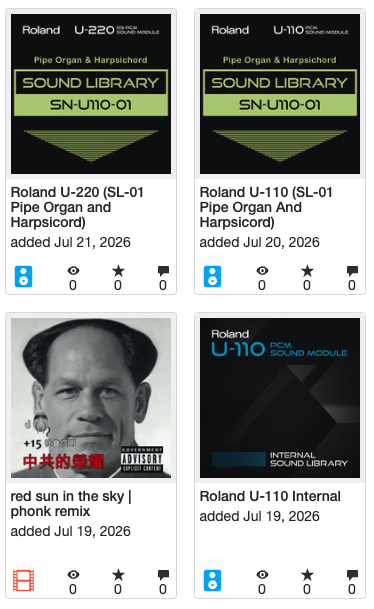
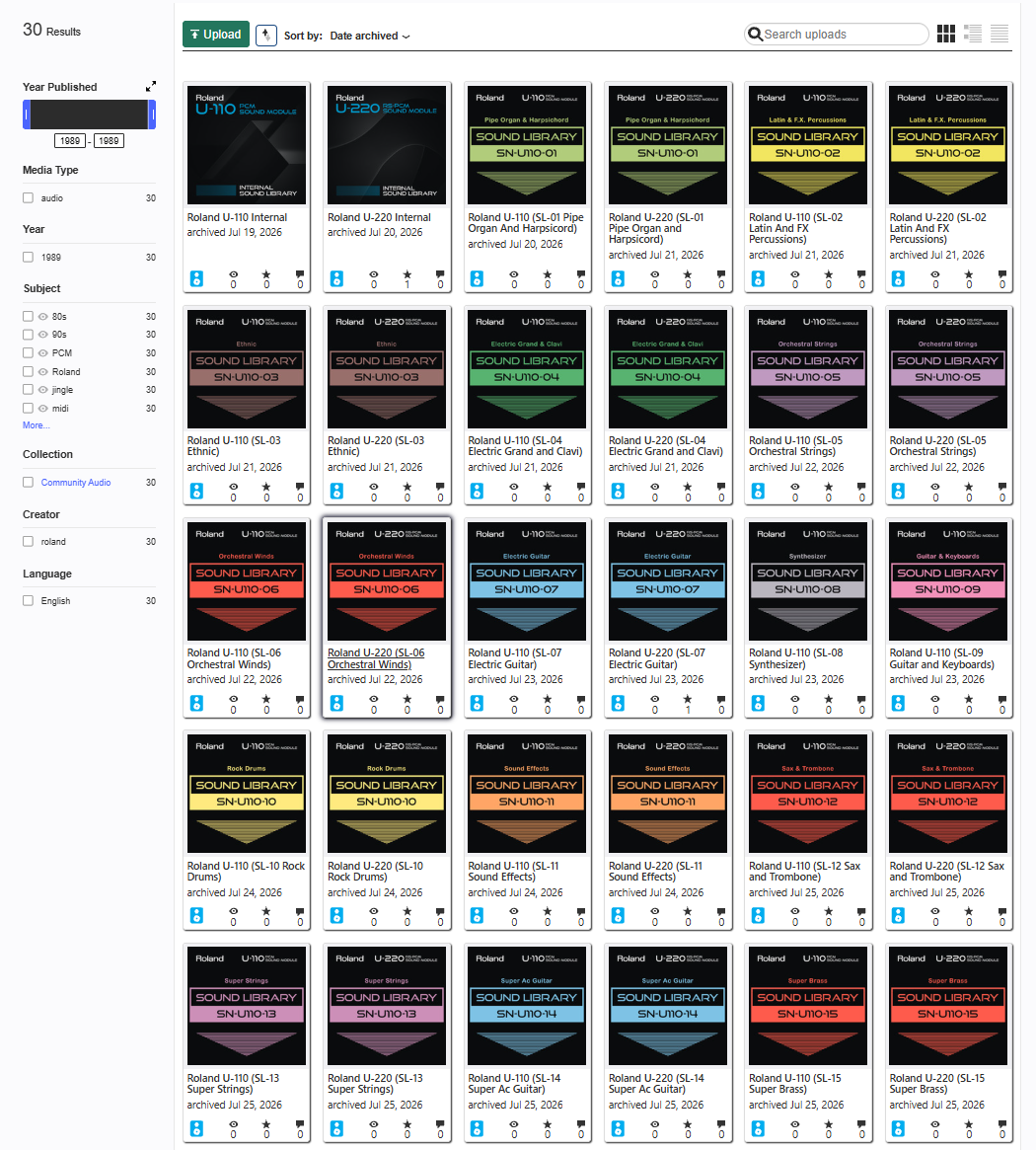
I’d be happy to help with the cover images for the collections, if you like? Nothing crazy, just something clean and “on brand” while also aiming to be consistent across the collections you upload.
got it, these look really good by the way, i was impressed you did the “RS-” as well, that RS is the whole reason i did the cards through both boxes, the tech in each unit is very unique in how they treated the data, and the resulting audio signature’s are distinct. U-220 is more polished and commercial sounding in the center range but less useful and many times humorously useless in the extremes, while the U-110 is a little bit lower fidelity in the center range, but at the extreme ranges the aliasing and harmonic beating of the data reconstruction error is wholly unfiltered and musical like an acoustic instrument.
The cards are all uploaded, best way to find them together is search “Roland sample PCM vintage”
The samples are 128 notes per every patch, when you look in the zip file they are sectioned off by patch in folders, but all in the same directory level for faster navigation. (The whole card in one directory level.)
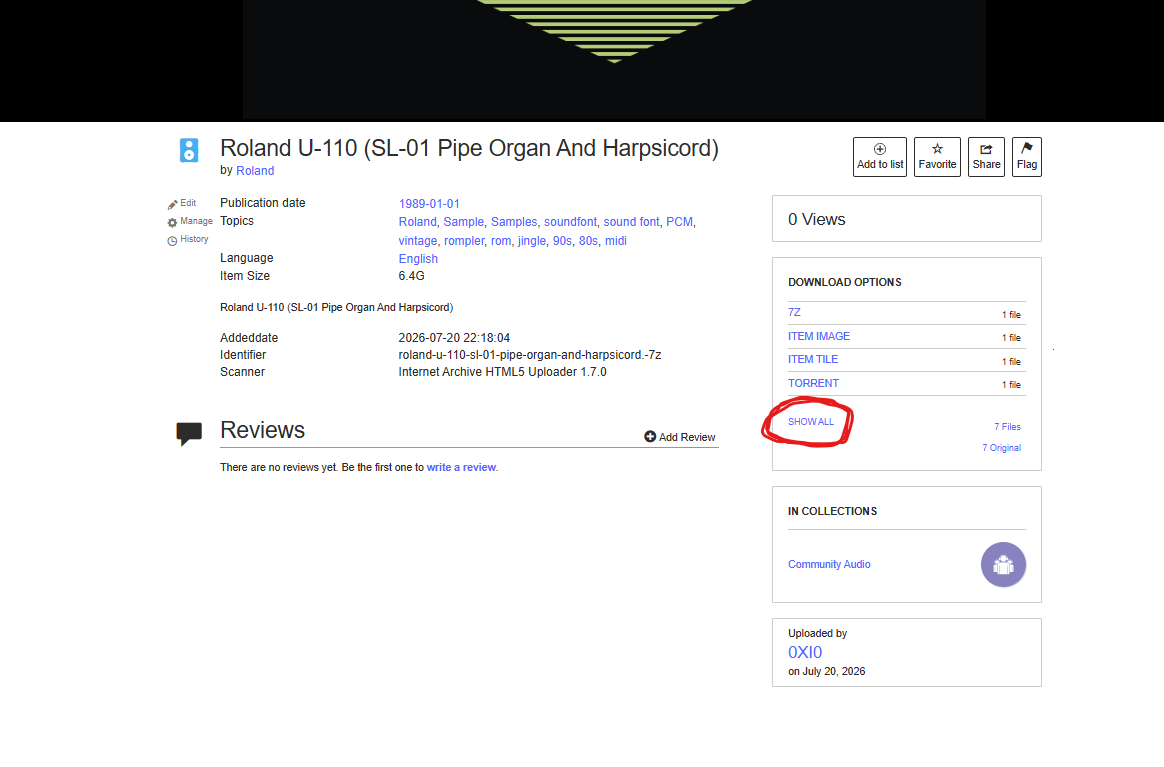
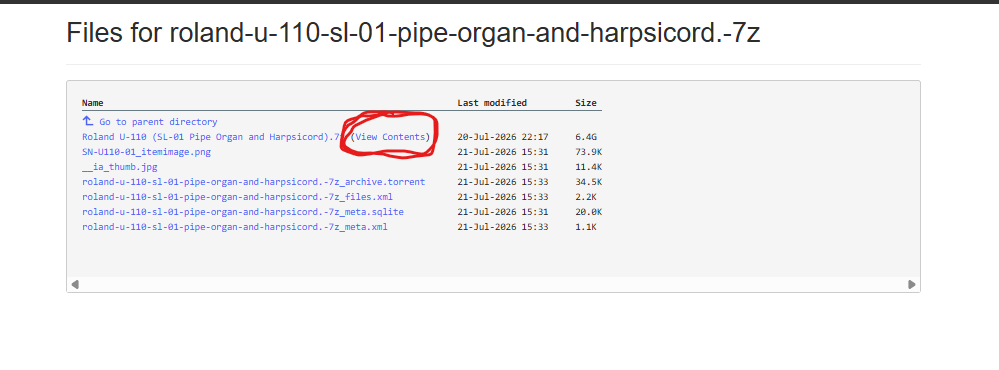
If you want to only grab a few notes of a patch you can drill into the zip file by clicking “show all” in the download options section, then “view contents” of the zip file. For example, Ctrl-F “C4” on the parent directory, then go through and grab all the C4 notes of each patch.
The reason i wanted to get all the notes of these cards through each box is because, like early samplers, the limited technology of the time has a distinct sound at extreme pitches, with pitch-locked waveform clicking in the low register and the rawest form of aliasing in the top register. In the 110 especially, it has zero filter or error correction from EPROM to output jack. The 220 has “improved” smoothing and filtering, which ends up sounding “better” in the middle, but a little smeared at extreme pitch ranges.
To get an idea how remarkable these boxes were for the time, check out the Super Ac Guitar, Super Strings, Super Brass cards. The cards with the “super” designator were exclusively made with some separate “Left” and “Right” patches where you run the related patches at the same time in multi-timbral mode hard panned. The patches with “ST” means stereo. It sounds really different if you run the L and R patch together but not hard panned, sometimes i autosampled both methods. You’ll know when you hear the multi-timbral mode because the stereo image wraps around your head like 5.1 in a way that sounds crazy for 1989. I like to bring attention to this intended capability because the effort required to set up the box in that mode to get at one sound is highly prohibitive, and the true super stereo patches are as remarkable to me as real technicolor film recording technology.