Might have to sell my OT to afford it, though…
1 Like
How much is he asking?
I had an email exchange with him last year in which he mentioned around 2.5kEUR. In a later message, he stated that they moved back to a knob-per-function design, which would reduce the price, but he didn’t say by how much.
1 Like
 Thats a lot of
There are definitely differences, even if it’s only the level difference I roughly corrected (the different compressed file sizes already prove that), but even if there weren’t, they would be hard to null because the Octatrack adds some latency.
I’ll give it until this afternoon and then post which one is which.
1 Like
I’d say 1st is the original, and would be glad if I’m wrong 
My choice would be OT second, but I couldn’t make out any huge differences tbh.
1 Like
I personally like this video from Max Marco. A lot of great infos.
4 Likes
It’s the rack version of this:
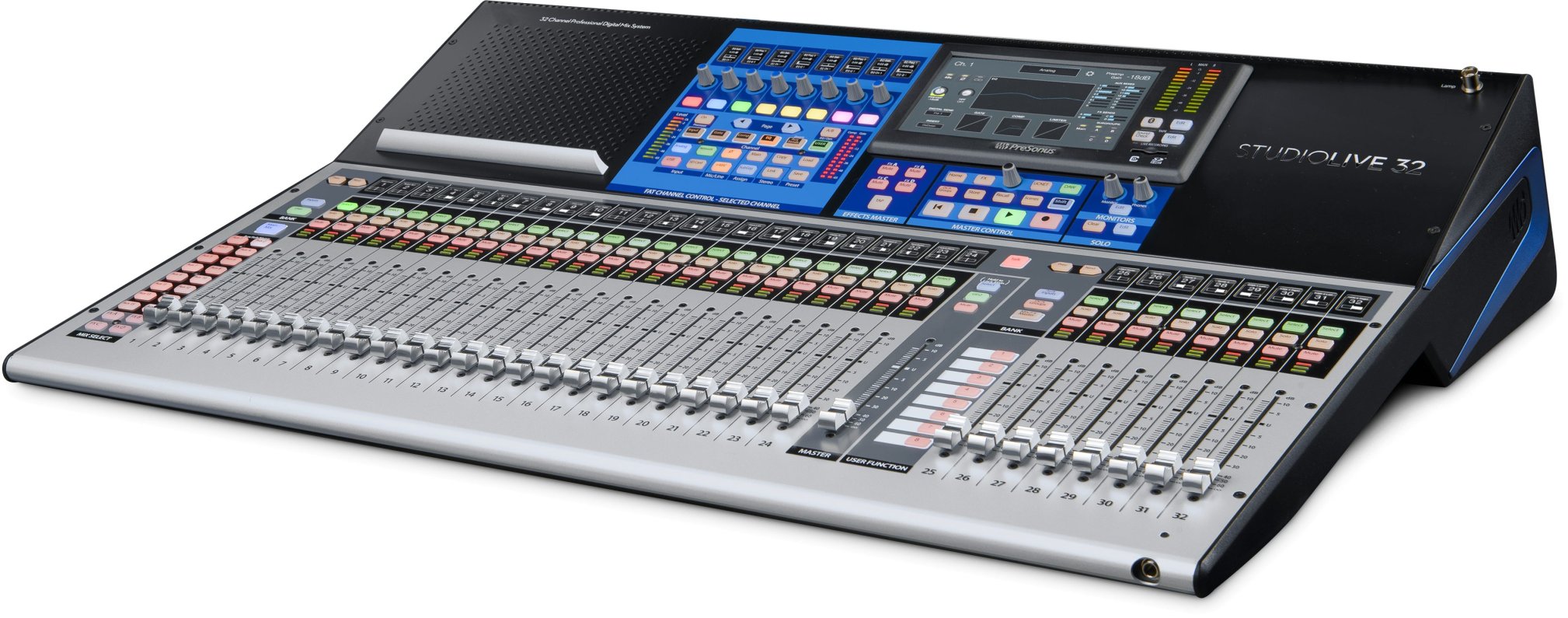
Same engine and converters but no physical control surface, only software control over USB or LAN. The main interface I was using before was a Black Lion Audio signature modded Digi002. I didn’t do a side by side comparison or anything but my initial impression was that it sounded a bit better but not enough to counteract how much more usable the Studiolive is. I did a simple loopback test with some white noise when I first got it because I thought it might have a but of a high end boost but the response was ruler flat up to about 19.5k and then there was actually maybe 0.2db of rollof, so what I was hearing as a high boost was probably just that the outputs are a lot hotter than the old interface and I hadn’t calibrated my monitors for that yet. I know it’s just sort of vague and buzzwordy, but the best way I can describe the difference between the two is that the modded 002 sounded more “analog.” the stuff I’ve recorded and mixed on the Studiolive since I got it sounds very accurate and detailed, nothing wrong with it but maybe a bit clinical. The 002 sounds a lot like tape (when you record to tape at a modest level so you DON’T get compression or saturation), in fact when I got it back in 2012 it was the first time I’d heard digital sound as good as (not the same as but as good as) a decent 1/4" recording.
Point is, IMO the Studiolive is a perfectly good interface (especially considering the amount of i/o for the price), more than good enough for a comparison like this. But I’m not selling the BLA 002 any time soon even though it’s retired for now; some day I’ll probably set it up in a rack with a DIY 8 channel summing box and my GSSL for stem mastering to tape.
FWIW JunkieXL is recording a lot of his stuff through a Studiolive 32r now (which I didn’t know when I got mine):

(it costs about half what he says; imagine being able to not know how much your gear even cost!)
1 Like
Jack of all trades - master of none.
Choose the right tool for the job.
1 Like
I’ve done both, at different points. For the last year, since the main production thing I was doing was on indefinite hold for covid, I’ve only been doing it for fun and that has been great. I was doing it part time for a few years , and full time for a few years before hat but when the company I was working for at that point was bought out and laid off everyone (a pretty routine thing unfortunately) I decided not to try to find more audio work for a while because it was making it hard for me to enjoy listening to or making music in my free time. While that job was going and for a year after it ended I couldn’t listen to music for pleasure at all, and that was awful (for most of the 2000s when I was working at record stores part time on the side and doing meta-analysis for a successful music-related startup, I would listen to about 10 albums a day back to back at least 5 days a week, but a couple years of full time editing and mastering I wasn’t listening to anything unless I was paid for it and to this day I still don’t listen to nearly as much as I did before).
I’ve done some other stuff in the last 20 years but nothing worth mentioning (all of the post audio and incidental music for an extremely bad low budget movie, got a music tech degree, and years of playing a lot of shows in regional underground bands that were at the “getting paid enough to break even” level).
So I guess “pro-am”? Or maybe more like “am-pro.” At this point I don’t think I want to do any more professional work unless it’s a specific project that I’m personally interested in (or when I inevitably get rich and famous doing goofy, mid-fi drone music full of 90s ROMpler sounds without compromise).
2 Likes
Good to know. I did the so-called “hi-fi mod” on the inputs so that it handles line levels/impedence more gracefully but I didn’t look at the outputs at all since nobody ever mentioned touching them; I assumed there was some kind of buffering going on since the sound on one set of outputs doesn’t change noticeably when you connect the other set.
1 Like
Good to know
My point is and I include myself rather than talking about the same topic over and over which is not adding any value, why don’t we just go and make amazing music
Ok the Octatrack does not sound like the DT - the OT has €1 converter, the OT has €50 converter so what?
If you are good you can make music with everything, it is not the tool that makes the difference.
2 Likes
I can’t speak for anyone else but it was almost 100 degrees in my apartment yesterday, and I didn’t want to turn on the desktop and make it even hotter so I ended up here.
Anyhow, I was skimming the thread before work and thought you were literally asking, hence the bio.
As a new owner of an OTMk2, I have been following this thread with some interest. I am glad it is continuing. The recent post by @darenager (about proper metering, recording levels and gain staging) is precisely why it interests me. With needing to know so much about the basic functionality of the OT just to start using it, I would not have known this. So, thank you for pointing it out. I also understand the frustration many here have voiced related to @NoiseLab and their continuing vague criticisms of the OT without really any evidence provided specifically about the OT’s sound quality.
As far as Elektron’s ideas, obviously, neither I nor anyone else “not in the room” during technical discussions and planning can only guess what they were thinking in deciding which converters, processors, and other infrastructure ideas guided them in the final product. I can say that they must have been doing something right if 14-15 years after its initial release, with little changes made other than cosmetic and UI, people like myself are still willing to put down $1,500 for a new one, and used ones are selling within 80% of the cost of new (which is why I bought new). So, one question is, if there are samplers with better sound quality “out of the box,” (at the risk of making a controversial statement, let’s say maybe MPC One/Live/X), why would people like me and many others still be willing to pay a premium for the OT? Because I know I can VERY EASILY achieve the sound quality I want by running whatever I create through a plethora of additional sound manipulation tools, and I expect I will have to do so from nearly all of my equipment, and based on what I know so far, once I become adequately familiar with the OT, I will want to use it either alongside the MPC One I own, or replace the MPC One because I am not thrilled using the MPC, but am thrilled using the OT.
I remember buying a very early Akai sampler back in the early 90s. I thought I needed it because ROMplers were few and mostly very expensive then. As digital-sample based synths became better and cheaper, I sold my Akai Sampler, because it was a hassle (for me) to use for what I wanted to do back then. Also, back then, using compressors, limiters, EQs outside of the box the sound was made in was very, very expensive (essentially cost prohibitive for a hobbyist like me). Now, I can get many of those same tools for pennies on the dollar from UAD, NI, Arturia, and even those built within my DAW (Logic). It is SO EASY now to get the sound I want. And here’s the thing, I want my sampler to give me very, very neutral sound, until I decide what I want to the sound to do, whether that’s running it through the “lo-fi” FX options within the OT, or send the signal without FX to my other gear, through my Strymon or Eventide HW processors, or my UAD Audio Interface processors, or my DAW processors. So, in that sense, this whole argument means very little these days. If it were 1994 and you really did need the OT to have “sparkle,” “wow,” “warmth,” or whatever you were looking for, right out of its Main Out channels, then yes, this would be important (which is why I spent the money on an Akai Sampler back then, and not a less expensive, less quality sampler.
Oh, and so, the reason I bought the OT, despite hearing previously questions about its “sound quality” out of the box. This: I am not able to find, right now, today, any other box that can do all of the things I want to be able to do with a sampler, that I can do with the OT, eventually. Yes, I can do them with Logic. But. I. Don’t. (do them with Logic), because it is not fun. I am already having a lot of fun, with the immersive ness of the OT, which is not a surprise, given my experiences with the A4 and M:S.
5 Likes
Anyway, my last word on this (other than revealing which clip is which in a few hours) is that while I’ve always heard a definite but not very serious sonic footprint from the OT’s converters and basic engine (i.e. without effects) that’s similar to and about as minor as the difference between dithered and undithered 16 bit audio, I think based on the stuff I did last night that most of what people are hearing is the volume drop. This isn’t even the first time I’ve done some kind of signal path test in the OT and it still surprised me that with the input and output levels set to maximum (which from what I’ve been ableto guess about the internal gain structure should be the cleanest way to get unity gain with a thru machine) there was still a bit of a drop. Basically, its gain structure tries very, very hard to enforce high headroom (which is a good thing, especially at 24 bit) but because, at least on the MKI, there isn’t actually a ton of makeup gain available at the end of the signal path the output tends to be on the low side. The only piece of gear I own that’s quieter than the Octatrack is the old JV-1080.
The good thing is the OT’s noise floor is low enough to be irrelevant, so you can just boost it with a preamp or in a DAW or with an Analog Heat or whatever.
5 Likes
In answer to an earlier question - If Elektron made new flagship sampler, would you buy it? - my answer would be no.
The OT I have now works fine for my needs. That’s why I didn’t by an OTMkII when it came out.
If I need to work with 96KHz or higher resolution samples I’d get the appropriate tool for the job.
I’m not very good brand loyalist either
How I work is about realizing ideas and I don’t want to be slave by tools that are limited or overwhelming to get the end result. It’s up to myself to be the creator and what is needed to make it happen.
Ps. Maybe there is a bit of misunderstanding by foley recording vs foley work. Because it’s more music concrete what I do.
To get the whole picture about my criticism of the OT.
1 Like


unclicking track
1 Like