Windows MIDI Services is the new MIDI API, Service, and SDK in Microsoft Windows. It’s delivered in two parts:
In-box MIDI Service and plugins, the new MIDI 2.0 kernel driver, plus backwards-compatibility support for WinMM and WinRT MIDI 1.0 APIs. You get this when you install Windows (Update 26H1)
An out-of-band shipped SDK Runtime and Tools package. You need to download and install this yourself.
Windows MIDI Services brings MIDI 2.0, multi-client (multiple apps using the same device) MIDI 1.0, app-to-app MIDI, faster USB transports, built-in loopback MIDI, and much more. The Runtime and tools enable applications to use this new API, and for you to be able to configure, customize, and troubleshoot your MIDI setup.
20 min presentation from NAMM
===================================
I’m starting this thread so all of us eagerly waiting for the rollout can discuss and support.
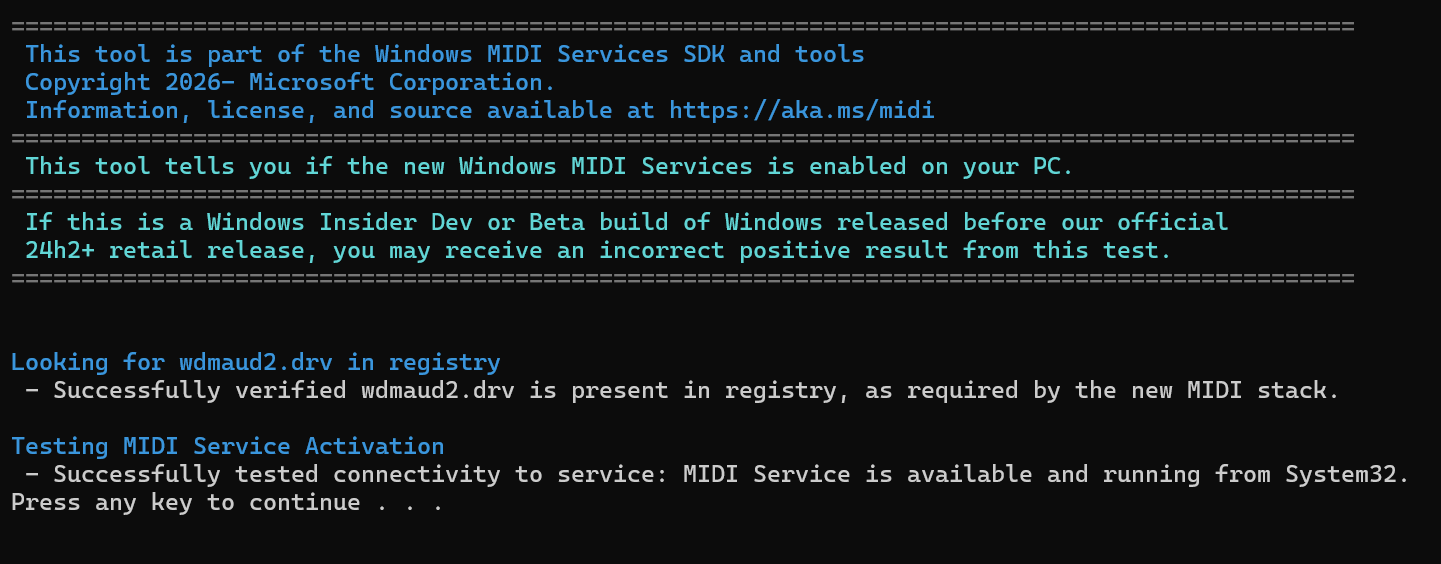
I’ve just installed the Release Preview, but somehow the enablement checker says, that I still don’t have it, so I’m confused. I will try to install the SDK and tools package now. Anyone else trying it out as early as possible?
EDIT: OK, here is explanation of my current roadblock:
There is no way for customers to force enablement of the Windows MIDI Services stack. Everyone who has installed the KB update will be enabled by the end of February as part of the phased rollout.
Also waiting for this one, but since Windows 11 recent updates are all messed up, i am kinda waiting for them to sort out their os.
There is a huge backlash from users regarding their push for ai and vibe coding making Windows questionable in current state.
Thanks- I have used AISO4All in the past that did something similar but it added latency and wasn’t as stable as my main driver (X32 desk), I’ll give this one a try. I did a quick AI check and got the following…
Yes, Windows audio aggregators for ASIO—such as ASIO4ALL, VB-Audio Matrix, or ASIO Link Pro—generally introduce additional latency compared to using a single, dedicated hardware ASIO driver.
While these tools are designed to work around Windows’ limitations by enabling multiple devices to be used simultaneously, they impose performance penalties.
Edit- slightly OT but this dropped today for Live, network aggregate? interesting…
Neat but I’m staying on Windows 10 IoT LTSC for the forseeable, and moving to Linux eventually. Microsoft have completely lost the plot with their operating systems.
Yes, you will have to accept double digit latency if you add windows audio devices into the mix. I am not sure if single digit latency is possible if you only use ASIO / VASIO devices.
I think the backlash against Win 11 is over blown.
The future will tell, hovewer at the present moment, there are no obvious negative warning signs popping up during regular usage.
And mod tools such as Windhawk are getting more and more mods as we speak, so we can customize and improve many aspects of the UX that actually affects our daily workflows.
Enteprise user here (no MS at home). It’s an absolute shitshow constantly with functionality breaking on every major update. Maybe it’s the TPM certificates, maybe it’s the user logon, you never know!
The issues are definitely not overblown.
You need WSUS (deprecated btw) just to make sure your users don’t get fucked by this vibe-coded OS.
Probably the most well known and most limiting problem this solves is changing previously exclusive MIDI ports (only one app can use a given port) to non-exclusive MIDI ports (all apps can use all ports at the same time).
This will greatly simplify the “virtual MIDI infrastructure” many of us had to build in order for MIDI to be able to flow across multiple apps running in parallel and / or from various physical MIDI controllers into multiple apps (m:n relationships).
In the hardware / DAWless terminology, every MIDI port hosted by Windows MIDI Services will be acting as MERGE / THRU box with infinite number of DIN sockets.
Every day I am happier that I moved to Mac 18 months ago. Switching on my PC these days is about as enjoyable as cleaning a blocked toilet, to the point that I will download Windows software on the mac and then move it via USB stick so I don’t have to turn on wifi in Windows and have it try to communicate with Microsoft HQ.
I don’t want to piss on the new features but what it says it’s gonna do vs what it actually does in practice can often be far apart. The idea that you can install an update but not be allowed to test it out until a time of MS’s choosing is just a giant ‘WTF no’ for me.
Does Windows 11 finally support MIDI BLE like Apple devices do? without having to install stupid hacks that may or may not work? It would be great if it does.
I noticed that Windows 11 currently cannot decide which built-in driver to use for attached USB-MIDI devices. The old one from 2006, the one updated late last year, or the one updated earlier this year. This, amongst other things, screws up the Port names in software like DAWs and editors.