Did you ever try the Hydrasynth (not the Explorer)? Is that different?
I’ve never tested one but I know someone that has. It did it much less than the explorer but it was still noticeable in recorded midi data.
OK, good to read about these issues - I still prefer Fatar keybeds over any other, but if a more affordable (price) product would satisfy my polyAT needs (and the haptic feeling), then I would give it a try.
I’m used to play a Fatar TP/8S modified by GEM with polyAT since mid nineties and it’s gorgeous!!! (Modified by GEM = it’s the one installed in GEM S2/S3 music workstations).
That’s what I thought the explorer would be but it just wasn’t good enough. But maybe it’s been fixed.
Sounds like there’s a new option for a polyAT keyboard — the Rhodes midi mk8! Not exactly a budget option, but pretty!
2 Likes
Wow. I was wondering when they’d add proper midi to it. So tempted, even more so if I had the money or space.
Sequential Fourm
Said to be a new design, in a “Slim” size.
Will Novation inherit this too ? It would be nice in a controller from them. They need something to compete with the Korg Keystage.
1 Like
This poly-at keybed designed by Sequential will be used in another keyboard synth as well besides the Fourm !
From this article in CDM. ( Thanks to cutlery for linking this article over in the Fourm thread. ) :
Oh, and by the way, if you’re hungry for more poly-aftertouch keyboards, you heard it here first from Sequential’s CEO: “We’ve already started the design of another instrument that will use the same keyboard, because we feel like this is something to invest in and keep moving forward with.”

Photo of the keyboard mechanism in the Fourm
The article also relates how closely they had to tune in the outputs of the p-at keybed into the control electronics of the analog synth. ( In the digital Hydrasynth adjustment of the modulation matrix is left to the patch maker. )
ADDED : I am interested to see how well the Fourm can perform as a controller. That is something the Hydrasynths do well. It is a challenge to design both together.
5 Likes
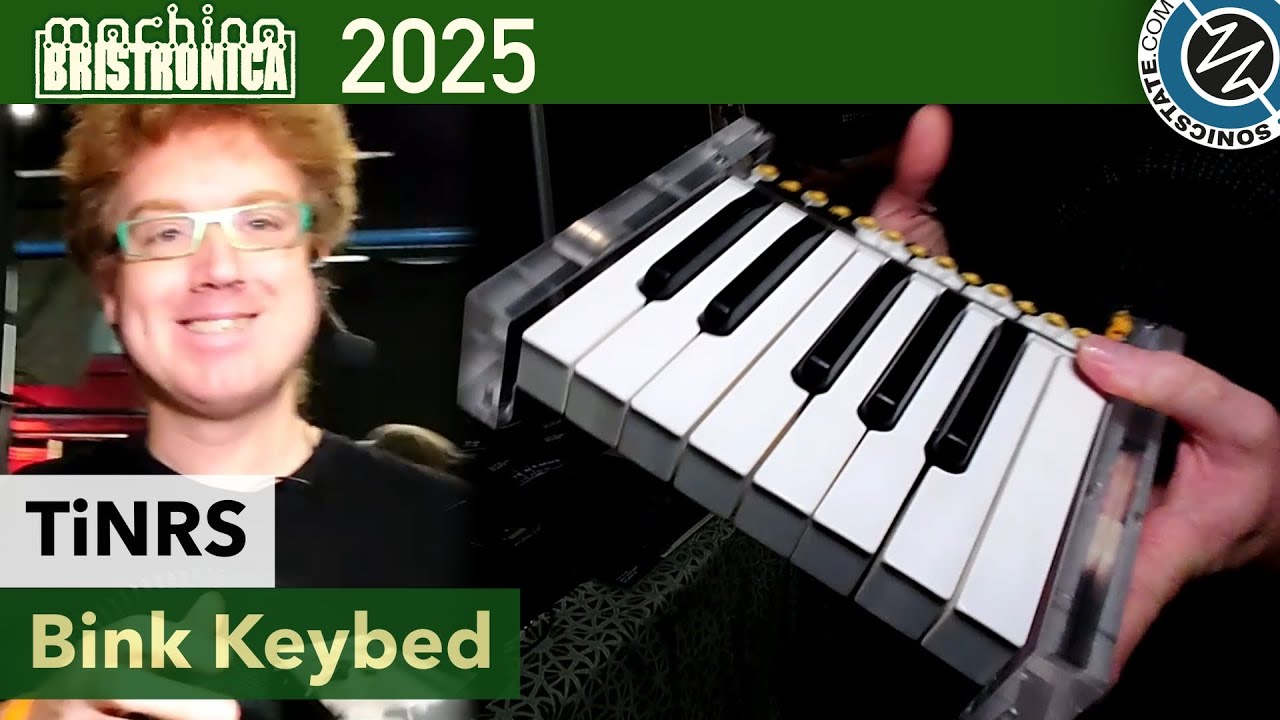
New premium synthesizer keybed with poly aftertouch, physically adjustable aftertouch tension, better weight calibration than concert piano standards… 200 EUR B2B wholesale price for 4 octave keybed
5 Likes
Yamaha Electone ELS-03
In addition to polyphonic aftertouch, the ELS-03X models have Horizontal Touch, which allows pitch manipulation by lateral movement of a key.
OT to this thread but the vocal harmonizer is pretty capable too
Correct me if I’m wrong, but I think only the pads have PolyAT. Not the keys.
2 Likes
good catch! I think some people will buy it anyway.
Deleted the post because it’s OT
1 Like
I only had a hunch because I bought the 61 key version without doing my research and found out it didn’t even have mono AT.
1 Like
Given the leak in May 2026 ( it was listed in their catalog ) i think the PK61 can be considered Gear In Progress now.
The addition of a ribbon to the design is new now. There is supposed to be a pretty generous range of controls too. We’ll see if this happens anytime soon, as well as being anywhere near their original target price of $200.
1 Like
I noticed that Tempera didn’t send value 0 for polyAt after note off, and that it was even sending a few polyAt values (key pressure). Consequence, when playing a new note on, last polyAt value is applied, then it restarts from 0.
I checked Hydrasynth Explorer : it sends polyAt value 0 just before note off, and no polyAt after.
Does anybody know about official midi recommendations in that concern ?
My understanding is that the original MIDI spec is quite vague on many points, but my reading of the MIDI MPE spec is that NOTE OFF messages are required.
You can dig in to the spec here:
Thanks but I search spec for regular key pressure, not MPE. Even if it is the same principle !
Here it is pretty vague…
It is the link given for that google AI result :
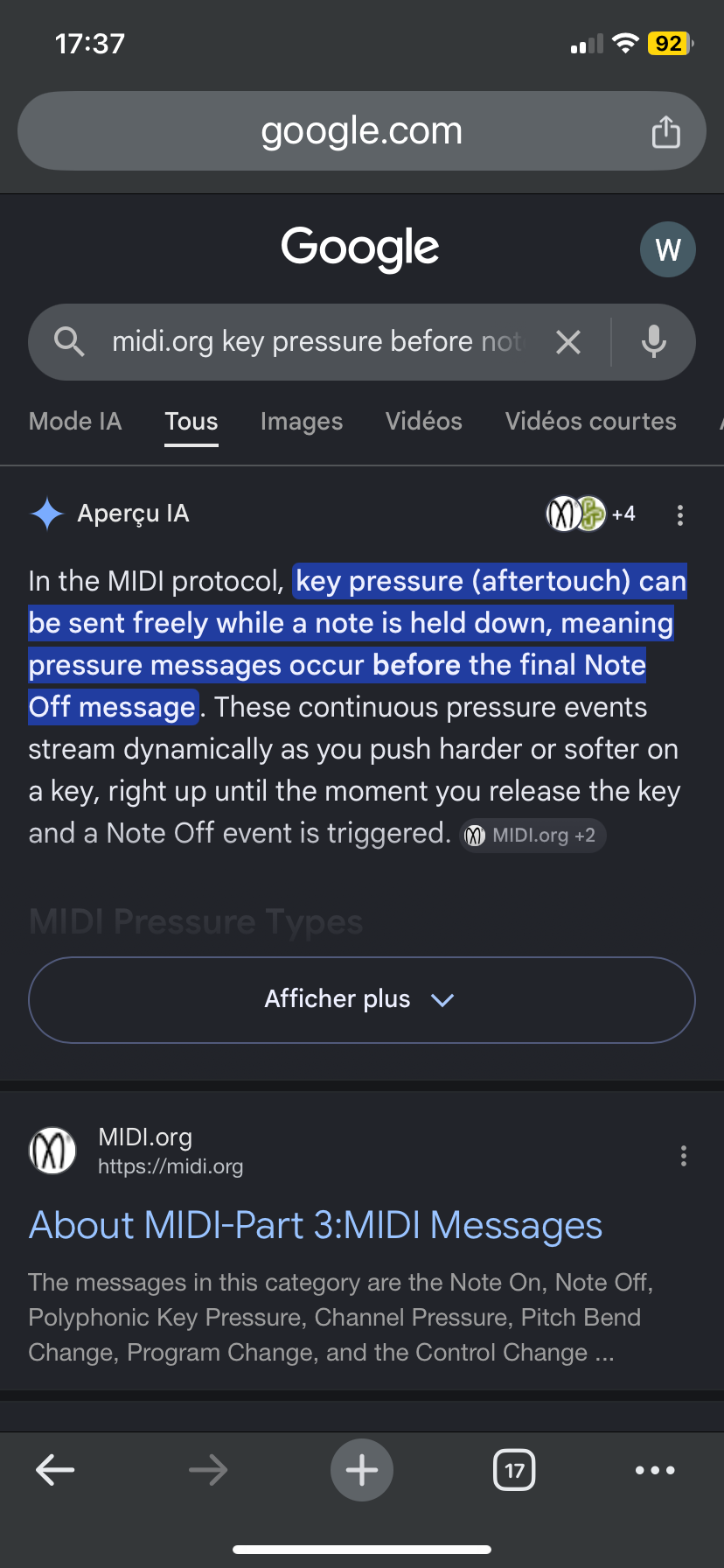
I can’t find that particular info for polyAt concerning last At value . I don’t want an AI sum up…
You may find these pertinent:
3.3.4 Channel Pressure
Many synthesizers are designed for use with controllers that set Channel Pressure to zero before the termination of a note. For full compatibility with these, and to simplify sound design on MPE-compatible synthesizers, Channel Pressure must be set to zero immediately before a Note On or a Note Off wherever it is appropriate to the design of a controller.Not all controllers can be expected to behave in this way. In the simulation of certain hand drums, for
example, pressure applied to the drum skin is adjustable independently from the note creation mechanism.
In MPE, Channel Pressure and all other per-note control messages work this way too. Values for all these must be tracked and stored on all Member Channels, even when no note is playing, to provide an initial state for a new note.
The prevention of per-note control after Note Off allows rapid reuse of unoccupied Channels, and applies even to notes that are kept active by a Damper Pedal message or a long release envelope.
It is. Ideally I’d want something specific to polyAt / key pressure…(about key pressure value 0 before note off like Hydrasynth.)
I actually use it as an MPE controller with channel aftertouch, but using an RK002 cable that dispatched notes to different midi channels and map key pressure to channel pressure. Works really well, but without this polyAt reset I get artifacts that can make it unusable with certain patches…
(8 octaves, minor scale, capacitive, fixed velocity 127, polyAt)
1 Like
I may have misunderstood the issue (MPE key pressure effectively being per-note channel pressure). I don’t have access to an Explorer for the specifics. My HSK is at our band facility now, but I can run a few tests through a MIDI Monitor in the near future.
1 Like