If you ever point an LFO at amp vol, remember that you’ve done it this way though. Sometimes I modulate hi hat’s by doing that.
Good point ! I’ll try to not forget it
pain in the ass
I couldn’t have said it better ^^
I wish the Digitakt mute trigs would actually mute the sound (that’s what muting means right?) and not only the notes coming from the sequencer. Honestly, that looks like that feature was not thought off much.
Any time I have a longer sample, if you mute the track internally, it won’t cut out, instead it plays the length of the sample in either it’s entirety or dies out slowly. The only way I’ve resolved this is slicing the longer samples and assigning them to consecutive trigs.
If that’s the problem you’re having I think that has to do with the envelope of the samples, or just how the sampler handles longer samples. That may be what I wasn’t understanding about the original problem, but it does explain why cutting the volume works for you.
what I mean is to take like for example a sample that usually lasts 16 steps and then slice it into 16 parts (with slice machine) and use the function which allows you to lay those on 1-16 consecutively, then each section ends at the length of 1 trig so when you press mute, it won’t trigger the next slice.
This is, as I understand it, because these are samples (even when pitched chromatically) and not notes as they would be from a synthesizer. Just to say that it’s an expected behavior.
So just as an example (because audio tracks play samples) are these drum sounds or what kind of sample sounds are you talking about? Triggering an audio track plays the sample, and the sample itself has a fixed length which you are either playing in it’s entirety or you set a start point and an end point in the trig menu, correct?
You can choke a sample by starting another sample (because there’s no polyphony) but you can’t stop a sample (mute it) once it’s playing without having the envelope be very short and expire or having it die out as it will do when you have a long sample on an audio track like I was mentioning before, it will slowly decay. It was always explained to me that this is just the behavior of long samples, but even with short samples unless you choke it, it plays the sample to completion as it’s the behavior of the sampler to do so.
But in that sense, you could hypothetically choke it with another silent sample even if it’s very very short, or like you’re doing you can turn the volume off, but turning it off doesn’t stop it from playing, it just makes it inaudible.
I think a good test would be to use a sequenced drum track, like a snare or a hi hat (as opposed to a drum loop) and try it the way you were originally. The samples should be shorter and muting would then kill it almost immediately. It doesn’t help what you wanted to do originally, but it just demonstrates the phenomena.
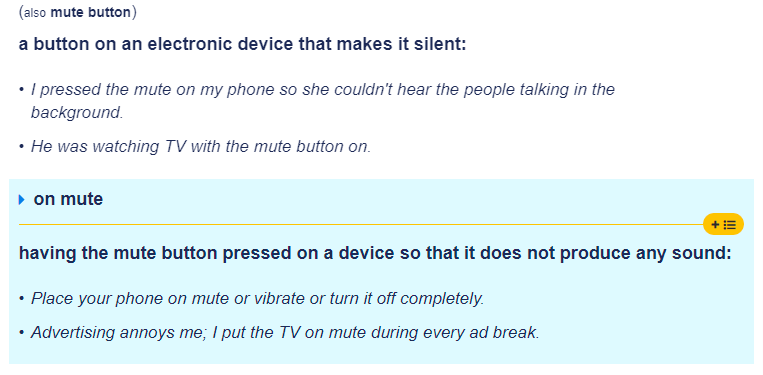
Clearly Elektron definition of ‘mute’ differs form the Cambridge dictionary definition since there are several cases where a muted track still produces sound
mute is indeed a word which may inaccurately describe the behavior, as it’s not a volume drop as it is in the typical application. I agree with that, but if you try it with a sequenced hat sound or something short like that, you’ll see what I was talking about in my prior post’s amendment.
I don’t know what you’d call it that fits on a single button if not mute though? perhaps cease? sounds more confusing still lol
typically, the mute that we’re referring to when we say mute in the colloquial is more accurately described as attenuation, hence the ATT button on a stereo. I think mute is sort of misappropriated in the english language as it means unable to produce sound, so to mute something isn’t it’s original intent, it’s adopted to mean quickly silence. Regardless, the elektron description could be reassigned something like “silence as quickly as circumstances allow” when doesn’t really fit the immediate silence that we associate with the word (in the case of samplers only, elektron mute works as expected on synthesizers).
somehow, I think common needs are not always taken into account when designing new products. lots of advanced features and innovative interfaces which at times neglect a small thing that could make a world of difference. for everything else offered it’s a trade-off I’m willing to accept but given the choice, I’d want this feature.