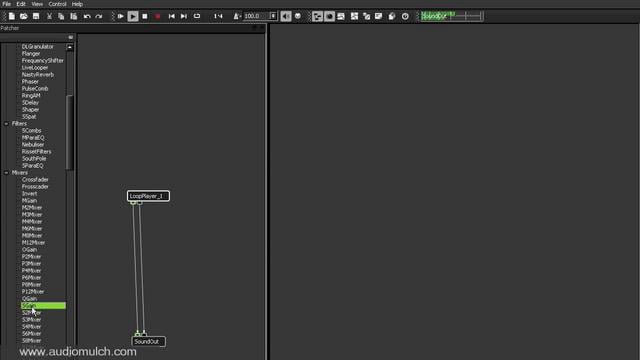
My first DAW was Synapse Audio Orion, which I liked because it mimicked Roland TR and SH hardware. Then I started to hear about Audio Mulch – which allegedly had some users in the Mille Plateau ‘clicks & cuts’ musicians. http://www.audiomulch.com/
Still available, but without an update since 2016, AudioMulch concentrated on processing audio, by connecting together a series of contraptions. The granular processors were a highlight, plus the ability to do recursive patching (loopbacks). It lacked conventional midi processing or sequencing and was a great digital audio playground. It was similar to having a collection of effect pedals that you could connect together, which in made it a kind of modular DAW.
It was even possible to do live sets with it, by making loops that could be loaded on the fly, then mixed, layered and processed (pre dating Ableton). It was a lot more fun than the more conventional linear sequencers.
So…time has moved on, I can’t remember my licence for AudioMulch and think there may be alternatives out there.
What’s your experience of modular DAWs? What have you enjoyed? What have you used them for?
For once in my life, it’s not all about me, but these vague requests can be frustrating, so it would be interesting to hear about experiences of using modular daws to layer, record and process audio including syncing to hardware.
The closest thing to a modular DAW I’ve been using is Bitwig. I’m really impressed by how easy they’ve made it to modulate everything. For me it really opens up new ways of working, like being able to build my modulation sequences directly into my patches; this results in much cleaner arrangements, since I’m not having to mess around with as many automation or modulation lanes. (I mean yeah you can sort of do this stuff in Ableton but it’s soo much clunkier.)
And then of course there’s “The Grid”, their modular sound design environment. I haven’t played around with this much but I’ve seen people do some pretty crazy stuff with it, including some wild generative patches.
In a similar vein, while it’s not a DAW, Phase Plant is the closest thing I’ve seen to the “Bitwig approach” in synth form: you can build pretty much anything imaginable in a single patch, effects and all. And then Snap Heap brings this same approach to effects/processing.
i remember audiomulch, lucky enough to be shown it in 2000. would love to find that CDR of audio mulch projects i burnt.
first exposure to granular synthesis! i remember its bubble blower being really fun for timestretching.
it’s funny how these small independent programs had such a big impact, but probably most of us didn’t even notice.
Oh yeah. It was my main “daw” in 2000’s until its development stopped due to source code loss. The community was active for some time and there were even compatible clones like Buzé. It was not just a modular tracker, it even had support for audio feedback loops and VST. But the huge problem was stability and compatibility, clones did not support the plugins (machines) fully and it was common for the app to crash randomly.
I miss that kind of experience to quickly throw multiple plugins and create unique chains. On the other hand, the quality of blocks was very different and it was easy to create a mess that would be impossible to mix properly for a release…
The granular devices in Buzz were actually very cool and I struggled to find alternatives.
But the very first time I heard MI Clouds I was positively shocked: one of the algorithms was sounding very close (something to do with feedback of grains)
I use Drambo on my iPad as a modular “DAW” in a hybrid setup. Its extremely powerful and with a bit of creativity you can customize it to your needs.
In my case, I’m using an external sequencer (Hapax) so Drambo mostly functions as a modular environment and plugin host. If you sequence Drambo externally, you can then use some new Drambo functionality to host all instruments for a live set / album in one Drambo project and then switch between instruments with program changes messages. Drambo can be set now to only use CPU for the active instruments, but you can have all the plugins “open” so you aren’t clicking through menus to load different tracks during a set.
This is all kind of a ramble of my specific use case, but I think iOS can be a powerful space for this. miRack on iOS is also very powerful. AUv3s + modular is very rewarding. It doesn’t hurt that plugins on iOS are a ton cheaper than a pc.
And now you’ve seen a third. I loved Orion - it was a terrific environment for electronic music production. Easy to use and the built-in instruments were quite good. I’ve known quite a lot of people that used it when it was still around - mostly 'industrial/EBM" musicians (and one Berlin Schooler).
Yes, Orion was conceptually the same as Fruity Loops (neither were 'modular DAWs). I think the developer, Richard also did some work for Fruity Loops. After the success of Dune (which he developed) and competitors like Reason Orion faded yet further into obscurity. I did like it’s way of working - each machine had a sereies of sequencer patterns, none unlike today’s Elektrons.
I had wondered if Bitwig might be the modern equivalent. To AudioMulch (and then some…) The grid is quite appealing - but does look quite low level, like Reaktor, linking together basic building blocks like oscillator . Can you incoporate higher level components too?
Yes, I know - it’s a bit woolly. So it’s a digital audio workstation in the widest meaning of the term - it’s an environment where you can process audio. Unlike say, Cubase which which is a little bit like choosing what synth, audio, plug-in goes in what slot, in a modular environment you can connect stuff together however you choose
As a longtime Kyma user, I’ve not really explored the alternatives lately. I used to write about this stuff for a living, so had many opportunities to check a lot of them out. Mostof these can be seen less as modular DAWs and more as graphical programming environments. Many are long gone now, but I remember liking Bidule:
I also liked the previously mentioned Buzz.
Audulus was pretty quick.
If you have an old Mac, SonicBirth was free and kinda cool, allowing its various things to be exported as AU plugins.
Most of these sorts of applications were designed for modular synthesis and processing, less for DAW-like behavior, but some offered audio recording and playback combined with modular processing.
Yeah it is admittedly quite low level. Part of the reason I haven’t delved into The Grid much is because the rest of the DAW is so modular, and there are more than enough building blocks to do everything I’ve wanted to do using just the stock devices and modulation workflow.
What’s especially nice is that you can mix and match: The Grid itself is just another device, and you can place it inline between stock devices. So for example, if you’re 90% of the way way there, but you need to do something very specialized, you can just drop in a Grid device (synth, FX, or MIDI) next to your other devices and then save it all together in one composite instrument.
Some really clever stuff, had a very active community around it. Weird story though, a promised huge v2.0 was a complete re-write but had tons of problems and missed lots of what users loved about the last version. The dev did a deal with Behringer at some point and they bundled it with interfaces, then I think he more or less lost interest or moved on to other things.