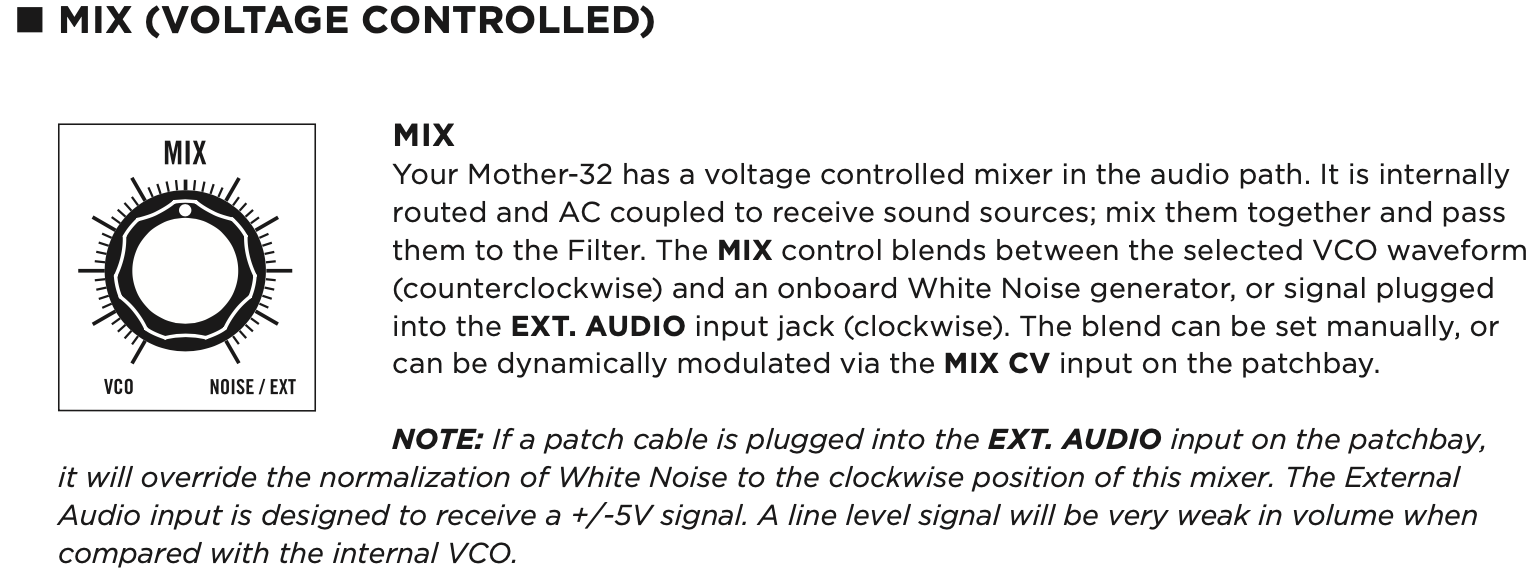
I was hoping to feed my Moog Mother 32 some new oscillator shapes from my Behringer Model D.
I tried connecting the Model D’s mixer (pre-filter) output to the Mother 32’s Ext. Audio input, but the signal is practically inaudible. The Mother 32 wants a +/-5V signal. I couldn’t find the spec on the Model D’s mix output, but I suspect it’s a line level signal.
Does anyone know of any economical solutions?
Note: I must have been doing something wrong for the signal to be barely audible. Perhaps I had the oscillator set to triangle. I may have also been using the main output rather than the mix output on the first attempt.
I don’t know about the specs but there are 4 outputs on the model d. On the front phones & main out and the rear high & low. I figure one of them should work
That would be for modulating the MIX knob via the patch point. If you set the Mix knob to 12 o’clock, you can modulate the full range of the knob with a +/-5V CV signal.
As for the low level, the MIX input is looking for euro rack levels and you are likely feeding it Line level from the Model D. Look at the Model D manual to see which patch point gives you output at euro rack level. It is likely one on the front panel and not off of the back of the unit.
Edit: Model D manual states the ‘Main’ audio output on the front panel is 0dBu as is the ‘High’ output from the back. I would use the ‘Main’ output from the front panel.
@Portray The main output works for me, but it’s a weaker signal, which makes sense. Presumably the headphone signal doesn’t work because it’s stereo.
I just tried the BMD’s mixer (pre-filter) output again, and the signal strength isn’t nearly as bad as I thought. It’s just quite variable depending on the number of oscillators switched on and what shape they’re set to. I suppose it makes sense than a one-oscillator design would be louder than a three-oscillator design with two switched off.
With all three oscillators set to square waves at full volume, the BMD is ~2 dBu weaker than the M32. The overload circuit can boost the signal a bit, too, though obviously it changes the timbre.
I just wish it was a little more on tap, as it would be easy enough to attenuate, but quite tricky to boost without more gear.
@echoicMalady everything you need to know is in this section of the manual above.
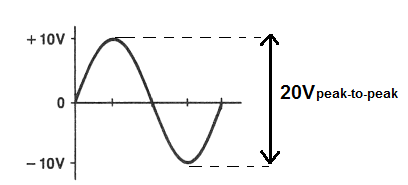
RE: External Audio Input - "Because this is a unity gain input designed to Eurorack level standards, an external audio source applied to this input should be 10V peak to peak.
RE: MIX CV Input - “With the MIX control at center position, a -5V to +5V CV applied to this input will crossfade between the selected VCO waveform and the EXT. AUDIO input”
The NOTE section of the manual page you posted seems to be poorly worded.
The short of it is that euro rack levels are much hotter than line. The input expects euro rack levels. The ‘Main’ on the BMD front panel or ‘High’ output on the back should be hot enough. If not, some type of amplification is needed.
The delta is 10V to be sure but I believe the answer has to do with polarity. I’m a euro rack neophyte myself so I “mostly” know what to feed into what at what levels.
10V peak to peak I believe is unipolar where +/-5V is bipolar. How this applies to an audio input is outside of my domain to speak to. I’m sure others will chime in with a more detailed response.