Eletron made the analog keys with 12 keys in an ovtave
2 Likes
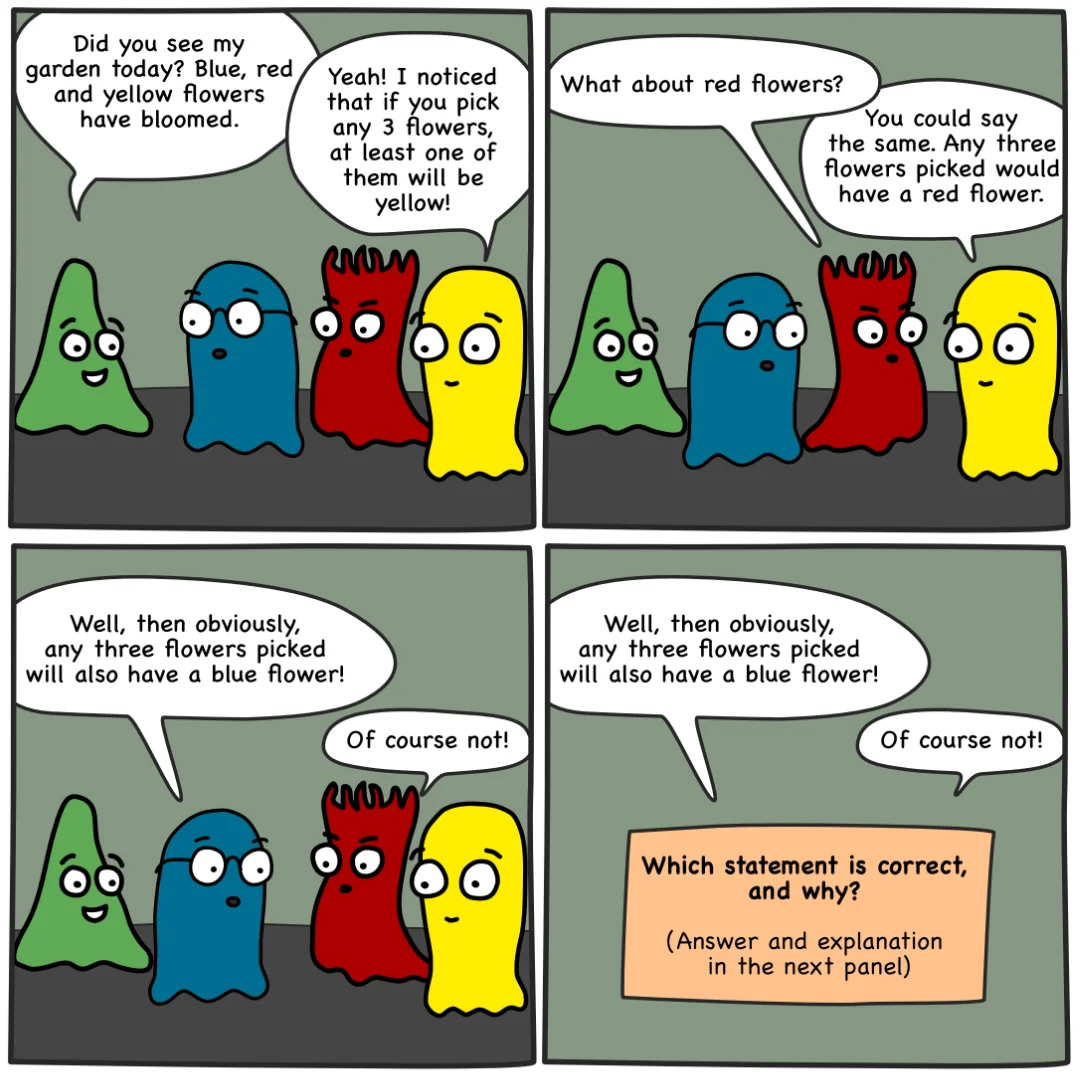
(this puzzle was initially posted in text. there’s no hints or trickery in the drawings. the fact they are the same color of the flowers has nothing to do with the puzzle.)
Well i know the intended answer, but in my garden the intended answer would be wrong.
By compromise, given that our hands have a total of 10 fingers.
While singers can sing an infinite amount of tones in an octave, one can approximate 1200 different tones with equal-tempered tuning in an octave. The real limitation comes from fixed-pitched instruments, which are often tuneable but allow for only a few playable tones at a time.
Finally, our ears are forgiving on the many nuances of tones generated by stacking up major thirds (just intonation), due to their complexity, so that generating 12 tones by equal-tempered tuning seems good enough for many purposes, despite being wrong in every way.
12 is divisible by 2,3,4,6. that’s a lot of harmonic potential!
1 Like
A nice side benefit that happens to result from a more basic reason.
Octave (2:1)
Perfect fifth (3:2)
Perfect fourth (4:3)
1 Like
Those make some nice assumptions.
So far we have :
Given :
Frequency ratio multiples of 2 and 1.5 sound good.
Create …
4 and 6 have no benefit harmonically, for they are covered by 2, 3 and 5 - unless you are referring to the number of notes to stack for generating chords.
Summary
2025 is the product of two perfect squares, 25 and 81.
1936 = 121 x 16
2116 = 529 x 4
Do you mean the digits in the lowest place value (the ones and tens)? Not sure what sequence I’m supposed to be looking at
2 Likes
Very interesting
And yes this is true, and for a reason.
What i was digging for was :
1936 = 44 ^ 2
2025 = 45 ^ 2
2116 = 46 ^ 2
But you quite cunningly have found another similarity to these three numbers !
Now because, 44, 45 and 46 happen to not be prime you can refactor them as you have.
Prime factors :
1936 = 2 x 2 x 2 x 2 x 11 x 11
2025 = 3 x 3 x 3 x 3 x 5 x 5
2116 = 2 x 2 x 23 x 23
As it turns out 43 and 47 are both prime, so adding those to the series now ends this trend.
43 ^ 2 = 1849
47 ^ 2 = 2209
So the years with perfect squares we have so far :
… , 1849, 1936, 2025, 2116, 2209, …
Which takes us to the Part B question. Notice the lowest two digits of these numbers. What’s special about them ? But you notice the direction they are going. You can go forward and back in this series, and you can see this “coincidence” continues. Why ? ( And it’s not a coincidence. )
2 Likes
What about augmented chords, and the three notes with the tritone. In a major scale in C the F and B are sitting right there devilishly.
ADDED : And the tritone is central to the dominant 7th chord sound.
Ah, nice … because every perfect square that is not the square of a prime number can be written as the product of two smaller square
Part B
Thanks for the clarity! I’ll take at a shot at it.
We have the perfect squares of our single digits, but seemingly decreasing.
A maybe first thing to note is that the ones digit of consecutive perfect squares follows the pattern
1, 4, 9, 6, 5, 6, 9, 4, 1, 0
Which we note that the, besides the 0, is symmetric. So it is, in some ways, a coincidence that we see the perfect squares decreasing.
Let’s dig deeper thinking about modular arithmetic.
First note that: (n+1)^2 - n^2 = n^2 - (n-1)^2 + 2
i.e.
1^2 + 3 = 2^2
2^2 + 5 = 3^3 …
8^2 + 17 = 9^2
9^2 + 19 = 10^2
starting at 40, we see that
40^2 + 81 = 41^2
41 ^2 + 83 = 43^2
Since we’re just looking at that two digits, we’re talking about equality over mod 100. Some equal operations under mod 100 are, for example
-19 = +81
-17 = +83
So we have, equality mod 100
40^2 = 1600 = 100 = 10^2
41^2 = 1681 = 81 = 9^2
TL;DR: perfect squares exhibit a symmetry mod 100. In fact
n^2 = (50-n)^2 mod 100 (for n < 50)
1 Like
Are we talking single tones or chords? I was referring to the harmonic relevance of prime numbers in just intonation. In this context, 4 and 6 are out.
Chords move by 3rds (including 6ths), 5ths (including 4ths) and 2nds (including 7ths). Movements by descending 5ths from a major chord to any major or minor provides resolution. This includes the use of the V(7) chord, which naturally pulls to I.
You got it
Indeed. This as you notice has everything to do with our number base. Base 10, 10^2 is 100, and since you added the cross products together, that means at half way, at 100 / 2 this is going to occur. Also notice that above the year 2500, those two digits go upward again. 2500, 2601, 2704, 2809, …
Indeed it does repeat entirely because it starts with a zero, 0 x 0. Same reason ( 5 - n ) ( 5 - n ) up to 25, and then ( 5 + n ) ( 5 + n ).
So in other number bases, the value of the perfect squares are always the same, it’s the digits that represent them that are different, and so these crossover points will be different.
Base 10 also does something with the ( 500 - n ), and so on.
When i discovered this I realized because of these patterns how much easier it is to memorized the perfect squares, a little farther up, not that it matters.
At one point in my life i was able to do dozenal ( base 12 ) arithmetic in my head, and it actually has uses in addition for musical problems, but i never found much use for multiplication base twelve. But given this other problem i’ve posed above it may, i need to think about it
ADDED : Another interesting thing about the perfect squares, you can calculate the next one just by adding the next odd number. There is a algebraic reason for this too, which i will leave for those interested to work out for themselves. So 9 + 7 = 16, 16 + 9 = 25, 25 + 11 = 36, … forever.
There are other tricks on the multiplication table with additions and subtractions, but enough already with this post.
1 Like
I like doing this sort of thing. It makes me think, and helps me see things.
It just struck me, and i think i know now how to completely learn the Tonnetz system and get it into my fingers. I struggle for a year now snd pretty much gave up, but now i see a way. ( The guy in the last video in that thread ( ADDED : Will Daniels ), is totally fluent moving among the Tonnetz, standard notation, and fingers on keyboard ). I think I can get there too now, though it will probably take six months or so of practice to get there.
January 2025 – Day One.
1 Like
Easy to think about geometrically  I’ll have to sit down with it algebraically, number theory is not really my strong suit
Thoughts
Is it because the circle of fifths comes around after 12 steps?
Mathematically, because 12 is the first power of 1.5 that’s pretty close to a power of 2?
A great 3B1B video where he talks about how dividing the octave into 12 gives us intervals that are “close enough” to the simple integer frequencies that are pleasing to the ear
https://www.youtube.com/watch?v=cyW5z-M2yzw
(I love measure theory / analysis)
3 Likes
Yes you've got it.
So now that we have listed our the assumptions, we can go ahead and compare the data.
Given :
Frequency ratio multiples of 2 and 1.5 sound good.
Create a way to compare a series of successive values for the two ratio progressions looking for the first place where they become equal or get very close to equal.
Find the values of each.
The way i solved this was with a Python program that make successive calculations and comparisons. You multiply the ratio for each step along the progression.
So the perfect fifth has values along – ( 1.5 ^ n ) for each successive value of n, and the octave goes along ( 2.0 ^ m ) for valuss of m. The octave values are then the powers of two, 1, 2, 4, 8, 16, 32, …
I am on a cell phone at the moment so can’t easily format the data for display on this forum, but indeed as you expect at the twelfth iteration on the perfect fifth ( 1.5 ^ 12 ) gives :
129.746337890625
And 128.0 for the octave.
That’s seven octaves up, and twelve steps around the fifths. ( 1.5 ^ 12 ) = 129.746337890625. This is not exactly equal, but, this is very close. Close enough and that’s why twelve works well for these preset conditions
One way get then to fit exactly is to adjust the fifth to be slightly less so it is not the perfect ratio of 3:2, and thus creating 12 equal temperament notes.
Setting the ratio of the fifth to ( 2 ^ ( 1 / 12 ) ) ^ 7 = 1.49830707688 ( you can see this is close to 1.5 ) and making the calculations for all twelve notes in the scale makes the octave then come out perfect at this final step.
You also get to look at values of the major and minor thirds, and see how close they get to pure integral ratios, and either adjust them to not have equal intervals, and tune to a key in various ways, Fortunately as has been said above already, our ears make an adjustment if things are close, as they are with the equal temperament tuning.
This is a pretty brute force approach, but a strength of this approach is you can easily change your assumptions and rerun the program and create other systems and tunings. You don’t have to hold to the assumptions realtive octaves and fifths, but could choose other intervals and rerun the calculations.
This is a long explanation, and i’m sure not as carefully stated as it could be, but that’s the basic idea.
I expect to post the Python program in a couple of days, and make it available for experimentation. It’s pretty roughed in, but does the basics.
1 Like
I am going to try listing the program, but I think the forum software will mess with the leading spaces which is part of the syntax in Python. ( Yeah i can see in the preview it strips the leading spaces, so it won’t run as shown here. ) This program was run on online-python.com and the output such as it is, was compared by hand.
r1 = 2.0 # perfect octave, but any value
r2 = 3.0 / 2.0 # perfect fifth, but any value
r1_ct = 0
for r2_ct in range ( 65 ):
f = r2 ** r2_ct
if ( f > (r1 ** r1_ct)) :
print ( r1 ** r1_ct)
r1_ct += 1
print ( " ", r2_ct, f )
I changed the initial value of r2 to 7.0 / 6.0 and ran the program again which gave a very good completion with a nine note scale.
7.0 / 6.0 is a integral ratio note interval not well represented on a standard 12 tone equal temperament scale. Of course this alternate tuning sacrifices other intervals.
1 Like
That’s the whole thing right there.
1 Like