Let's design a fantasy groovebox together?

Is anyone willing to exercise their imagination a bit?

A little bit of context first: if there are any people here who dabbled with game development at any point - they might have heard about the Pico-8 - it’s a software emulator for a gaming console that… never existed! Games are distributed as virtual cartridges. It’s also a simple end-to-end development environment to create games and produce those cartridges so that others can “insert” them into the “console” and play. The whole point of it is that it has a limited amount of colors, lines of code, and sounds - the kind of limitations that unlock creativity and help to overcome the paralysis caused by unlimited possibilities.

And so I thought today: what if a fantasy groovebox like that existed?

Limited enough so that you don’t get lost in endless sound design and four-bar loops, but with enough functionality to produce listenable music. Something that is much less than a standard DAW with default plugins but much more than a chiptune tracker.

How would it look like? How would it sound like? Maybe if we dream it up, someone will eventually create it? (I am software engineer myself, but currently too busy for such an endeavor).

The closest thing I’ve found is Fors Opal - but its dependance on Ableton and more of rhythmical/drum nature - is not exactly what I have in mind. Also, its price is definitely not toy-like at €59.

So let’s try to imagine that fantasy groovebox together. Let me start:

  • A standalone desktop app
  • It could be MIDI controlled, but its design would be very biased towards the QWERTY keyabord.
  • In terms of the sonic palette it could be somewhere closer to what Model:Cycles or some Volcas are - limited but still very capable.
  • It would be sequencer-based (like Fors Opal) with ideas borrowed from Elektron: p-locks, glides/nudges/triggers, etc.
  • Like Model:Cycles, it would have a couple of engines - one per sound type: melodic, percussion, bass, etc. Should they be traditional subtractive synth? Simple 2 or 3 operator FM? I dunno.
  • It would output virtual “cassettes” which can be only played by its corresponding music player (maybe the same app but in the “player” mode). The player would be also web-based so that cassettes can be loaded into it and listened online by anyone. These cassettes would contain the project data so when loaded in the groovebox app - they can be freely explored and learned from. Output to traditional audio formats like .wav would be possible, too.

What else? What kind of design would be the most comfortable to emulate the groovebox-iness, with the knobs, and a screen while controllable by a QWERTY keyboard? Which basic sound design capabilities would it have?

6 Likes

I’m thinking made from wood and comes with four to six strings! That would be super dope dude!

12 Likes

And the point of this joke is?.. :grinning:

I liked the idea of this thread when I read the title, but in reading your post, realized the title should be: “Let’s design a fantasy VST (or virtual) groove box together?” Had I read that title, I would not have clicked on the thread. I am at my cabin. I have two “groove boxes” with me. An OP-XY and a Linnstrument (for use with my laptop. I am thinking of my MPCOne, my Ableton Move, my Standalone Push 3, my Polyend Play+ and Polyend Synth, My Model:Samples, A4MKII. I have them all because I keep looking for an actual physical box that lets me do what I do with Ableton and Logic without having to use a mouse/trackpad and keyboard, which I get very tired of doing, and which drains out of me the desire to make music, unless I have something in the physical world to control those elements. So, to me there is no real possibility of a VST groovebox that is worth having. Respectfully, and noting, YMMV.

6 Likes

I never thought I’d be able to own anything like what I have now! No need to endlessly search for something that doesn’t exist and be grateful for what you have!

I guess that was the point to my not so funny joke!

#MendozaHeisman

4 Likes

Oh wow this is pretty!

I agree with @michaeljk1963, I need fewer apps/VSTs, not more. I will say though that a physical box that is basically Battalion with synths+samples, and a way to switch from one saved pattern to another, probably with 70s/80s cassette futurism vibes like what @Bitsnbobs posted or the Orchid? You would have my attention for sure.

1 Like

A cadavre exquis groovebox, that’s a neat idea

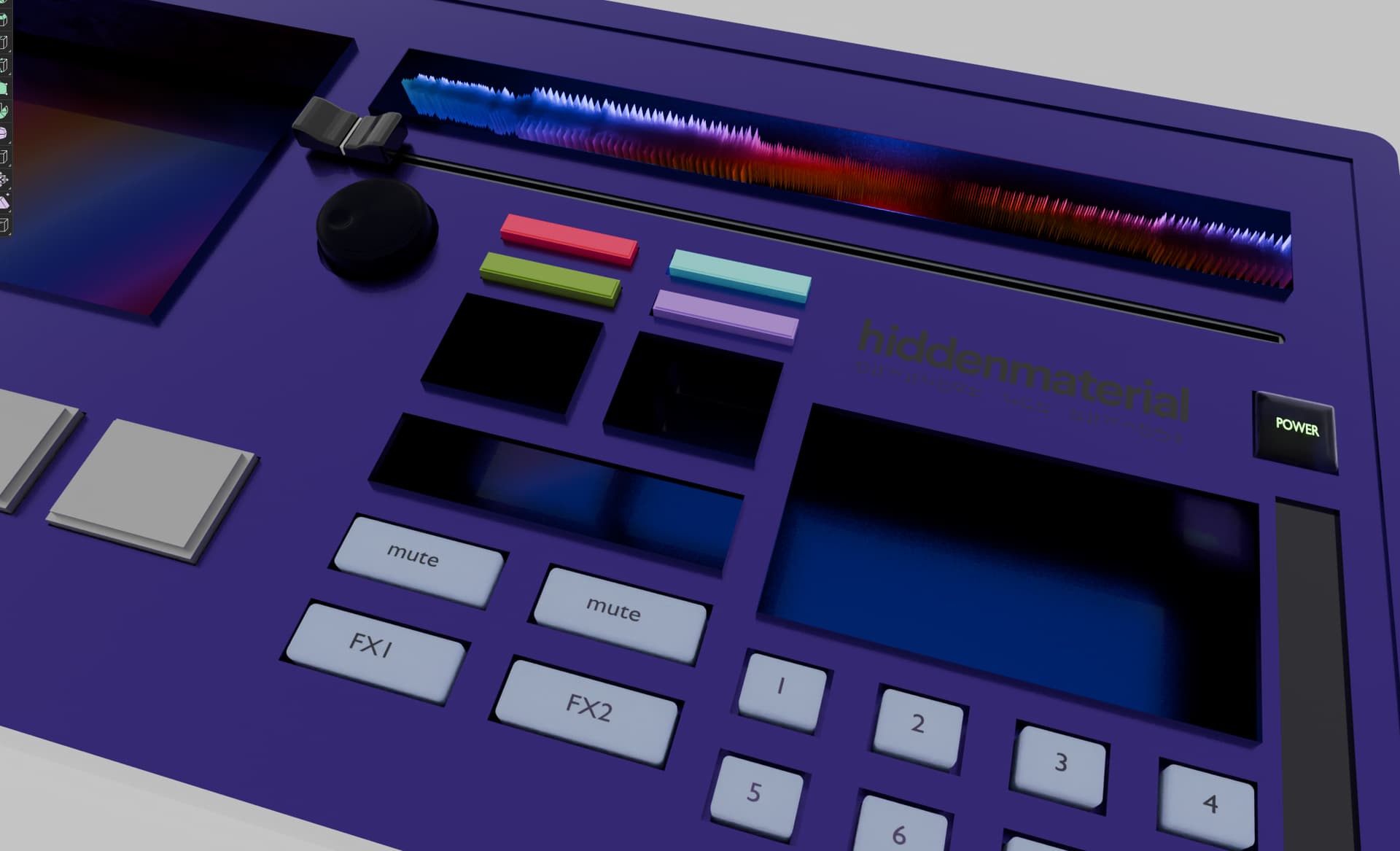
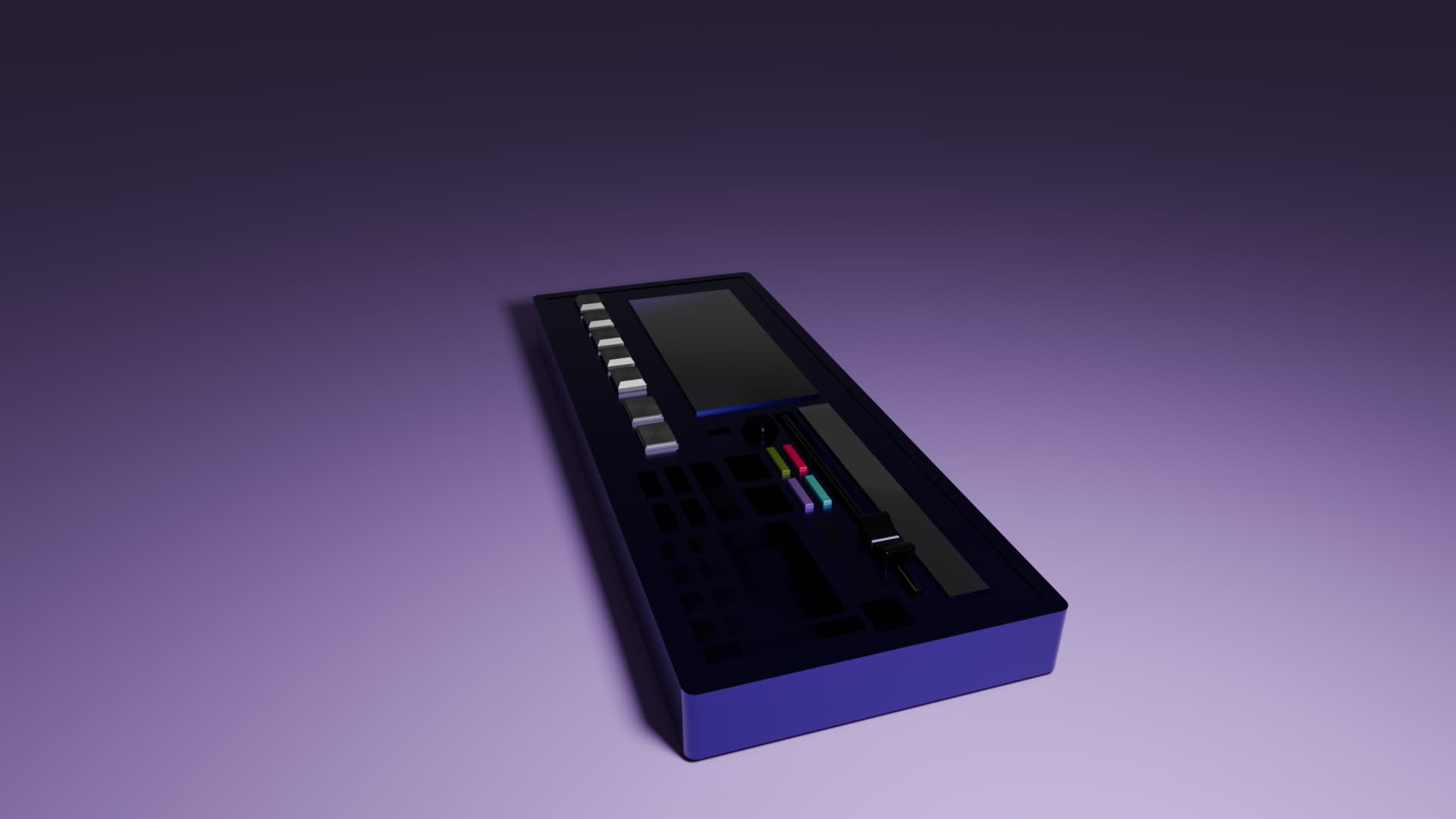
i started working on something like this “dream groovebox” in blender but never got around to finishing it. nothing serious more just like eye candy but of course some interface/form stuff inspired from my favourite grooveboxes

figured out how to import an audio file and have it displayed as a waveform

then i got the “display” working in geometry nodes

some more images:


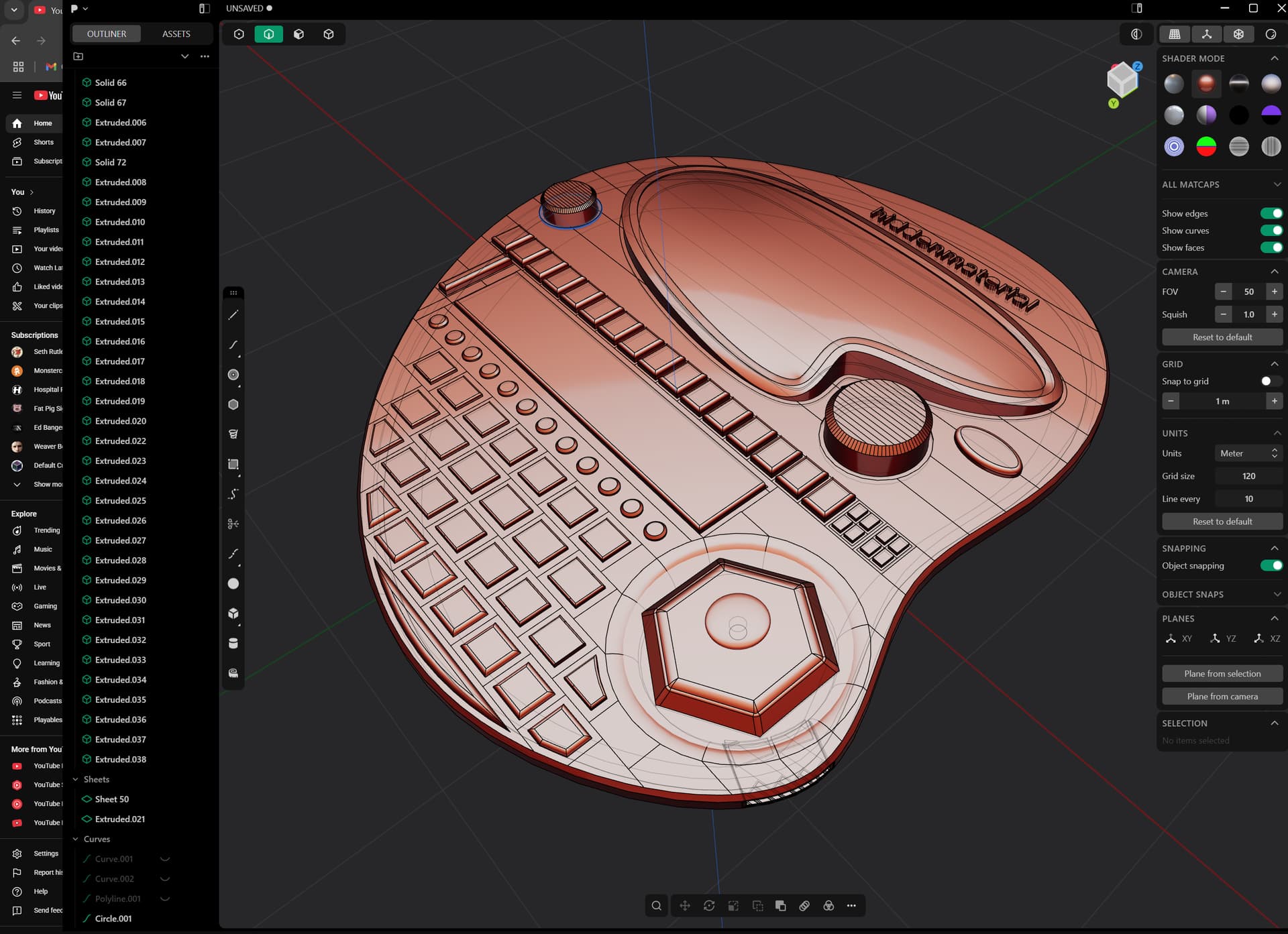
was practicing in plasticity 3d and came up with this lol. very little thought into the layout and more like just make a cool futuristic computer synth thing

8 Likes

If you want to test a technique, a specific structure, a certain rhythm or sound, or even if you just have an idea that you can’t try out because you’re not at home, you can let Claude do the work for you.
I think the machine has all the code manuals from a big city library.
“Make me an artifact. It should be a usable Roland 303 clone. no fancy s***, just exel style”
This gives you a solid foundation to build on.
Polyphonic, interactive, different waveforms, filters, LFOs, MIDI—you name it, it’s possible.
If you’re stuck with the code, you can always get it checked for errors and see what’s possible.
…Eventually, you’ll get to know what works and what makes sense.
Just start building it like a modular system. Just take it one step at a time.
No links from me, because AI products are generally not welcome here (for reasons).

2 Likes

It only took 10 posts for someone to mention letting ai vibe code a garbage vst that’s bound to be shit. Impressive speedrun.

The perfect portable groovebox already exits, it’s Ableton Live on a laptop. If you can’t make what you want there, the problem is not the tools.

16 Likes

all the present day demosceners probably heard of pico-8… not much of a coder but i dabbled with their sibbling tic-80 in some code jams. pico seemed kinda cooler, and some people made really epic stuff with it. but any hows!
this is maybe the nerdies topic i’ve seen in a while lol
i’d love to see a groovebox that is not but a synth but also has some weird stuff on it like all kindsa literal bells and whistles that make dingyti-dong and rattle-rattle stuff, cowbells connected with cables and stuff :smiley:

1 Like

I got really excited for a second thinking this was real and was about to ask where do I get this??

They just need to make a laptop with Live that has buttons and knobs! Oh, right, Push 3 standalone (kinda).

I really appreciate this thought. Maybe the best way to build the best groove box is to start with something completely imaginary, see what’s possible, but not as a VST, as a concept for a physical box. I have no interest in doing this, but so often VSTs are just two-dimensional representations of a three-dimensional way of making sounds. At first, these seemed like a much better idea than having to get under the hood and program your own sound making tools (anyone remember the Environment in Logic when eMagic still owned it?). Now, though, it is tired. I’d rather go the other way. Design something on a computer that doesn’t at all exist in the physical world, as in never-before realized synthesis types and sound design methods, try to imagine what it might look like if you brought it out from the computer into the real world, and then make it in the real world and see what people can do with it. To some extent, my most recent purchase (not a groovebox) is a prime example, the Steampipe by Erica Synths.

3 Likes

Lately I just use my drum machine and a LiveTrak 6 and then just put the pieces together later in an NLE.

The more features a sequencer has, the less I’m inclined to use it, especially when it’s dark patterning you into vendor lock-in with their own apps or app system.

That’s why I like HY-Seqcollection2 or HY-Seq32 and Cantabile if I’m using a computer. All the MIDI and audio routing is represented visually in Cantabile, and you can make it as simple or as complicated as you want, bringing in any MIDI sequencer, arpeggiator, synth, or audio effect (as long as it’s a VST) while setting MIDI filters on each connection.

Really the modular approach is the best approach. Mix and match what you like. Just build your own template and save it. Voila, there’s your groovebox.

1 Like

Cupholder.

8 Likes

Personally, I wouldn’t really be all that interested in something that would be run off of my keyboard. If I were designing a VST groovebox, I think that I would be trying to design something that could work seamlessly with a MIDI controller.

In any case, I don’t think that the thing I want really fits with what you want. But I have thought a fair bit about what my perfect groovebox would be. And this is as good a place as any to lay it out.

Personally, I’m mostly interested in using samples. So it would be sample based. What I would like is something like my old Sampletrak where you can record samples into the memory and then assign them to the pads. I don’t like the SP-404 style of things where you record to the pads. I think it’s slower and clunkier than it needs to be.

On the Sampletrak, the way things work is that you can assign a sample to any pads you want. From there you can edit the start and end points of each pad. If you want to truncate the sample then the machine will look for the first start point and the last end point and delete anything outside of that. I like that. Even without a dedicated slice mode, chopping samples is very fast. I think that’s also down to the fact that you can mark things by ear, scroll through the sample with the little wheel, and precicely edit with the arrow keys. I would like to replicate that kind of hands on system. You can also pitch each pad. So you can play them chromatically if you want to.

I think that it’s the easiest to use and most flexible of the old phrase samplers. I like it a lot. And I would like for the pad section of my groovebox to work in basically the same way. My only problem with the Sampletrak is that you only get 3 banks of 8 pads. I think I’d want 8 banks of 16 pads so that each pad could be triggered with a MIDI note.

On the sequencer side, I would like things to work more or less like the Digitakt. I would like 8 tracks with all the same parameters. I would want 2 modes. One would be chromatic. By default, I would want it to play whatever pad is active chromatically or in a scale of your choosing. But I would also like an option to assign certain pads to certain note ranges. In addition, I would like a pad mode. In this mode, you just sequence the pads. And since the pads are just a sample and some parameters, I would want the sequencer to be able to override those parameters with parameter locks. So, for example, you could repitch a pad on a given step.

One thing I would add would be an additional filter to the filter section. A lot of times, when I’m using my Digitakt I wish that I could run a track through a proper high pass and a low pass instead of the little base width filter thing.

From there, I would have an fx section. i like the options on the Digitakt and the Digitone. I like the reverb, delay, and chorus. I like the Digitakt’s compressor section. I would set things up about the same way. One thing I would add would be the option to run tracks through each other. So, for example, you could route your melodic tracks to one track and filter them all as a group. It would also be great to be able to run an external track through a track. I think it would also be fun to have the option to send tracks to the fx pre fader if you want to. Finally, I would want the fx to have their own track so that they can be sequenced, as well.

I also really like the way that patterns and scenes work on the Circuit Rhythm. Each track runs at the same tempo as the other tracks, or at a division of the tempo. Other than that, they’re independent of one another. They can have different lengths and be cued or changed independently. You can also save combinations of them with mute states as scenes and then trigger those. I really like the way that works together. I would like something like that. But I would want to add instant scene changes. I think that you could have a lot of fun jumping between scenes, especially if that involves moving through different fx states.

On the more nuts and bolts side of thing, I think saving kits and instruments would get messy in a system like the one I’m imagining. One option might be to save banks of pads. And I think that for saved instruments, ones with pads assigned to note ranges, I think it could work by saving all those settings. Then when you load it into a new project, it could create those pads on whatever pads you have available. Also, I think that you probably shouldn’t be able to truncate a sample that’s already been saved since a saved sample might be used by another project.

I think it would also be nice to have a way to import pads one by one. I think that an option might be to have an import mode where you can open the pads of another project and choose which pads you would like to import.

In any case, what I would like to see is something like the Digitakt’s plus drive where files could be named, renamed, moved to different folders, etc. The fact that things didn’t work this way on the Lofi 12 XT, kind of killed that instrument for me. If that system wasn’t so annoying to use, I think that I could have got over the clunkiness of the rest of the UI. I also think that you should be able to choose whether or not you want recordings to be saved by default. The one thing I don’t like about the Digitakt is that if I’m just experimenting I need to unload a sample and then delete it from the rec folder if I don’t want it. But I also understand not wanting to lose something you forgot to save. And that’s how I generally prefer things as far as patterns go.

As far as the physical interface, I’m imagining something like a Circuit Rhythm or a Polyend Play where there are pads that can trigger sounds or be sequencer steps. That would mean at least 32 pads. Plus things like shift and bank buttons.

As far as screens and knobs go, I really like the Elektron way of doing things where every option on the screen has a corresponding knob to adjust it. It lets you get a little menu divey without it being too painful. I mainly just don’t want a touch screen or one of those old style text displays.

Basically, I would like someone to smash together all my favorite things about my Digitakt, my Sampletrak, and my Circuit Rhythm. I want something that can sample and delete things very quickly so that I can sketch things out and maybe discard them without much set up like my Sampletrak. I want my favorite aspects of sequencing on my Digitakt and Circuit Rhythm. And I want something at least as painless as the Digitakt’s file system.

Oh, and I want it to be able to stem everything out with something like Overbridge.

If anyone wants to make this, all I ask is that you give me one.

5 Likes

I would love a groovebox that gives you a simple EQ per channel - surprisingly rare feature, takes very little DSP overhead, and is incredibly useful for designing sounds.

I’d also love an OTT compressor effect built in alongside audio inputs. It’s very rare in hardware, unfortunately. Failing that, an upwards compression effect to really bring out the strange qualities of whatever audio you feed it.

I’ve had a fantasy groovebox floating around my head that could meet my desires for effects design. I imagine an 8 track synthesizer with 8 audio tracks that load multifx algorithms. You can route each synth track into as many of the audio tracks as you like, and route audio tracks into each other. Rather than a fixed-architecture device that gives you, for example, a bus, two sends, a master channel etc. you could just use your routing to determine whether audio tracks function as an insert effect, a bus, or a send. However, this might defeat one of the groovebox’s core tenets - simplicity. I imagine my fantasy groovebox’s routings could get messy.

I think I’ve just invented an octatrack with a built in digitone lol.

I would also love a custom version of TE’s punch in effects crossed with the functionality of a tracker table. On the Dirtywave M8, a table is a special sequencer that’s summoned whenever you like and on whatever channel you like for modulation sequencing. My dream groovebox would take tables and let you assign them to keys somewhere so you can just drop in a custom-designed modulation as a performance effect.

2 Likes

You’ve almost exactly described the MC-707 btw

Also, I think the time is right for a Casio groovebox. Give me six to eight channels of sweet, cheesy rompler sounds. Casio’s latest crop of keyboards support limited application of insert FX as well which is cool. Some of their keyboards already have multi track sequencing built in - the biggest missing factor, imo, is just a UI that focusses in on sequencing rather than being a player’s instrument. Coupled with Casio’s aggressive pricing, I think a multitimbral nice-sound rompler thingy would be a no brainer for a lot of studios before you even factor in sequencing! Maybe even drop in a way to run their fun little auto accompaniment ryhthms, especially with a MIDI out. Their keyboards can already do this so I think it’s definitely possible.

Unfortunately Yamaha’s Seqtrak occupied a similar space as a rompler groovebox and had a confused, lukewarm reception - might scare off any companies thinking about dropping a rompler groovebox. IMO they should’ve dropped in more AWM engines. The AlphaTheta ChordCat seems to have a fair few happy users, so maybe there’s a chance…