People keep saying things like “released in '17 so it [RAM] wasn’t a real issue back then”, or “it is 2024 this shouldn’t be a problem”.
^The reason for this is that it takes a humongous effort to change embedded systems. They are still using a freakin’ Coldfire in the DT2, which says a lot. If an embedded platform works, you squeeze as much as you can out of it. Moving to a different architecture requires extensive rewrite of libraries, modification of existing peripheral and interfacing circuit topology, etc.
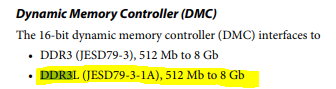
Yes, they did increase the RAM availability to 400MB from 64MB - this is by using a 512MB DDR3L IC. Could they have gone larger? Yes, the limitation of the ADSP-21569 SHARC SoC 16-bit DDR3L interface is 8Gb == 1024MB:
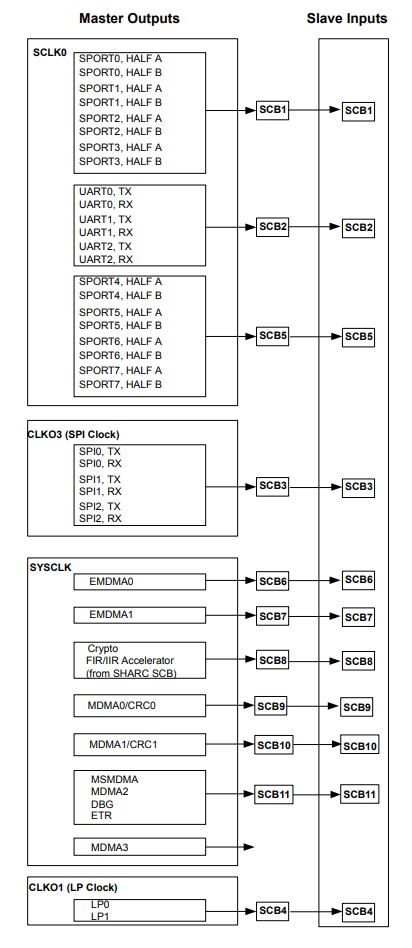
They likely did not go to this density for another good reason, perhaps because each system crossbar is limited to 400MBps of bandwidth in each direction. 16 * 192KBps audio streams is only 3.072MBps of bandwidth, but we don’t know how much headroom the system has in crossbar bandwidth (see discussion post below). The cost between 1866L 512MB and 1024MB ICs is negligible.
Things are usually done for good reason, not out of laziness or lack of design effort.
For sure, I was curious why the numbers were in this range as well.
Better than the TR-8S at least…no internal storage, RAM limited to 64MB, have to navigate them one by one on that tiny screen, actually takes considerable amount of time to load them into RAM. Still, TR-8S slaps so I put up with it
Love this, can probably make a mean kick drum with one of the filters now.
Ordered mine from Moog on the 24th and was very surprised to see that it shipped the 26th. It’ll be delivered tomorrow, very excited. Going to change my whole live set.
I was wrong - it seems the 400MBps crossbar bandwidth is per system crossbar (SCB) in each direction, and there are 12 SCBs including SCB0, which is the main bounding box around all these SCBs and has multiple paths between multiple requester and completer interfaces:
Additionally, the DDR3L is capable of 1866Mbps == 233.25MBps bandwidth itself. If doing memory-to-memory DMA (MDMA) transfers, the maximum rate is a 2000MBps…I believe there are two MDMAs, so the maximum rate is 4000MBps @ 64-bit memory and peripheral bus width:
This SoC can definitely pump data, so I am actually a bit curious now as to the exact reason they chose a 4Gbit DDR device instead of an 8Gbit…simply (512M words X 16) instead of (256M X 16), so I’m not seeing a very obvious answer anymore.
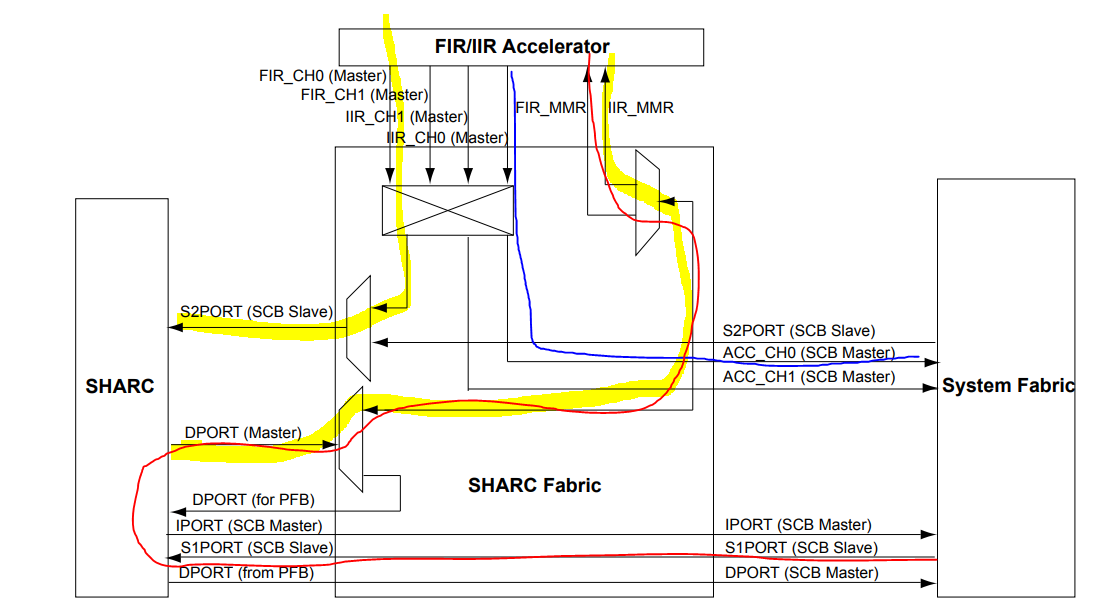
Also pretty cool in this architecture: the FIR and IIR filters connect directly to this SCB / system fabric, and can also access the SHARC L1/L2 cache directly. The whole thing supports duplexing all over in general:
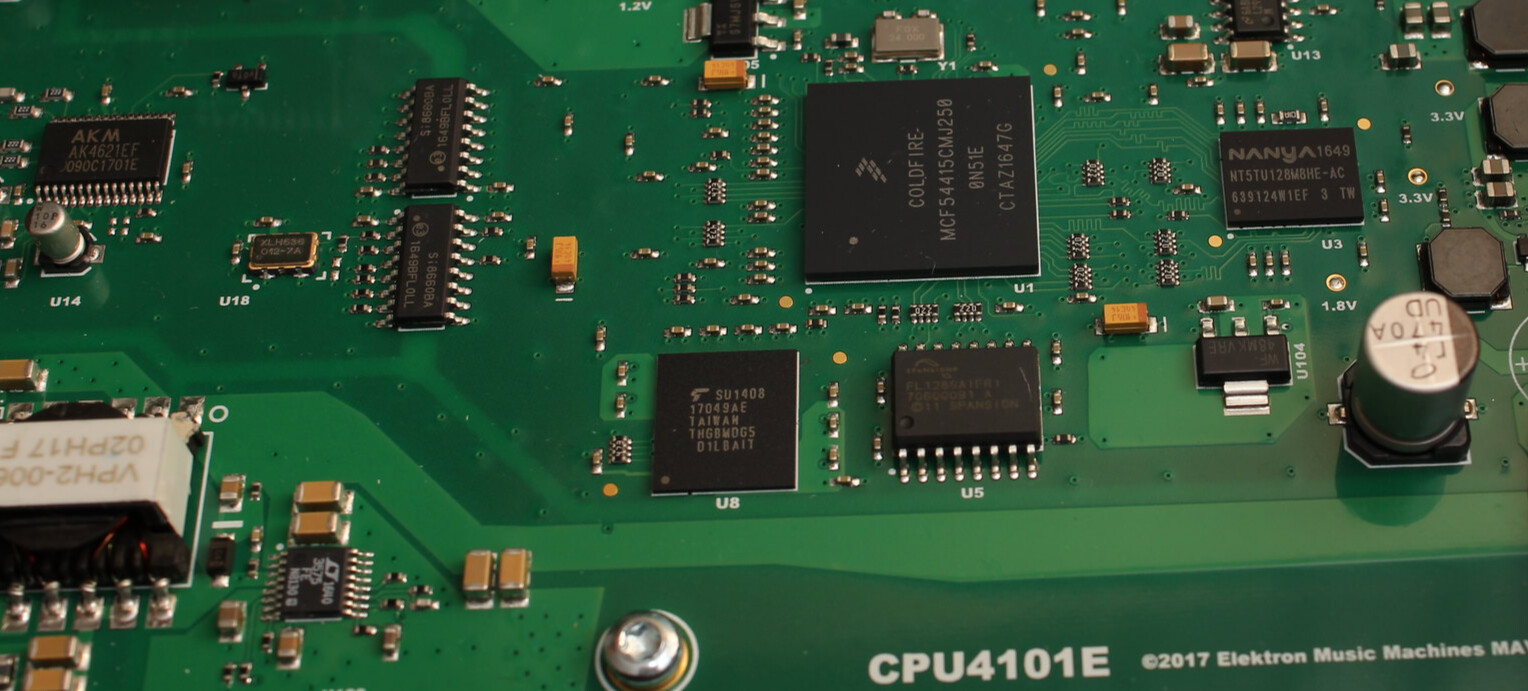
It appears that the Coldfire processor remains the same (MCF54415CMJ250)
NVM storage near the Coldfire was THGBMDG5D1LBAIT, a 4GB eMMC NAND Flash device. This would account for the 1GB +Drive size. This device is also End Of Life, which is probably one of the hard motivations for discontinuing the D1 and designing the Digitakt II
Firmware boot device is the S25FL128S 128Mbit SPI Flash memory, as opposed to the Winbond device on the Digitakt II of the same density. The S25 IC is also impossible to find now (at least easily for me)
NT5TU128M8HE - 1GB DDR2 SDRAM again, same device on Digitakt II
We also see a AK4621 - 24-Bit 192kHz Stereo Audio CODEC, plus 2x Si8660 optical isolators to separate the codec and analog I/O from the digital side.
So, the entire ADSP-21569 SHARC SoC system, larger eMMC NAND storage device, and additional 512MB DDR3L interfacing to the SoC are new to the Digitakt II. The audio CODEC looks the same on both from what I can make out in the Digitakt II images posted previously. Very cool!
There is a lot more capability in this new system and a lot of love went into this new PCB design in comparison
Correct, that was my download source. The manual was already tagged with 1.0.1. So I thought the manual was up to date. Anyway, I’m glad it was just a mistake in the manual
One question: is it better that Digitakt II converts the files to 16 bit itself or is it better to do it in a DAW environment with more options (for example, different dither algorithms)?
Since DTII has a higher octave range, would someone be willing to do a comparison of ranges between DT & DTII? Would like to hear if the same sample is played back at closer to original speed on the DTII at +12 for example. The DT can get pretty drastic in my experience with just 1 octave up/down so curious how the experience is here.
I know there is the new STRETCH machine, but looking for the result without it.
Why should there be a difference when repitching? When you change the pitch of a sound one octave up, its frequency doubles (A4 = 440 Hz, A5 = 880 Hz). Without timestretching there’s no way to change that
Yeah I should clarify that I am wondering if that behavior remains the same and that is how the new ranges were achieved, or if there is some under the hood time stretching going on outside of the stretch machine.