i like this approach a lot, great to get away from the sticky “pop trap”
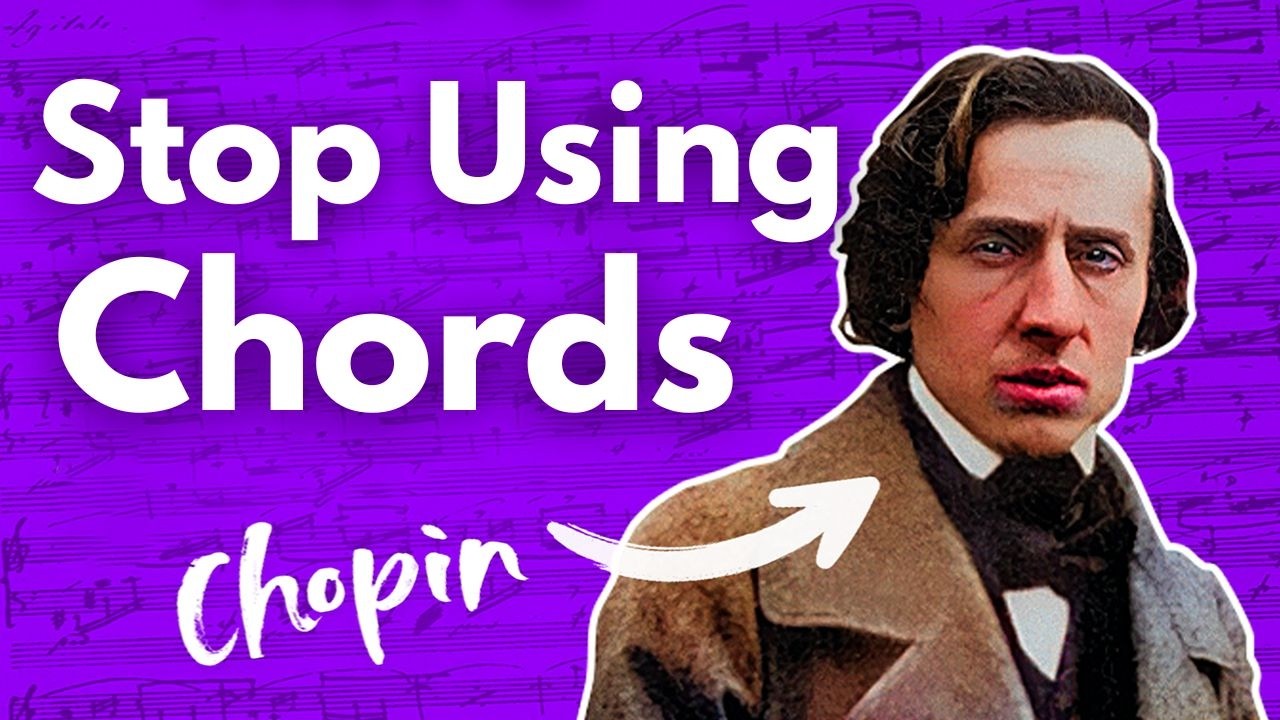
i like this approach a lot, great to get away from the sticky “pop trap”
Functional harmony is overrated.
The only thing you need to know is minor plagal cadences.
Excellent video. To sum up the message: Don’t think about chords; rather focus on voice leading. Think of harmony less as a collection of static chords, more as multiple interactions, in the moment, between separate, independent melodic lines.
Yes, instead of creating the melodies to a given chord progression, you develop the harmonies starting with a melody.
Let’s fill this out and interconnect some things.
First you don’t have to throw away chords to use voice leading. I mean sometimes you’re playing to a chart, but you can still approach it in this way.
My favorite source of musical connection to playing is Chris with Implied Music. Here’s some more parts to fill in.
It works on guitar too.
So suspensions can be part of that.
Chris has some other good videos on modal exchange.
Chris also does a video on the same Chopin Em Prelude used in the first post in this thread.
I like Jameson Nathan Jones for this sort of thing
sure, but then we are back to chords and i tried to get away from them with this thread ,)
Did you watch the video? It’s saying the same thing as the video you posted.
Thanks for the resources. I’ve just been struggling with melodies being predictable / chord tones a lot and I think my problem are those static harmonies that I select before doing melodies.
i watched it and had the impression, it is about finding “fresh” chords. Which is a good thing too, but a chord based approach.
Yeah if you’ve already got a melody, let it guide a harmony later.
I’ve got to agree with cgb, the ideas in that particular Jameson Nathan Jones video doesn’t fit here.
It can be interesting though to compare those 3 different approaches i have to say.
JNJ is all about writing horizontally with voice-leading rather than vertically in chord blocks. Of course you end up with harmonies/chords any time you have three or more notes together.
He has other videos on non-functional harmony.
I initially thought I should have posted a different video. But on reflection, the OP video and my one are really talking about the same thing.
The fact that in the original video, he calls chords “Alan” doesn’t hide the reality that he’s still making chords. Ditto JNJ calling his chords “colours”.
I just push the buttons on my LPPMKIII until it sounds good bro.
One of these days I’ll learn this music theory stuff, problem with it has always been, I get bored with its basics and never advance far enough where (mis)using it would get interesting…
In essence this relates to the Three Note Rule that Daniel Fisher offers and i posted about in a thread about learning to play keys for composition, not performance.
A fun aspect for me with this is as experiment you can just forget about formality, and making music and just float with the simple rules, and passively listen.
I think another fun aspect is applying this to the interaction of more than one performer. That also connects to the origin of voice leading with the movement of separate performer’s voices.
That’s why i like the first video - you don’t need to know any chords etc. ,)
Interestingly, the guy in the first video did know his chords. He identified the somewhat obscure chords in the Chopin excerpt, then pointed out that the knowledge of those chord names wasn’t particularly useful in the musical context.
I’m concerned that the takeaway for some watching the video is: why even learn your chords? My concern is an analog to the expression, “You need to crawl before you can walk.”
When Chopin used a French Augmented 6th chord in the excerpt, I’m guessing it was the result of voice leading decisions, rather than the decision to use that particular chord. But, at the same time, I assume that Chopin did know what a French Augmented 6th chord was. For example, he had to provide the correct enharmonic spelling of it in the manuscript. And, as a pianist, Chopin was undoubtedly skilled at converting notated chords into played chords (which speaks more to an understanding of vertical chords, rather than horizontal voice-leading).
I think sometimes we need to learn a simpler, less elegant system (of whatever) before we can move on to a more sophisticated one. Sure, there is a danger of getting stuck inside the simpler system (e.g. thinking of chords). But thinking we can “leapfrog” over the simpler (if somewhat flawed) method of doing anything is worthy of skepticism.
Agreed.
I think the aim of the video is to help people to get from an intermediate understanding to an advanced understanding, but it would be easy for people to think you can just jump from basics to this although I think anyone trying would quickly get lost.
i don’t think that’s the aim. I think he just wants to encourage people to start with a one voice melody and then add melodies and see, where it leads you harmonically.
I did something with AALTO vst about 10 years ago, if i find it i post it. It is really very odd / experimental and nothing special, but it is interesting to add voices and just see where you gonna land instead of having a chord progression and then try to find a melody for it. Totally different results, one cannot replace the other.
Edit i just found it:
(funny also, the master tempo is automated, so the whole thing meanders between slow and fast through the whole track )