
I’m sure it will help you a lot. focus on hearing the start and the result if you don’t have a computer to pass through a scope plugins to see the wave shape of your kicks… and find your multiple stages depending on your machine and (maybe) pedals or something
Also when you don’t have a distortion unit try to change the sine wave for a triangle, or a square, or a sine wave + FM it could help to get harmonics in the initial waveform if you can’t add harmonics with distortion after… EQ is a filter, transient/clipping, waveshaping all of that of course will be difficult with one machine and no computer. But at least with you have a great overview on full [sound design + processing] of the kick drum
If layering interest you : go further on phase
after that : the drumbus processing (not in this course)
keywords :
NewYork/Parralel processing - Glue compression, Distort by the bottom, clipping by the top…
and you good to go
@Acidvideo : feel free…
to PM me directly along your learning if you need tutorial recommendations or explanations on stuff you didn’t understand. I’m here to help.
thank you so much! closest thing to a sine in the A4 is triangle, but i guess it’s a good one for kicks
Yes you also have the filter self resonance to make a sine wave i PM you a link to my lowend101 ebook+soundpack where it’s explained this and you have the settings to make it works
and self feedback CV (but I never tried this one)
cool thanks!
I’ve been going back to these a lot lately. The pacing and the explanations just really click with me. It’s for Tempest, but is pretty easy to translate to A4.
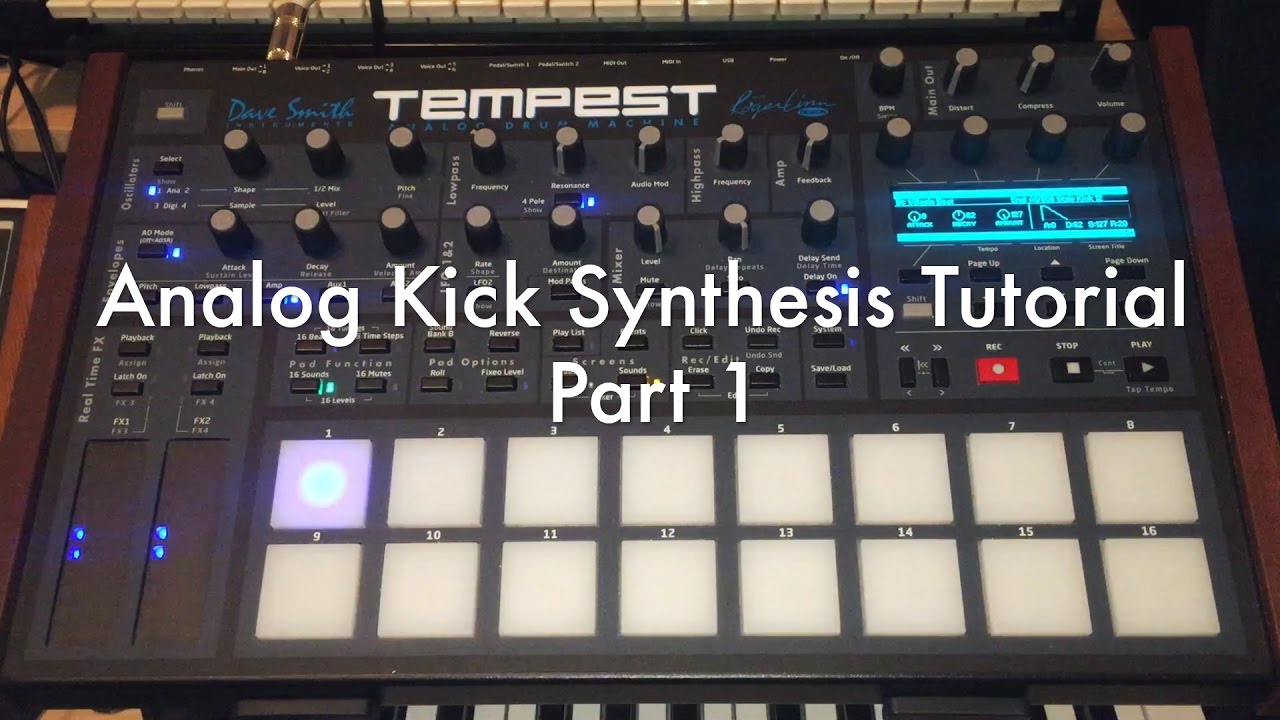
Super good call!
the tempest tutorial is awesome. I’m having a ton of fun creating kicks with A4. the machine is incredible, even after 12 years of playing it.
here’s what I found:
- the bend/slide functionality is nice, but not fast enough
- the various env shapes are a godsend
- there is more flexibility in the envelopes when the notes are played super short. like this, the entire adsr can be used (if the notes are played too long, then you only have the decay to shape the volume. also, with varying note length, you get this nice extra millisecond of sustain at the beginning of the kick.
- I like to use the env modulated peak filter with some resonance to create a nice low end. the ladder filter serves me best to tame the harmonics in he kick’s tail. fun part: instead of using the same filter env for both filters, use a one shot lfo or even the pitch modulating env2 to control one of the filters.
- it’s fun to use noise to shape the transient.
i’m now exploring using the second oscillator, potentially shifting between the oscs using a one shot lfo, as is shown in the last minutes of the tempest tutorial.
In my experience, the best that sounds on A4 is to use big resonance on one of the filters as a sine oscillator and use the filter envelope as pitch envelope essentially. As you can imagine, the filter modulation sounds different depending on the kind of filter you use. You may or may not want to feed an oscillator into it. You can use a second lp filter with lower resonance and less envelope mod to emphasize a frequency range a bit higher than the fundamental for the “punch”. You can use feedback (on osc1 slot) and overdrive for more colouration options. But in any case, patience, it’s extremely fiddly, and the envelopes and cutoffs have to be tuned just right.
One thing I’d like to bring up, as I feel this gets too little mentions.
Best tool for kick design ever is a monitoring environment which actually tells you how your kicks sound on a big PA system. I can tweak plugins and outboard till the cows come home, but unless I can really hear the “power” in those lowest 2 octaves, as they truely are, I am just wasting time… nearfield monitors dont really give me this, IME it has to be a system with a sub or better yet, a PA system.
When this aspect is properly in place, kick design becomes soo much easier
This is a good tip. I was going to suggest the technique I’ve used on a number of machines, including synths, and it starts with using a sinewave. As mentioned earlier, the A4 doesn’t have a sinewave osc, so a triangle is the closest. Alternatively the self-resonating filter technique works since it generates a sinewave.
Then it’s all about getting the right pitch to start with (somewhere between 50hz-60hz is a good starting point, notes G1-B1) and tweaking pitch envelope parameters. When using the a resonating filter the filter EG (as mentioned above) becomes the pitch envelope.
Keep the attack, sustain and release initially at 0 and use a combination of the decay to set the lenght of the pitch sweep and the envelope amount for the depth. Once you find something pleasing you can add a bit of release to set the tail.
Where this often doesn’t work as well as it should is when you’re using an envelope where the curve is linear (a straight line) vs exponential ( a curved line). I believe the Elektron machines might use a linear envelope that doesn’t always allow you to get the curve that might best to you, but play around. Try to the envelope in the LFO section instead.
Then you can begin adding short transients to add a bit of a snap or punch at the start, if neccessary (it isn’t always for my tastes). Overdrive can help too.
Let me know if any of this is helpful.
also, if we are talking about generating kicks for resampling, it is true for kicks especially that running them through a good compressor, overdrive and (soft) clipper can reshape them very significantly, there is a whole range of possibilities even with one starting sound
Sure. Processing can do wonders to point sounds and percussion in general IME
Camel Phat.
I think it helps to think of kicks in terms of the different elements that go into the sound. This doesn’t mean that you actually have to layer a bunch of different sounds, but it’s useful to think of the different parts of a kick.
Subs - This is the danger zone. If you can’t hear what you’re doing down there you might run into trouble. I personally think less is more.
Body - This is pure tone of the drum resonating at the fundamental.
Punch - There’s an area of high lows or low mids above the fundamental that can sound kind of boxy or muddy on their own but actually contribute to a punchiness that you don’t get if you’re trying to operate on pure fundamental tones or subs. This is the part that’s going to still sound like a kick when you listen on an iphone speaker.
Click - The attack of the actual beater. This doesn’t have to be a basketball level clickyness but it can be just some kind of short attack that gives it definition. It’s not always necessary.
Crunch - On a drum kit, when you play the kick, the snare might rattle. On lots of old soul or funk records there might be a tambourine mounted to the front head. Or you hit the hat at the same time as the kick. Then all of these various rattles combine together and get recorded to tape, then printed to vinyl, then sampled into an sp1200 at 12 bit. All of these things can add some level of crunch, texture, or dustiness that give some high end character and air to the kick sound beyond just the boomy fundamental. On a drum machine this might be just adding some overdrive, noise, and or bit reduction. Also optional but good to think about.
You could buy a Jomox Modbase 09 and never worry about your kicks again. As far as kick drum synthesis goes there is Jomox and then there’s everyone else. Once you’ve had it nothing else is quite good enough.
i used to have a jomox mbase but couldn’t get used o the sound. i like the kicks from the A4 much better
Don’t forget that envelopes can be set I deoendently of note length!