I am probably going to be projecting with this post, because it seems like I’m in a similar place to you right now.
I have much of the same gear (the Microfreak + Zoom MS-70, Digitone, TR-6S) and have similar issues.
I feel like I bought too much, too quickly (for me, because it was a new hobby I picked up in the pandemic - and some of that was definitely “retail therapy”).
What I really need to do is spend time learning the gear that I have, and finding out exactly what works for me and what doesn’t.
It’s very easy to see new gear and think if you just had this one extra bit of hardware, it would all come together. Or lust after the hot new thing because all the influencers have moved onto it now, etc.
The reality, for me at least, is that I need to practice my playing more, study more music theory, spend more time learning the tools that I have instead of thinking that buying more gear will make things easier.
In some cases, maybe new gear would be easier because it has more knobs-per-function, rather than shift functions and menu diving; but that’s not really what’s holding me back. There are many people that are extremely proficient with any of these devices, and making great music.
I have been feeling this a lot in my own setup lately.
Perhaps it’s my inexperience, but I think I just hate hardware sequencing and pattern chaining - especially without a “song mode” to store that chain, or when I can’t automate things like variation changes on the TR-6S via MIDI.
Despite how much others seem to like it, I feel like I’m constantly hitting up against restrictions or limitations when I try to use the Elektron sequencer - or maybe I just hate the workflow.
Sequencing has its place, for sure; but especially for synths - I greatly prefer to just play the part live and not have to worry about running over the sequence length, or programming things in just right, etc.
.
Now, I don’t know exactly what you mean when you say that you want to sequence “outside the 4 bar paradigm.”
The Elektron boxes that you own support up to 16 bars per pattern, with no restriction on pattern length below that (2-64 steps), and each track can have its own length if you’re wanting to use polymeters.
But there are many other ways to approach this, if what you mean is that you’re frustrated with the Elektron sequencer (as I am).
.
The most-powerful, but least-appealing to me is switching to a DAW.
For me, the whole reason I started this was to get away from sitting at a desk and staring at a monitor or tv all day.
But a DAW is unparalleled in this regard, as there’s essentially no limit on pattern lengths/sequences/generators, and you can just multi-track audio straight in.
The interface is so much easier than hardware for certain things as well. Everything I’ve seen of software synthesizers like Phase Plant seems to give a far better indication of what’s actually happening to generate a tone than actual hardware where you can’t see the oscillators running, etc.
.
If you’re wanting to experiment with things like euclidean sequencing or other alternatives, but are wanting to remain “DAWless,” consider mobile apps as a half-step between the DAW and very esoteric (often-expensive) hardware sequencers.
I’m only familiar with iOS, but you can enable class-compliant usb on the Digitakt/tone to turn them into a mobile audio/midi interface with the right cable.
Now you have access to apps that are typically in the $5~$20 range for things like euclidean/generative sequencing (e.g. Drambo) and other experimental sequencers like Fugue Machine.
It also opens up the possibility of being able to control/sequence software synths with your hardware.
And being able to sample directly from your hardware into other apps like Koala Sampler (though that may be less relevant with a Digitakt).
.
And one other possibility I’ve been looking at is a sampler like the Roland SP-404MKII for basic recording/overdubbing (and chopping up/resampling).
It is more hardware, and hypocritical of me - especially when a lot of it can be done with Koala Sampler; but in my case, I don’t have a hardware sampler yet.
For me, this looks pretty ideal because it does stereo sampling, supports up to 16 minutes per sample, has over-dubbing, 32-voice polyphony and chromatic sample playback, has good controls/interface for chopping samples, velocity sensitive pads for playback, and a good range of built-in effects (which might be able to replace the MS-70).
But I don’t know about the workflow. I’ve heard the sequencer is pretty basic.
All of the different hardware sampler options out there, such as the Circuit Rhythm and Digitakt, seem to target a completely different workflow/audience - so the specs alone are not enough to say whether it’s the right device for me - or whether it’d be a good replacement for a Digitakt if you’re finding mono sampling to be limiting.
Yeah - I really understand this.
My setup is smaller than yours, and the amount I’ve spent still eats away at me when I feel like I’m not using it to anything near its full potential, or think that it’s just sitting there being “wasted.”
I think the thing for me is that I don’t anticipate the resale value for any of this to drop significantly over time.
So for now at least, I’d rather keep what I’ve already bought, and spend my time learning it inside and out - even if that means I’m not using it all right now.
I’ve put learning the Digitone’s FM synthesis on hold for now, as it’s just too complex on top of everything else.
.
I do agree with people that say you should probably put a lot of the gear away, or create a couple of different setups - so that you aren’t spending more time fussing with the setup than actually learning the instruments and the workflow.
Maybe set up the Digitakt with the keystep and one other synth.
That way you can use the DT for drums/sampling and learning the Elektron sequencer (if that’s something you still want to do) while learning one of the synths.
Then, since it’s battery powered, you can use the TR-6S on its own somewhere else and learn it more in-depth, while getting a better understanding of drums patterns. I’ve been finding that quite fun on its own with a pair of headphones.
Or maybe run the Microfreak off a USB battery bank and do the same for synthesis. You could pair the two together as a more “mobile” setup.
It can also be powered over USB by an iPad (Pro) and supports class-compliant MIDI if you wanted to experiment with sequencing apps.
Unless you actually need the money, there’s no harm in putting some of that hardware back in its box and storing it away for a while, so that you can focus on learning one or two pieces of hardware at a time.
If you’re really wanting to downsize, I’m not sure that you need all of the Analog Four, Digitone, Microfreak, Typhon and Deepmind.
Five synths is a lot. If I had a better understanding of what I was buying at the time, I may not have ended up with both the Microfreak and Digitone together. But I feel that it’s currently more valuable to still keep them both, since they use different types of synthesis and there’s a lot to learn about each.
I hope this wasn’t too rambling (or self-centered) and there was at least some helpful advice here.
I’m just vocalizing a lot of my own thought processes on this right now - even with a smaller setup.
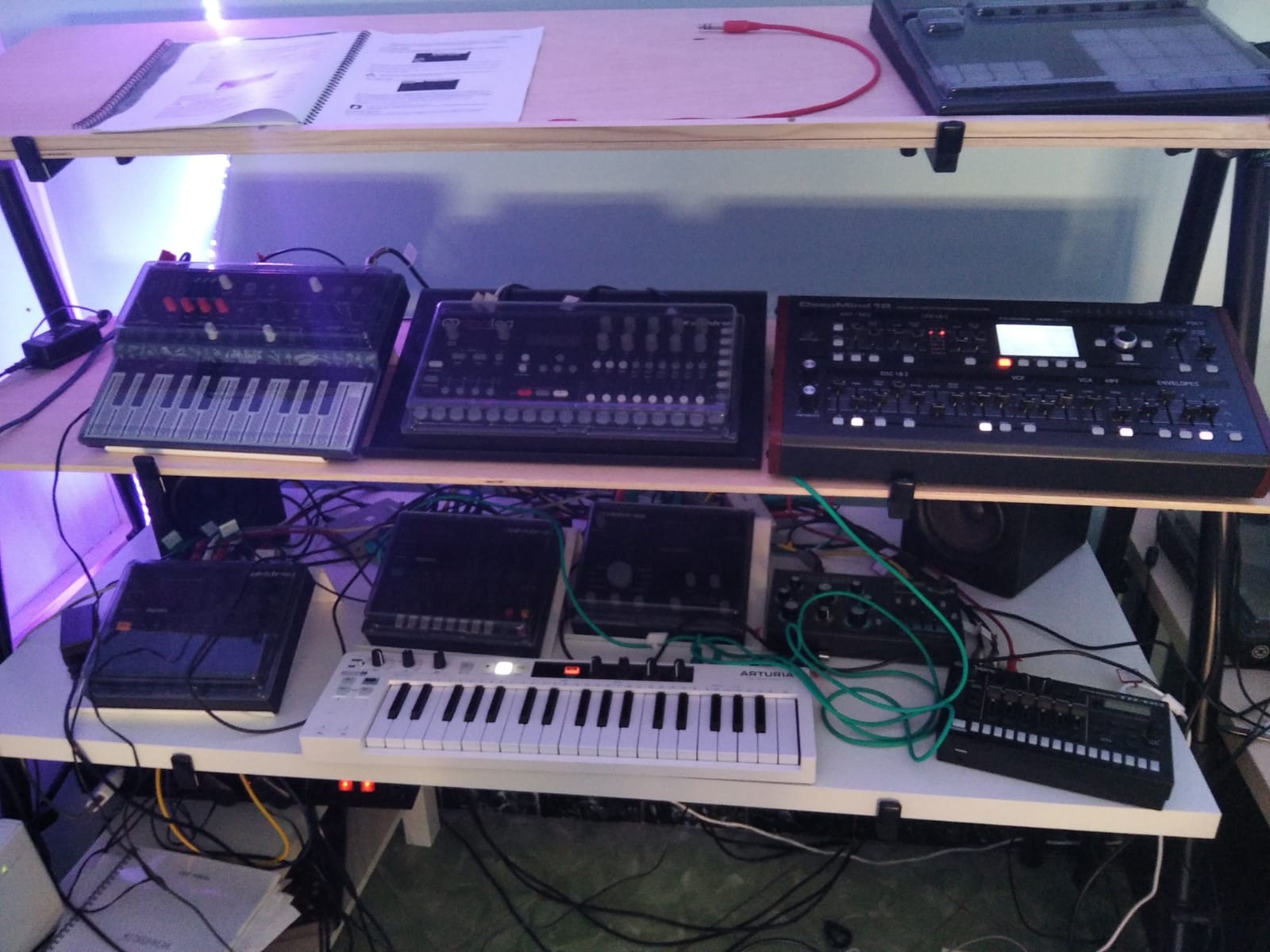
 But I dream with the DT+DN+ST combination, since the DT and DN are my preferred devices so far.