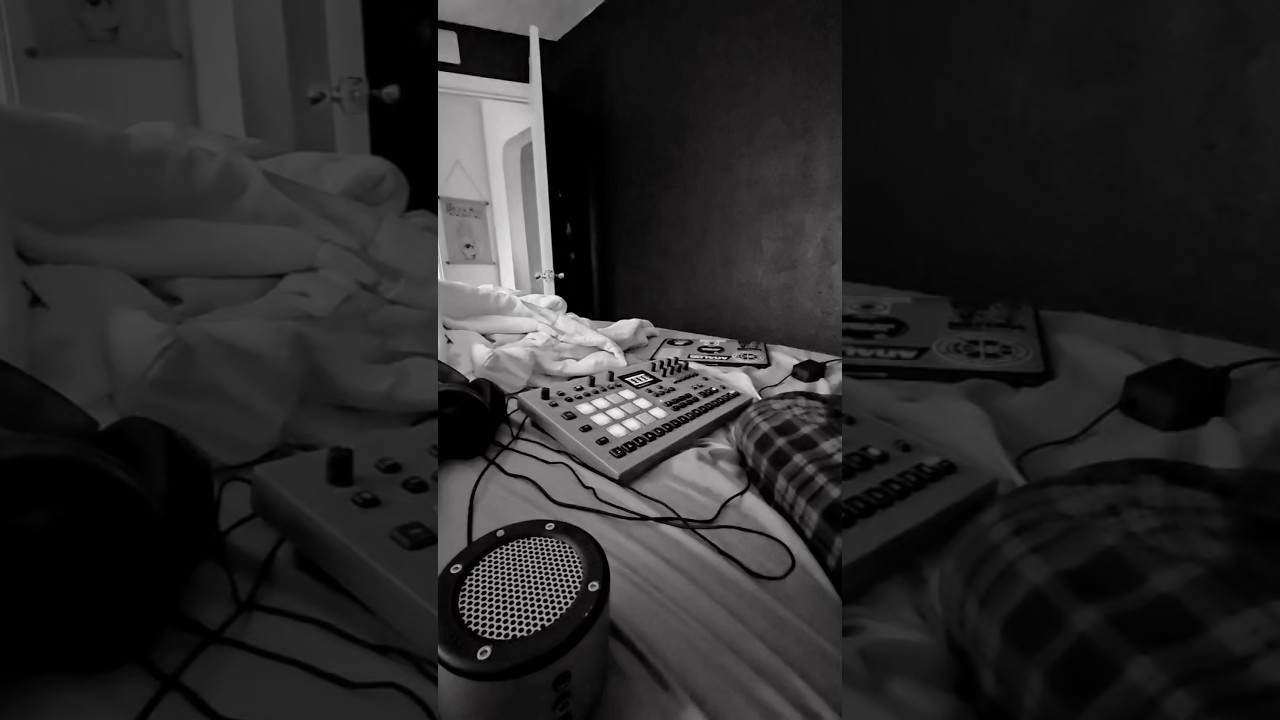
The Rytm has eight voices spread across twelve tracks. Tracks 1, 2, 5, 6 have their own voices where 3-4, 7-8, 9-10, 11-12 are paired choke tracks where each pair shares a single voice. If track 8 is playing and then you play track 7, it’ll cut the sound off from track 8 and start playing on 7.
Each of the eight voices have different sound engines available to them. The engines determine what types of sounds you can create on a voice. The engines on tracks 1 to 4 are the most versatile and have the Dual VCO’s on them (three voices). The other tracks have different engines/voices specialized for them (cymbals, high-hats, toms, etc). All of the engines support some basic stuff like impulse sounds, noise, and sampler. They differ in the other sounds that they can make.
So if you’re primarily looking at the Dual VCO’s there are only three voices, spread across four tracks (1, 2, 3-4), that they can be used on. You can always sample them though and play samples on any of the other tracks, however. The Rytm MKII lets you sample itself inside the device (the MKI does not support this; you have to load the sample from a computer).
—————
As others mentioned the Analog Four MKII is different than the Rytm. Its oscillators, filters (w/key tracking), and other parts of its signal flow sound different. It’s a very powerful analog synth focused on subtractive synthesis where-as the Rytm is aimed at percussion. You can use the Analog Four for percussion, however, as many use it to create kicks and what-not. There are probably some videos on Youtube of people using it as a drum machine which will give you an idea of how it sounds there.
If you like the sound of the Dual VCO’s then you’re only going to get that on the Rytm and Syntak, not the Analog Four. They have a wild and gnarly character about them that the Analog Four lacks. I always say go with what sounds best to you because that’s what matters in the end.
It’s just naming convention. If you look into RYTM’s manual, you will see that machine’s name “Dual VCO” is what name implies - two VCOs, and more. There are differences dependent on the predicted use case, which, in case of RYTM - to no one’s surprise - is drum sounds. So Elektron chose eight parameters, accordingly, with two pitch decay envelopes, sharing depth but having own times (that would be that “more”, otherwise it looks like other dual VCO synths, i.e. waveform configuration reminds me of the one found in Dreadbox’s Artemis). To understand that, look at DFAM’s front panel. Or better: try to recreate signal voice structure of both - DFAM and RYTM’s Dual VCO machine - in VCV Rack and you should be able to figure out why in these parameter restraints Elektron went with this parameter set. Because if they wanted, they probably could add more pages of parameter, skewing from current UI balance into different territory.
BTW: regarding my advice for VCV Rack and your inquiry into A4 territory. I want to put this thought for you. I believe that if you lack patience to at least recreate and understand Dual VCO in VCV Rack, you might (again: without being 100% sure) lack patience for A4, but you might be sucked in more in latter case, so I am not discouraging you, but trying to bring some thought, based on my opinion, into your consideration.
thanks @Wild for clearing that up. (re 3 voices with dual VCOs).
yes im feeling drawn to the dual VCOs (rytm or syntakt), and I agree on trusting my ears.
but i cant help but wonder if, like @Azzarole said, with all the control the A4 offers, it might offer the potential to go deeper and further into similar territory, and therefore posess more potential possability to be a texture/harmonics monster, and lead to territories i havent heard yet on the demos.
i guess it would take time and experimentation to really find out, but in theory with the 2 DCOs, and the in-depth sound-shaping controls, im still tempted. in theory, it does what im looking for.
The A4 is definitely deeper than the AR. Two filters instead of one, two LFOs instead of one, three envelopes, amplitude modulation, oscillator feedback, etc. It’s only four voices, though each voice has “four” oscillators (two you can change the shape of, two sub-oscillators that are square).
If you’re fine with buying used you could look for a used A4/AR MKI combo for probably priced about as much as a new AR MKII. Then you get the best of both worlds. The A4 MKI has slightly less bass than the A4 MKII, otherwise they’re very similar except form factor. The AR MKI/MKII sound identical less no built in sampling on the MKI and form factor.
@B_LD i get that you want to keep the thread under control, but i think its relevant. its not so much about the terminology as getting clear what these machines do.
Does the Rytm have 2 VCOs or a ‘Dual VCO’? and whats the difference anyway? to me, (and anyone like me who wants to get into controlling texture and harmonics) its potentially a crucial point in understanding the charachter if these machines. well, anyway its important to me in my decision.
@normanion thanks so much for the explaination of ‘dual VCO’. its not so much that i lack pationce, only that im just not that far along in my expertise yet. Im really dilligent at trying to understand something thoroughly when i put my mind to it, so im not scared off by the A4. like i said its depth and control that i want, and i know that comes with its fair share of hard work.
yeah thats definitely worth considering, thanks for the idea. getting my hands dirty and getting stuck in would definitely be the best way to find out which one i love. or maybe i’ll love both!
the main reason i was thinking of buying new is simply because of warranties. i just sent my OT back for repair and they were so helpful. its just reassuring to have that when investing.
The A4 is very deep in that regard, well organized modulations, envelopes, AM and all that.
You can make a wide array of sounds and drums a def a part of it.
I also have the syntakt and while it seems rather shallow on the paramters you get, you can make drastic changes and bend each machine in many directions.
I’d study both manuals, your sound design skills will tell you right away which of the instruments will speak more to your desired workflow and depth.
Modular may be another option to look into. Can’t get deeper and more flexible than that!
You really would do yourself a favour reading the sections about the analog machines in the AR and ST manuals, so you have an overview of what parameters you can tune.
I think one thing that has maybe not been explicitly stated yet, is that although the analog machines of the AR/ST cover a lot of possibilities of sound design in total, each of them are very specific in what you can dial in.
A BD machine will in most cases not give you access to the second VCO for example, while the Dual VCO machine will not necessarily give you the same control over the pitch decay as the BD machines, etc. they all are quite specialized.
None of them are a “general synth” machine where you have access to a lot of parameters.
As for voices, it really depends on who you are and what kind of music you make.
But if we focus on the analog voices, then I find on the ST that I fast run out of voices I want to have playing simultaneously (ringing out over each other). Then I use some of the digital ones which I like as well.
I assume the same limitation applies to the A4, despite being able to soundlock.
In my book the AR is the clear winner here, because you often want a hihat or two, perhaps a shaker, some cymbals, and then kick, clap, perhaps snare, and some wood blocks, etc. you just really fast run into having to do very complicated voice substitution with sound locks with only four voices.
And the ability to layer samples and run them through the filter is another level of sound design that is worth spending time on.
That’s important to point out! I’d also like to add another warning, since you seem to be quite interested in the synth engines like DVCO that are mainly for playing in melodies: the Rytm is a drum machine first and foremost and you will notice that when using it for melodic stuff a lot. For example, the octave range is rather limited. You don’t get stuff like filter tracking or portamento. And you’re playing in notes with twelve pads designed for drumming.
Don’t get me wrong, I love the melodic stuff you can get out of AR. But it’s more apparent on an AR that you’re using a drum machine that Elektron was nice enough to also allow us to make some synth patches on. Not like a Syntakt or Digitone II which feel competent in both synthing and drum machine use. Likewise, you might miss some drum machine features on A4, like retrigs.
okay guys. i really appreciate your reflections. its been super helpful to air this process upon your kindly ears. thank you
ive made a decision. ive just bought the rytm
(im so frickin excited).
@Wild your idea of getting both used was really good. i can read the manuals but the truth is i need to actually play them and hear them to really know.
so im starting with the rytm because i frickin love the sound and i can get into it right away. then i’ll get the A4 which i can take my time with; and like you said, i can pick up a MK1 used for about £550, so its not such a big deal to save up for. in the meantime i’ll be busy mastering the rytm
youll love the rytm. i’m of the mind that the a4 is a royal pain in the ass whereas the rytm is very fast and you get a lot of happy accidents. the sweet spots on the a4 are tiny and frustrating to find, whereas most of the (limited) sounds on the rytm dont take much work to vibe with.
A lot of what you’re claiming here is common myths and personal opinion. While I appreciate this holds true from your personal experience, there’s a vast amount of examples shared across this forum from a lot of users, that illustrate the opposite very well.
yeah, i know i made the right choice because i feel wildly excited.
i think the clincher was realising that the sounds i was hearing from the A4 werent really inspiring me for a reason. the DCOs have a different vibe. even though in theory it should do more of what i love, and would offer me endless hours of obsessive tweaking, the rytm just sounds fu£&in’ lush!
so my inner nerdy scientist that wants to slave over maticulous sound crafting will have to wait til another day.
 The A4 MKI has slightly less bass than the A4 MKII, otherwise they’re very similar except form factor. The AR MKI/MKII sound identical less no built in sampling on the MKI and form factor.