Do you know how to send your presets to the computer for back up ? with sysex I suppose but …
Thanks, yeah those were my first impressions on day one with the synth. I’ve dug deeper into multi out out since 
1 Like
Awesome posts. I love your writeups.
I need a manual for this thing, I don’t have enough time to puzzle through it all alone.
1 Like
I’m trying to do a post a week. I’ll have a manual’s worth soon 
2 Likes
I only know how to send one of them at a time:
- Load the preset you want on to part 1, 2, 3, or 4.
- Make sure you have something recording sysex on the other end of the Manatee’s MIDI out
- Press and hold the part with the preset you want to save.
The screen will flash something like:
SYSEX
TX PRESET
and send the sysex.
1 Like
Thanks 
Try different arp settings for separate voices of the same patch (I did a very simple pluck sound and the second voice had more release)–you can get really interesting polyrhythms by manipulating the “MSK” setting.
2 Likes
Maybe everyone already knows this, but you know how, in the spectral generator, the “PART” and “ROOT” basis are essentially the same? Have you ever thought that seemed like a bit of a waste?
That’s because the “PART” spectrum is actually editable. Hold ALT and the GEN button (that’s the one in the “SOURCES” section between the “SPECTRUM” and “FORMANT” knobs).
This takes you to the edit screen. From here you can use the ← and → buttons to select the harmonic you want to tweak and use the 3rd value pot to set the level.
The first value pot is a random generator, I think? Twist it to generate a bunch of random spectrums to try out.
The second value pot lets you browse through the other preset spectrums (ROOT, EVEN, ODD, etc.) to see what their values are. If you make any edits to these, they’ll be copied over to the editable PART spectrum to save you some work.
Changes made to PART looks like they’re saved with the patch, so each part can have its own custom spectrum (probably where the name comes from).
So much flexibility to be found in this box!!
5 Likes
Let’s talk about the spectral generator! Lots of pictures with this, so another blog post:
3 Likes
Nice mellow demo and sound design with EK
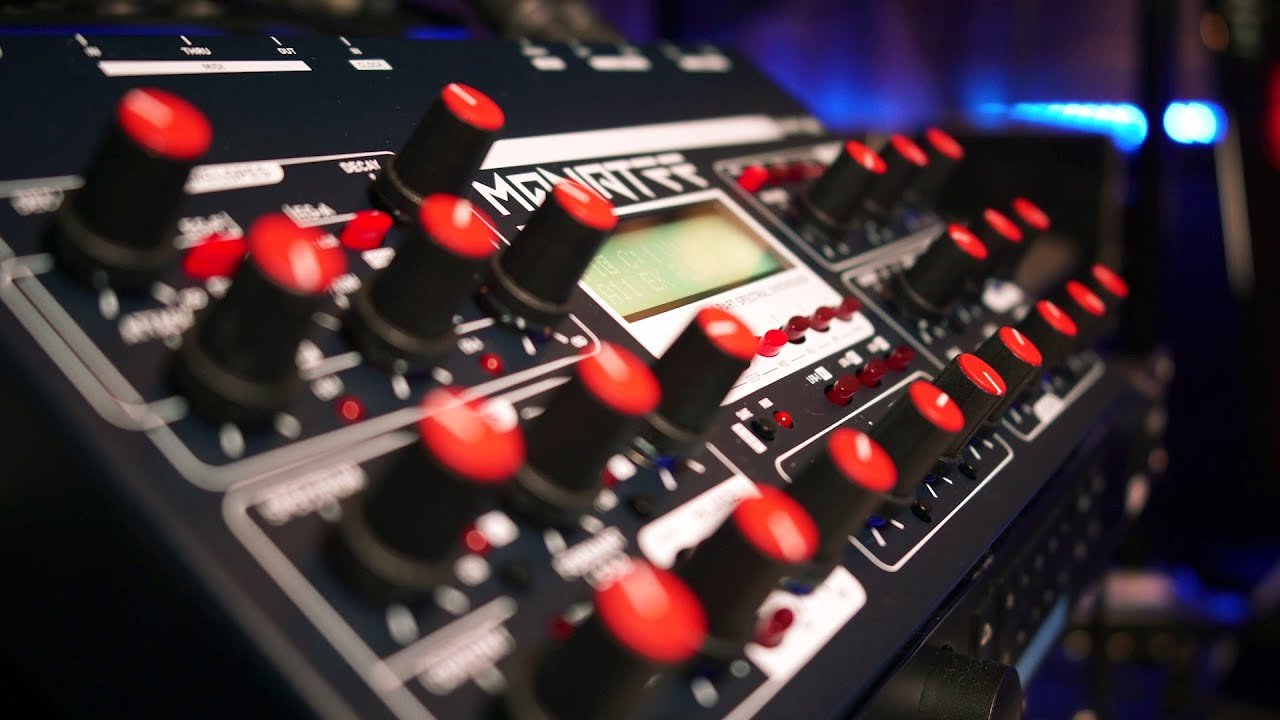
5 Likes
“Then there’s a fair bit of space in between each peak that we know we’ll never use because all those frequencies are in harmonic.”
… and my interest is gone 
2 Likes
But this will give us new hope!
Of course, the “mess” created by overlapping overtones of harmonically rich sounds is sometimes called “music”, so the Manatee happily provides us with an assortment of waves for the job…
But those are still snapped into the harmonic series and using the word “mess” there is exaggeration  It would be cool to have the possibility to stretch and contract the spectrum, or load different spectra, maybe derived from real world examples …
2 Likes
Though this is, IMHO, what the ring modulator is for. Get your harmonic tone via the spectral generator then dirty it up with inharmonics by ringing it with the sub.
Also, I think noise is a modulation source? If so, lots of possibilities there. I’m out of town until Wednesday, but will look it up when I’m back.
1 Like
I do wonder how it would work on the manatee, my understanding was it is not using a noise based spectra to pull from but instead wavetables? And if those wavetables don’t have inharmonic content there would be nothing to pull from. I do agree though there is some edge not really being pulled out of the manatee that I was hoping to see, that I hear in my Waldorf M and Q, heck Q you can be modulating multiple comb filters with a wavetables that’s being a FMed by two other waveforms. I still want to give the manatee a proper go though, seems to have an interesting sound.
Wavetables can do have inharmonic content, but of course I don’t know if Manate has such (almost all Wavetable synths do).
But I’m actually speaking more in general … I wish for synth designers to make us decide ourselves what is music and what is “music”, and don’t restrict for us the tools to explore unknown beauties of sound.
2 Likes
There are no wavetables in Manatee. It’s not a wavetable synth, it’s an additive synth. So it’s not really them deciding what is “music” and more them deciding what type of synth they want to make 
I feel like it does a pretty good job of that. The additive the spectrum is completely customizable. As mentioned, the additive stage can then be ring modulated with the sub. And the sub, itself, can be tuned however you like and do wild FM, PWM, and super saw stuff that makes the RM even weirder. Also, the Manatee is polyphonic, so combining intervals with various spectra can produce interesting results. It’s polytimbral, so layering patches opens up worlds (and it has a pretty robust EQ stage per part, so it’s easy to get them to sit together). Plus three LFOs, a decent mod matrix, and a fun drive.
As a tool for exploring sound, it doesn’t feel very restrictive at all. It’s not an omnisynth; there are some things it just doesn’t do (like wavetables and sampling). So it won’t be your one-stop-shop for every sound. But it definitely lets people decide for themselves what they want to make from it.
4 Likes
Regarding Wavetables, I was refering to what bwo wrote above. But anway …
Now we circled back to that there’s only one spectrum available (the harmonic series)
Sorry I’ve been misunderstanding you. If your concern is that the additive oscillator of the Manatee can only generate harmonic sounds, that’s true. It’s also true of every oscillator. A sine, a saw, some squiggly line… if it’s periodic, it’s harmonic.
But if the concern is that the Manatee (or any synth with oscillators) can therefore only produce harmonic sounds, that is not true.
5 Likes
To follow up, I’m back in front of my Manatee, and noise is indeed a mod source. With destinations like pitch, cutoff, etc. this is another way to push some boundaries.