I found the take five excessively complicated with its weird envelope modes and had a lot of problems with it retaining parameters when trying to switch between presets and panel mode. I also thought its effects were really terrible and the FM useless, though the oscillators and filters delivered as promised.
I actually think the Artemis is quite a bit brighter sounding and better controlled, a bit thinner but you can use detune and unison to get it quite thick. I’ve not needed to run calibrations on it much, every available effect sounds better, and it has the exact same continuous wave shape capabilities the take 5 does but with much more useful FM. I think the effects are very fun and deep and understand why the YouTubers go hard on them but I think the raw Artemis sound is incredibly musical and lovely, especially in 12db filter mode.
Every sound the take five did well for me that the Artemis doesn’t, I can get easily on my peak.
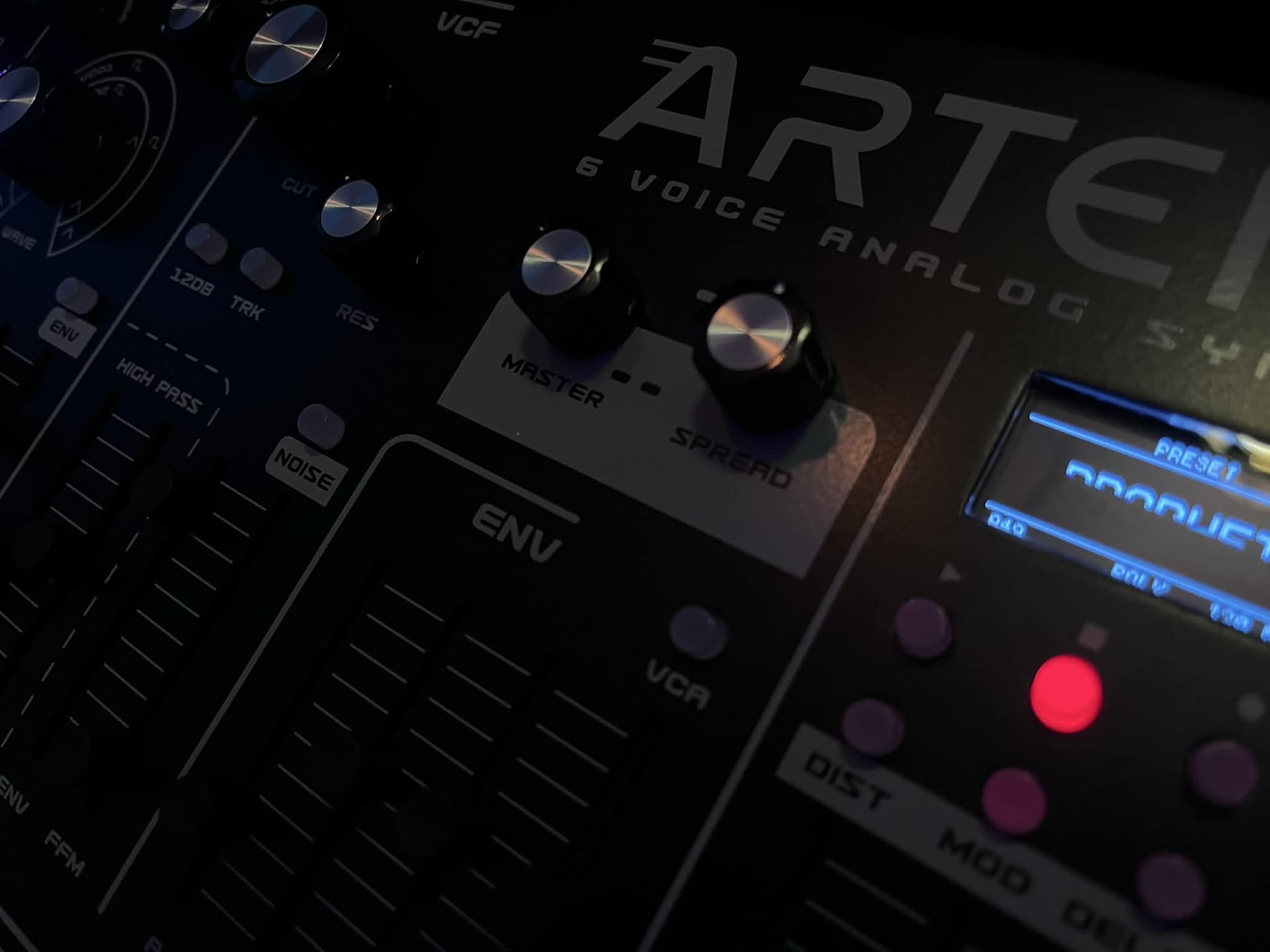
Also, I should point out that the Artemis has very close to knob (or fader) per function interface for all the most common things including effects parameters. I find it generally speaking at least as fast and intuitive as the take 5 and often more so. Filter overdrive, unison mode, drift, and osc1 tuning all require menu access as well as setting matrix mods, but the panel exposes a lot of useful common modulations directly and the effects and sequencer/arp aren’t any more menu-y than they are on take 5.
I do miss the extra arp modes and the octave range setting, but I send in arps from my sequencer most of the time anyway.
I’m actually with you here. i did not sell my T5 for the Artemis (i had to choose between the t5 and the M during a time when i couldn’t fund both, so i don’t have one currently), but i chose the Artemis versus getting a T5 desktop this time.
and i agree, i did not like any artemis demos. the T5 was my favorite synth ever (or tied with the M, not sure about which i like best) but i was not interested in the Artemis at all. until i started seeing recent demos where people are finally giving it a chance and its getting into the right hands. i will try to make some better demos and patch examples when i get some time to illustrate this
i think the t5 is almost perfect in a lot of ways. very rich sound, extremely powerful mod matrix, i love its envelopes and modulation options, i love almost everything about it. so i thought the artemis would be a lot less powerful. but theres something about it. it sounds pretty unreal. it is a little harder to get those extremely modern but still thick james blake/rival consoles sounds and the eg’s dont loop. and you cant stack modulations like pushing osc2 into osc1 5 times, then modulating the mod slots. BUT, its less tedious to do complex modulation on here, the tzfm does sound pretty good, and the mod matrix is very close, except that its just easier/quicker. so i’d still say its not as quite deep technically, but there are so many little interesting sound design tricks you can do and i think the core engine is a different character. and i don’t think you’d feel like you were really missing out in terms of sound design power
one thing i loved about the t5 is that it felt “mechanical” in a way. the envelopes felt like they were actually physically clamping down on the amp/vcf and you had real control over every dynamic, every transient. but here, by contrast, it feels “organic”. like you’re sculpting something unruly and beautiful from clay with your hands. i know that doesnt make sense, and im struggling to articulate this right now but as jeff says, it is less menu divey, which isnt usually a gripe of mine, but here it really is more hands on and nice to make sounds and tweak them. the mod matrix is very intuitive and easy but powerful
its less arduous. the raw sound is more interesting than the t5, you can still morph waveshapes dynamically. the fx are not only usable here (in contrast to the t5), but very tweakable and add to the sound (like people say about the deepmind) so they become part of the patch and they have a lot of room to explore within their parameters, especially in realtime or when modulating them. and the sequencer is actually usable and very fun to make creative phrases and rhythmic patterns on, then tweaking as it plays
it just feels more satisfying to do the same things id be doing on the t5 with this synth. and its faster and feels more natural. its as if you put a better core tone in the t5 and made it a little less tedious to patch. and i prefer knobs (especially the t5 knobs) over faders typically, but i have been really enjoying playing this synth. there’s something about it man. it has some of that murmux magic. i dont know what it is, and maybe it doesnt fully come across in demos, but its a gorgeous sounding synth
this is coming from someone who was proselytizing about the take-5 to everyone for the first 2-3 years it was released as if it was the greatest thing on earth. i still love that synth (top 3). im just giving you my perspective as someone who had the same exact thoughts you did
Is it true that Artemis has “linear envelopes”? Testing it with the latest firmware it sounds like “weird voice stealing” is happening, but upon closer look I suspect it’s “not very natural” envelopes.
If so, could an option of log/exp curves be considered for an update?
i would love that. good question, but yeah thats my only real issue. you can recursively modulate stages, but i havent experimented too much with that yet. i wonder if its the same as on the t5, where you can modulate the decay of eg 1 with eg1 to make it bend either log or exp (via + or - modulation)
faster lfos would be cool too, but thats not something im too mad about
lately ive been trying to get a better picture of how the envelope lfo shapes behave. it seems like the fade adjusts the attack, which makes sense. i’d almost like if we could have an option to keep those looping continuously, but also given the ability to manually adjust rise and fall like a function generator so it’s not just the same as the ramp lfo. in fact, if they could pull that off, they wouldnt even need to increase the regular lfo speed because the fall would determine the speed of that looping env lfo shape
Great observations though i woukd not say the Artemis is “better” than this or that hq synth, each has its own strengths i guess. And your demo does shows so well how different they can sound! Would also love to hear sounds from layered Artemis and T5.
There is a Artemis request thread at gearapace where inspiring ideas are collected.
Thanks @jeffroman and @less_wexners for your interesting comparisons to the Take 5! I think I will stick with that one, I rarely have time to use it anyways, and when I do, I love it. I don’t care about most functions on a synth these days like all of the modulation options you’ve mentioned. I mostly patch like I had a Prophet 5, with basic LFOs routed to tune and cutoff at slow tempo and little amounts. And then I just play around with envelopes, waveforms and filter. I don’t save it recall patches with these synths that can’t jump yo the actual value of a knob like Nina does.
I guess both synths would do that really well. I’d appreciate that Artemis is smaller and more “Elektron shape”, and I’d love having sliders over knobs. I would miss the dedicated controls for both envelopes and the FX. I know the FX on the Take 5 suck, but they can be used to add a little bit more character to a patch, and they can be used in a band context where you don’t really hear how crappy they are but notice that they make things sound more interesting. I’d also miss the Take 5 hold function, or does Artemis have one? I often just play a chord or arp and hold it to then tweak away in a live context. Oh and I guess I would just miss that Prophet sound, I’ve listened to too much Radiohead ti not miss that in my palette.
Something I appreciated about Artemis is that it has the controls for routing LFOs to oscillator tune and filter cutoff right there on the panel. Does it still work like that on the latest OS? I read somewhere that it has changed and is no longer hard wired, but I assume it still can be by default and then you can use those knobs on the panel?
its still hard wired, but you can also open up the matrix and with it open, move one of those faders and it will set automation for that. so you can use another lfo to modulate that normalled modulation of lfo to cutoff, etc
i find the t5 fx useful. esp flanger for soft tape like drift at subtle values, the hpf s great for bass enhancement (but i prefer the artemis hpf), ring mod at very slow oscillations to get a kind of Shallow Water undulation, overdrive for character
i also love the sequential sound. i love everything about them. one thing i appreciate a lot about the t5, even over my waldorf m is that it really feels and sounds like you have this unruly raw electrical impulse and you have to wrangle that into something musical. and on the t5, you can get it really tight. so this is an ineffable quality so im trying to explain using metaphors, but on the artemis it feels slightly “flabbier”, not necessarily in a bad way although i know thats a negative term in the context of synths. but that aspect also lends itself to more character and more natural sounding timbres
so to me its like the best of a roland, the best of an oberheim, the best of a moog - just in terms of the raw vco tone - but with more control over the modulation. but yeah it isn’t very sequential-like at all to me. so it was a hard sell but im glad i decided to give it a shot
im with you though, although i disagree about complex modulation. thats the best part of the take-5 for me. i wish all synths were that deep with all those mod sources and destinations and all of that control over recursive modulation, self modulation, modulating mod slots, using audio rate mod sources to modulate other audio sources, polyphonic voice spread, modulating the slop/vintage parameter (by the way, if you push the vintage mod destination really hard with multiple successive +127 mod slots, you get very interesting results), and the ability to fm one vco with the other, while hard syncing one of them, AND morphing the waveshapes and tune of both oscillators dynamically. then of course bending and pushing the envelopes and lfos recursively, looping them and using them like a Maths function gen, using filter out or audio out to modulate the filter, even just pushing a parameter beyond its front-panel max value range by using 3x time +127 mod slots on whatever knob with the DC offset mod source
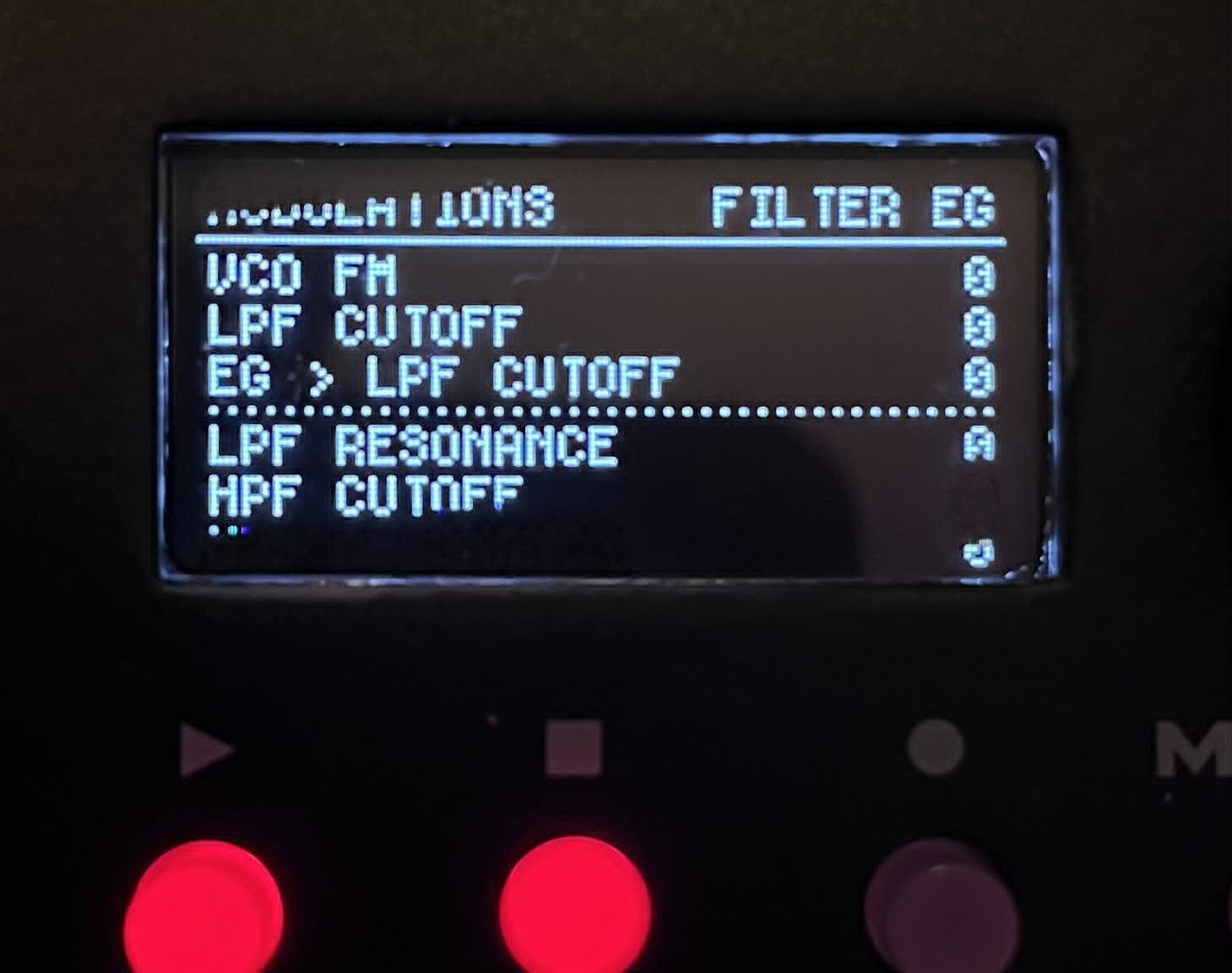
it is really cool on the Artemis that those front panel modulations are hard wired even in the mod matrix, so you can modulate those modulations as well. like here, im in the filter eg modulation settings where i can push the amp eg into filter cutoff:
its weird to have useful intricate beautiful effects in a massive analog poly like this. im really surprised by how much i love them. always in subtle amounts, but they’re all great. the barber pole phaser is so excellent for shaping the body of your tone, the soft clipper, the clouds reverb (although i use “huge” more often for more traditional massive nonlinear types of ambient room verb), the bbd chorus, the ping pong delay. so good
I made a sort of Sequential-style patch on the Artemis 2 nights ago that I cant stop listening to/playing:
I have just spent my first hour on the Artemis. Plugging it in and listening to it for the first time gave me flashbacks to the first analog synth i heard in person. This thing sounds so extraordinary that I did something I’ve never done before on the first day of owning a synth: I peeled off the screen protector and threw it away.
Here’s a demo with presets created using the 1.2 firmware. Maybe you find it useful. I liked the Artemis quite a lot before the update and - especially thanks to the extended mod matrix- like it even more, now.
(In case you’re interested in that sound pack, please use the code “MEDUSA” for a 25% off)
I’ve listened to Artemis, I’ve listened to the UDO DMNO. I’m confused. Very confused.
I’ve never had such a hard time choosing between two instruments. Usually I know pretty quickly what I want, but this time I keep finding reasons to choose one over the other
Having just bought an Artemis, I have to say that youtube clips do not do this thing justice. I hope you’re able to compare them in person. From what I’ve heard, the DMNO sounds amazing, too.
Yeah, it’s definitely rare for me to get excited about phasers and flangers but the sinevibes stuff really adds a layer of intrigue when paired up with the gorgeous dreadbox synth sound.