I’ve submitted several support tickets on the Elektron website, and have not gotten any reply other than once saying that they were on vacation and would reply when more people were in office. That was months ago. I originally submitted a ticket for this issue about 2 years ago and never saw a fix. I recently started using the A4 again with the most recent firmware and see that the issue persists. I started submitting tickets again since back in May of this year, and it’s like just throwing them into an abyss.
Is it essentially pointless to submit any sort of support ticket request with them?
My issue that I had with the A4MKII is for envelope shapes that are supposed to retrigger (envelope options 1,3,7,9 & 11)
I noticed that options 1,3, & 7 do not actually restart from 0 unless the Attack parameter value is 1 or greater. Even still, the envelope does not fully restart from 0 until the Attack parameter is about 5 or greater.
The issue is most noticeable with envelope options 9 (Full attack, linear decay/release) & 11 (Full attack, exponential decay/release). With these two options, it doesn’t matter what value Attack is set to, these envelopes never restart from 0 if triggered again before the previous envelope completes.
I can hear this is the case from using these envelopes to modulate different parameters within synth tracks 1-4, as well as I see this visually by using the CV Track outputs into an oscilloscope.
From my experience I can share that there seem to be a number of issues with A4 that have been acknowledged by Elektron Support and they do keep replying they are working on solutions. Some of these issues have been reported long time ago.
Keeping this in mind it seems obvious, that priorities are different and/or resource availability to work on these fixes are either very limited or bound to other projects.
For a product that has not (yet) been declared legacy I find that mildly frustrating sometimes, too. And I’d rather have a clear and honest statement about the plans Elektron are having with the analogs.
Still it’s an awesome synth with excellent capabilities I wouldn’t want to live without. That makes it a little easier to accept there’s some quirks here and there.
Apart from that there have been numerous controversial discussions around elektron’s support response times across the board which might at least give you the idea you’re not the only one with this kind of experience.
The reason being is that it always effectively has an infinitely fast attack … the reason you are not noticing it as much with 11 e.g. is that it has a faster decay from the ‘max’ level - with 9 you just need to speed up the release so it behaves a little more like 11 does in practice
I can set one test case with a fixed envelope profile (attack 1) and hear a difference for all 12 envelopes when they are cycled through one by one … it’s subtle (because the envelope is extremely fast) but it’s just about noticeable in every case so there is a difference between each envelope and each pair (with/without retrigging)
the question is, what do you expect to notice when the envelope is infinitely fast (when set to zero) ? is it reasonable to notice, what can be noticed ? what it the practical utility (to you) of having infinitely fast envelopes in this case combined with a reset when it’s so hard to discern … why not satisfy your need by having the attack set at a modestly fast level such that the reset is evident
it is clear to me that the envelopes are internally doing what they are intended(i.e. able) to
you do realise that for 9 and 11 that the attack is effectively a hold time - so there is no difference varying the “attack” time there, it’s always the same profile at the leading edge - although, for some reason, there appears to be a subtle difference between 8 and 9 and also between 10 and 11 which i can’t quite rationalise (given the attack phase is so steep, but perhaps not infinitely steep)
wrt your support issue, it’s periodic that support will be short staffed so there is an ebb and flow there, however, i can’t imagine that it will help if you resubmit issues (especially such marginal ones) time and time again
i can’t explain why you haven’t had a definitive response, but i wonder if it’s been bounced back to the developers who know(presumably) that the envelopes behave as they intended internally, but also that it’s a subtle affair when the attack times are set so quickly
i can only suggest that you illustrate, with a practical example, how this is materially important to you … with particular reference to why you want both an infinitely fast attack and a reset
perhaps we can tease out a bug, perhaps (more likely imho) we can arrive at a compromise
but please don’t resubmit tickets time and again (or use Elektronauts purely to rant, why not discuss the issue here within the last two years, as suggested on the Elektron support site, we’re all equally invested in having working machines, that’s why i looked into this … i’m satisfied that the machine works as it needs to in a practical sense, but i am open to be persuaded that it is perhaps compromised in some use cases, by virtue perhaps of having digital controlled envelopes, but is it really materially significant to compromise and use a “slower” attack time (keep in mind this is meaningless in 8, 9, 10 and 11 where it is a hold time value at max level following an instantaneous(they use the term immediate) attack )
Quite what happens an the CV track i am not so sure (haven’t looked yet), but if you are monitoring a zero voltage threshold here it may have a significance to you, but it can still be tempered by some of the arguments above in terms of practical (rather than academic)
None of this is to say that there isn’t scope for complaint, but it needs context and clarification
What I expected to notice is what the manual states should happen. Straight from the A4MKII manual “A dot to the left of the visual representation of the envelope indicates that the envelope will restart from level zero each time it is trigged.”
The practical utility would be for a snappier sounding envelope, such as for creating drum/percussive sounds. This could be noticeable when assigning the envelope to modulate pitch in designing a transient before the body of the synthesized drum sound.
There could be differences in sound between an envelope that starts at 0 every time it is retriggered and one that restarts from the last level it was at when retriggered. I initially noticed from listening to the synth tracks, so I checked what the different envelopes looked like coming out of the CV tracks when assigning an envelope to CV Value, and it looks to confirm what I was hearing.
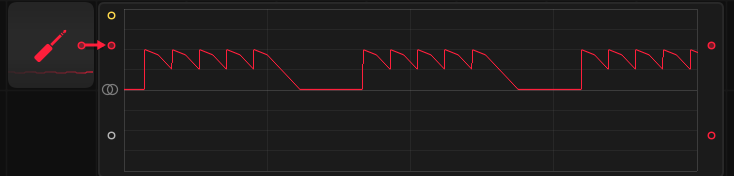
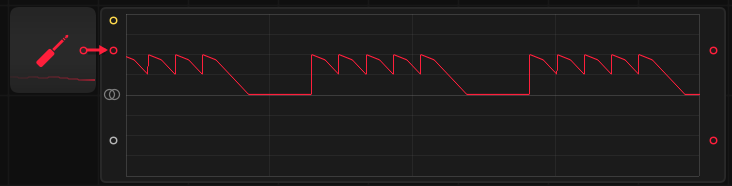
Here is a scope of a CV track with envelope option 8:
As can be seen, with option 9, when the envelope is retriggered before the end of the decay or release, it does not start from 0, rather it starts from where the level was last - which makes it identical to the behavior of envelope 8. So if this is the case, why have 9 as a separate option that is supposed to start from 0?
In both of these previous examples I had Attack: 0, Decay:60, Sustain: 0, Release:40
Another practical utility would be if I wanted to use the CV tracks to output an envelope and mult the envelope to simultaneously use the rising edge to use as triggers or gates. This is not possible if the envelopes do not restart from zero when retriggered.
Yes, I did realize that, but I don’t hear nor see any difference between those options, as shown in the first 2 examples I showed above. If there is no difference between the two, then what is the point of having separate options for 8-9 and 10-11? Unless I’m completely overlooking something ?
I guess this is lesson learned to seek more help through the forum first. I just assumed that submitting a support ticket would get me a response direct from someone who knows the inner workings of the A4. But I never even got an acknowledgment that my issue had actually been reviewed or considered. So I appreciate your thorough explanation here, and after experimenting some more, I can see it doesn’t make a material difference in most use cases, but it was just confusing as far as what the manual noted should happen, what I expected should happen, and what I was hearing.
No, definitely not. My experience of needing repairs has been excellent. They replied quickly and arranged everything.
A problem in the device firmware is not something that can be fixed so easily. Maybe they don’t want to commit to fixing something, or maybe they don’t even consider it to be a bug, or just haven’t been able to reproduce it from your description.
I have two tales of support tickets. One with my OTmk1 and one with a A4mk2. The OT was under warranty and I had to send it to Sweden for service. That being said, everything was super fast (considering I was sending it to Sweden). This was 2017.
With the A4mk2, it was not under warranty. The ticket request went pretty smoothly. I sent the request on April 12 got a response to send to the US repair facility on the 18th and posted it on the 25th. It is still there. I asked for updates about once a month until this month when I reminded them they told me they’d have an update in a few days and three weeks passed. It’s waiting on a part and they should get to it this week.
This is just my experience. It’s also possible that Elektron is not doing repair/customer-care in-house any more, and they likely contract with an outside company that may service Nord, Roland, whatever. In both my cases it was hardware issues.
I definitely wouldn’t submit more than one ticket for the same issue. And it sounds like you let it sit for a while (or let the issue slide) and then resubmitted a new ticket with the new firmware. I dont know if you posted to the forum on the issue before contacting customer care, but I know the A4 forum sees a lot less traffic than the DT, DN, and OT forums.
The problem with traces like this is that (to the outside viewer) they pose more questions than provide answers
I appreciate that you may be frustrated, but in order to get into the guts of this we need to be focussed a bit more on the details
e.g. we have no idea what the resolution of the device you used to capture that is, in terms of timescale, in terms of its resolution, in terms of the graphical rendering and in terms of the pixelated image - all that can mask a lot - as can certain cases, particularly where the eyes are leading
the hearing is surprisingly good at picking up tiny anomalies, that’s how i was able to satisfy myself that the envelopes were behaving differently (between each shape pair)
that in itself (an audible difference) doesn’t prove anything either, but it’d be hard to imagine that the envelopes were not all distinct
where we get into darker waters is where we have to start accounting for compromises
we are not describing a precision instrument for scientific analysis, we are discussing a musical device which for various reasons will have to have compromises to avoid unflattering outcomes, there may be programmatic reasons to implement an idealised algorithm or shape in a particular way and so on - all we can do here is assess the version we have (an idealised one) against what we hear (or see)
In reality, in terms of the synthesis, there is a lot of variables and in some cases the differences may be audible
the reason i looked further into this was because of my comment on a zero crossing, i don’t have an interface with dc coupled inputs (they both have dc coupled outputs) so i didn’t test against the cv case which would be the most simple and clear
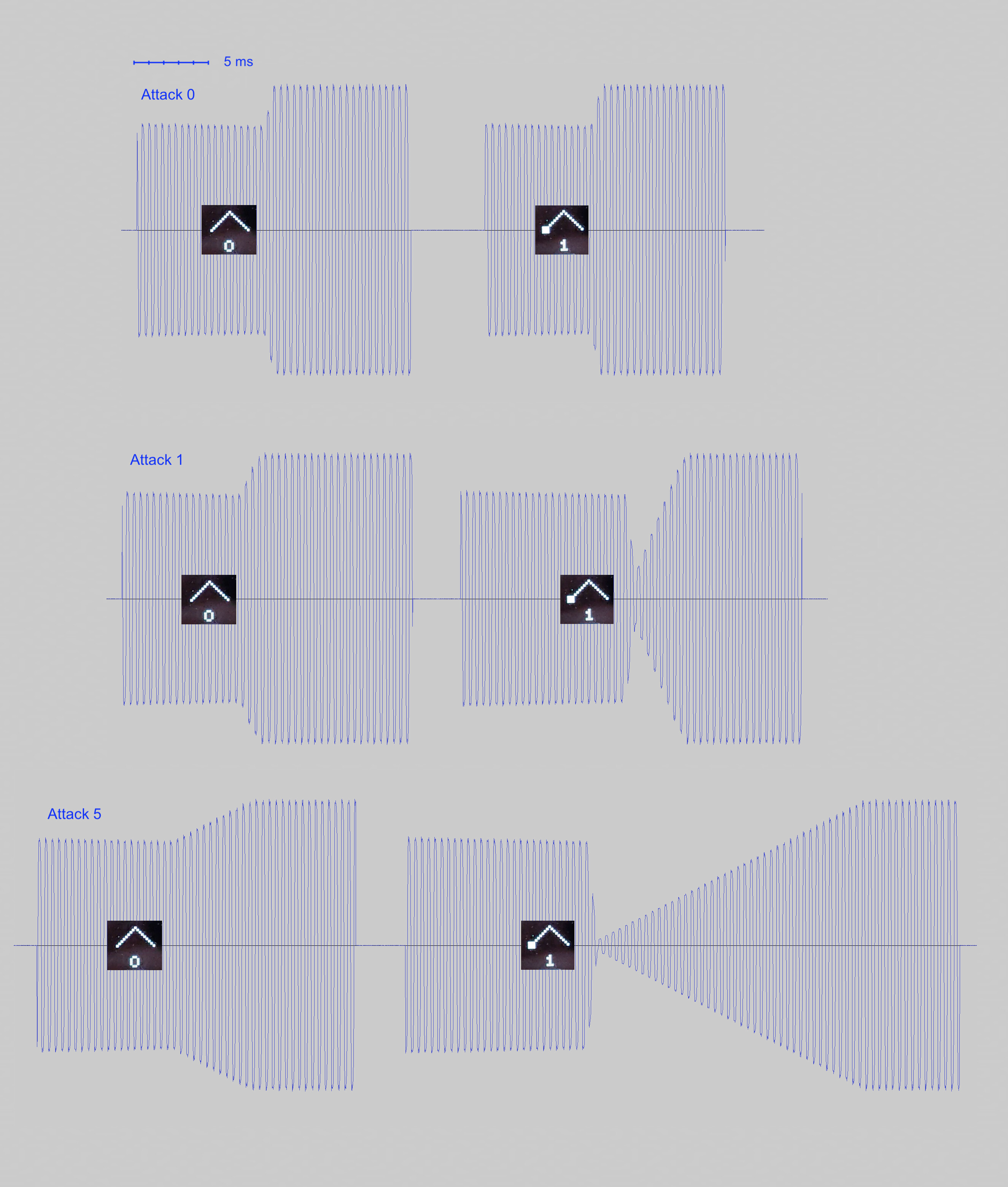
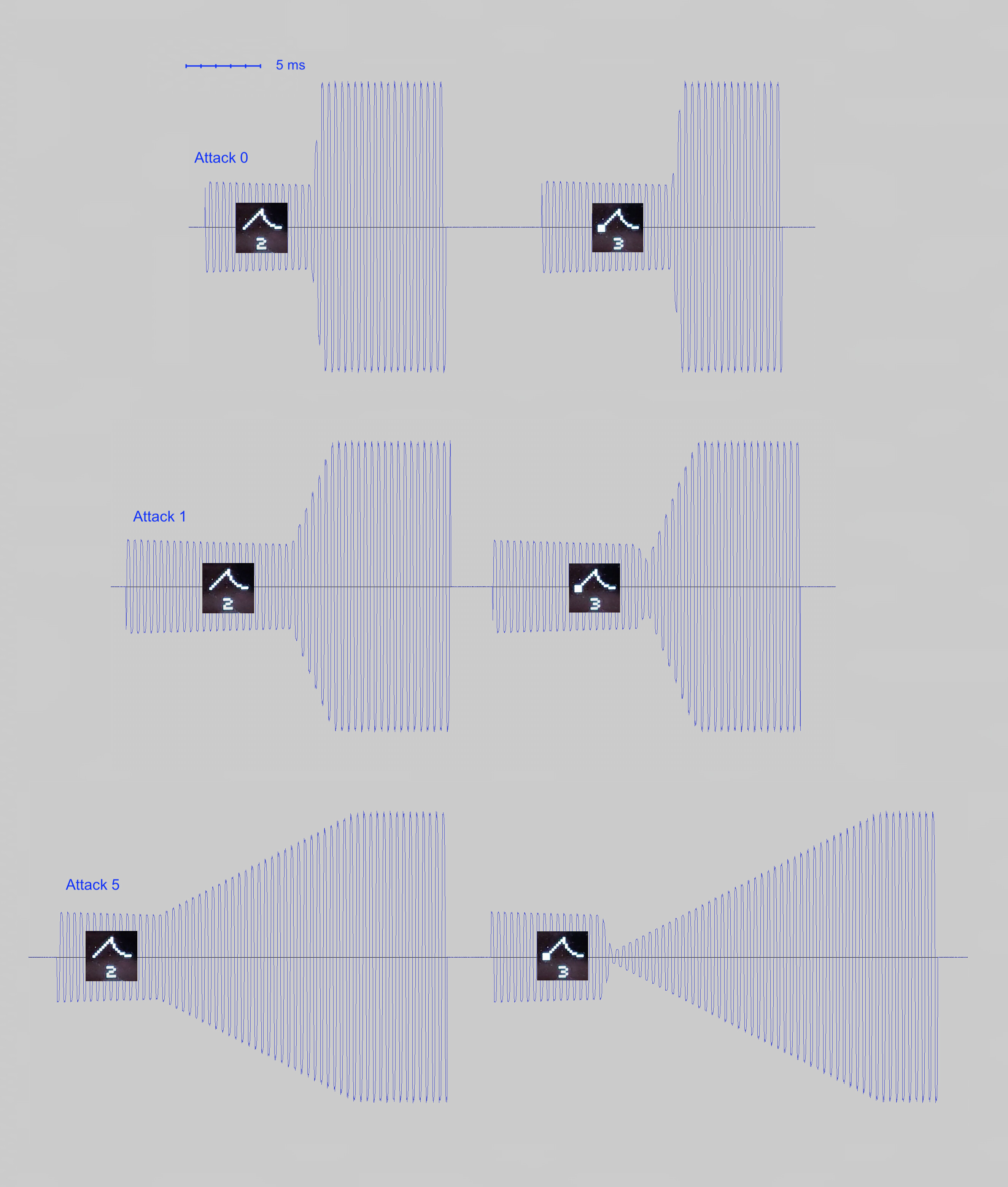
all i could do was try to keep it basic - so i have a pattern with 24 trigs over 48 steps so the release always rings out into the next note, there is always an overlap, so the interval between overlaps is also consistent
This is why we see some boundaries between trigs starting with a lower release level, before the “attack” transition … each transition is between two consecutive trigs of the same envelope type
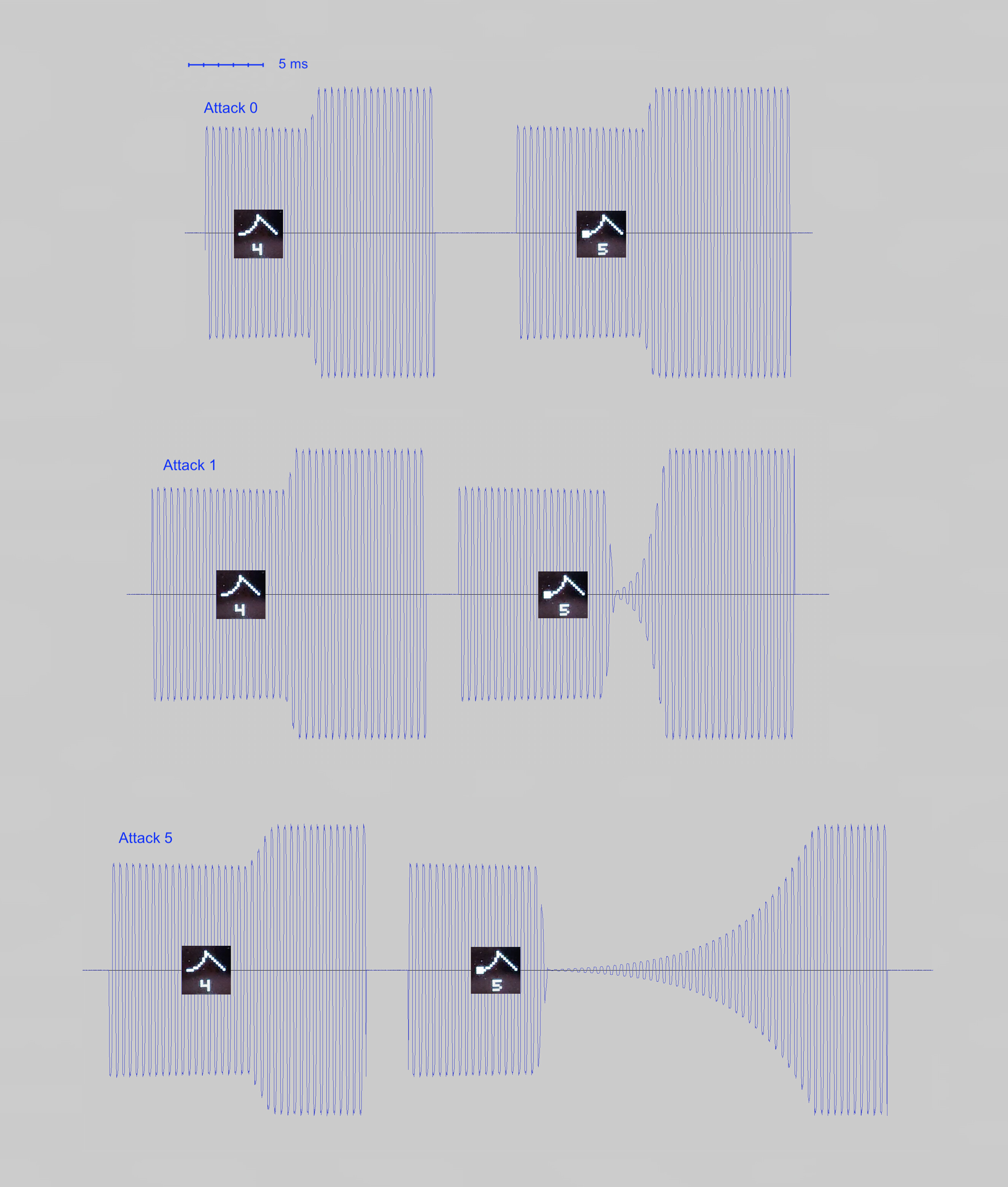
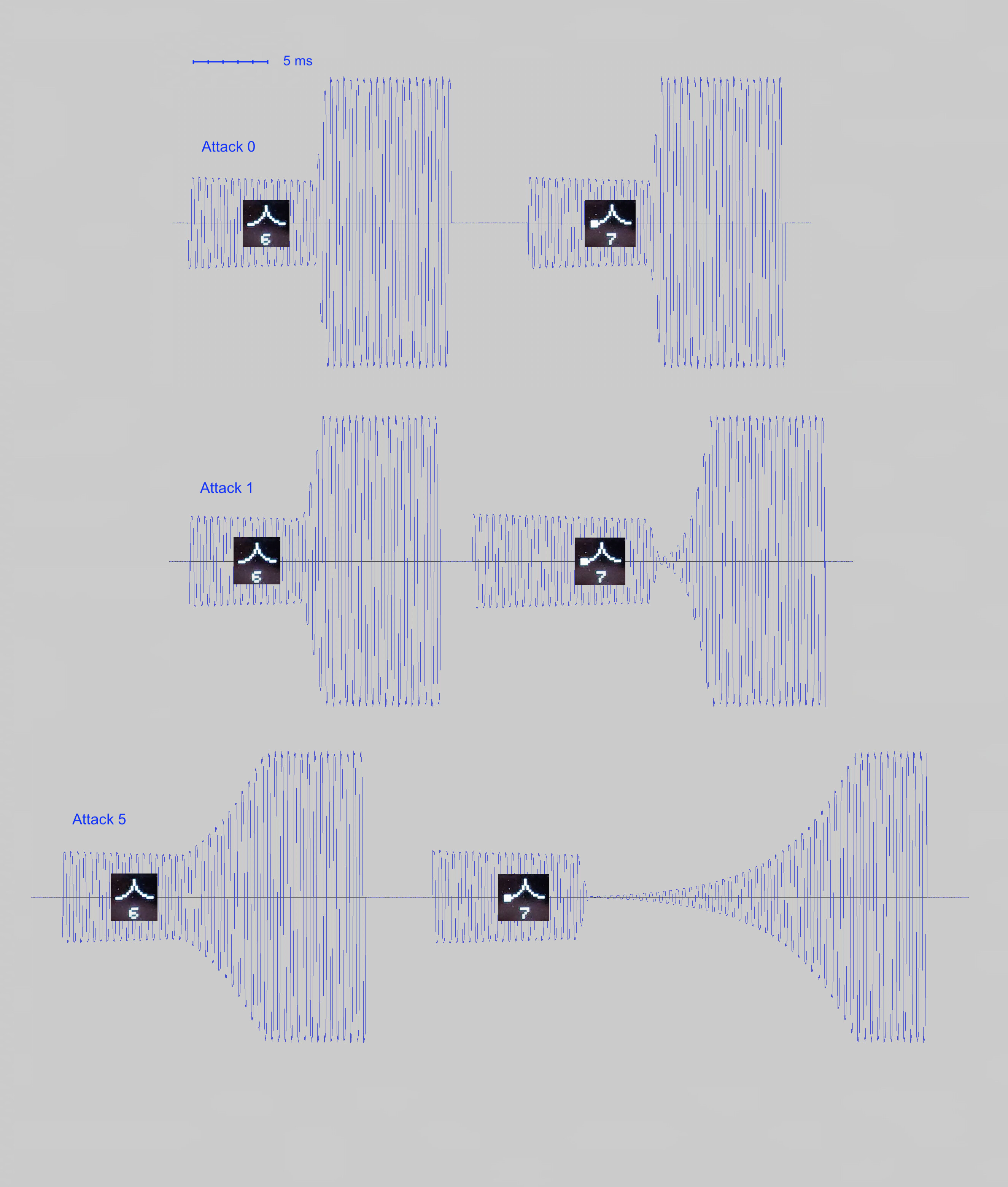
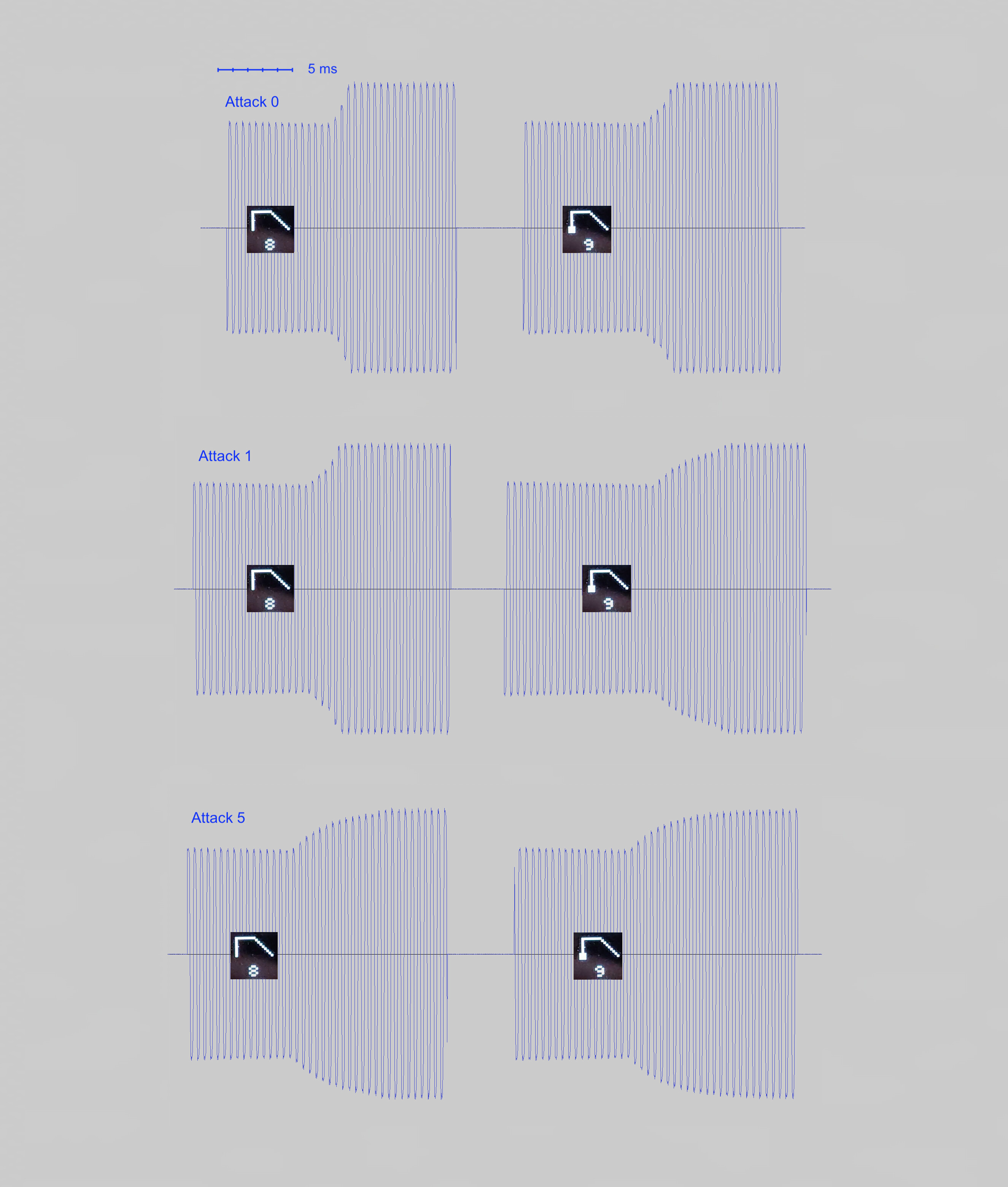
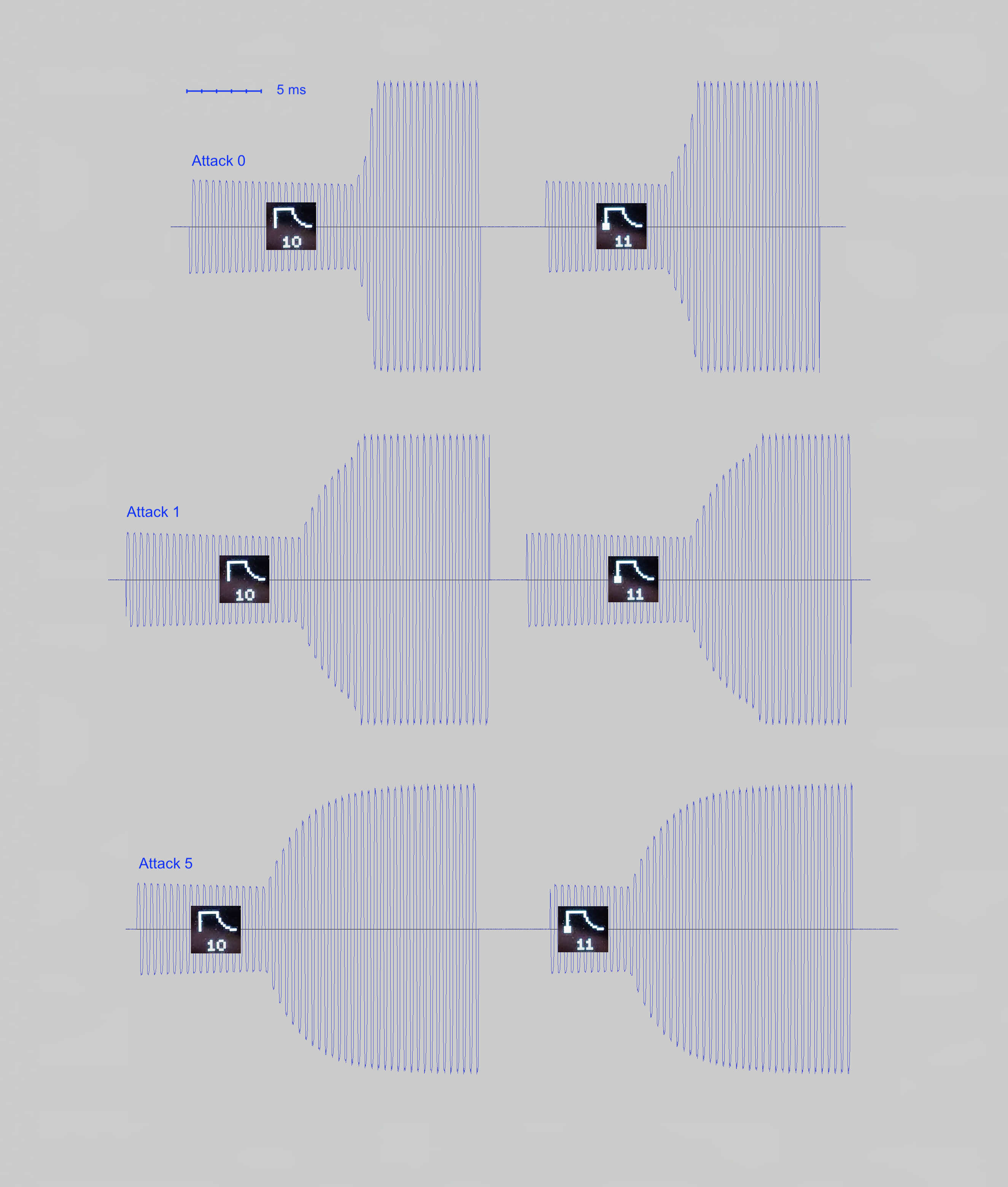
so there are 12 envelope types 0-11 and for each pair (i.e. the normal and resetting version of a shape) 0-1, 2-3, etc we have three variations in the attack time 0, 1 and 5
The sound is solely made from a resonant filter which is constant and of sufficiently high pitch to be providing ‘sampling points’ for plotting the shape profile
it was well within human hearing, but very high - for context i have annotated the sketches with an approximate indication of 5ms in time (i’m nervous that value is in error, but i read it from audacity)
the only activity is that a resonant filter is being opened by the AMP envelope - the trigs are all p-locked to different attacks and different shapes
I think that’s about it, it’s not rigorous science, but i’ve done my best to remove as many doubts as i could reasonably manage about what is ‘revealed’ visually (there’s not a lot to chew on audibly although the “resetting” is audible, perhaps more-so due to the gap in level when the attack is long)
In essence, it will raise more questions, but i don’t believe it yet illustrates that there is an issue … we do see a divergence from the idealisation of a shape, in particular wrt the notion that we are starting at level zero
to clarify what is being seen here - these are highly zoomed views of the area in and around the transition from one amp envelope releasing and the onset of the same amp envelope shape attacking - we are looking at truncated snippets of the audible signal at that boundary between two identical overlapping envelopes such that we can observe what might be happening
i think the envelopes are not implemented in an idealised way, i think they are subject to practical and aesthetic realities, but there’s not a lot of precise ‘zero crossing’ - we can discount the percussive envelopes as they don’t have an attack per se - we need to know what rules these follow - plus the case for an attack setting of 0 behaving differently when reset or not is hard to make for some shapes, except the slow gradient ones
I am still open to this being as intended, but i am more interested in being convinced that it is, or put another way, i’d like to understand the way it’s being implemented - only then can there be any evaluation of whether it’s doing what it’s meant to - there may well be some issues, but in most cases it is probably academic and not that likely to have a musical significance
you’ve certainly got me wondering about this
anyway - the plots, these are high res, so they are best viewed on a 4k screen or zoomed in until you see the steady sin waveform and the amp envelope profile at the transition (otherwise it will look like a moire plot)
I have a report ticket for my ARmk1. Got a response right away and even a reply past that, but once the problem seems like it could be hardware(or just weird behavior) I have not heard a peep from them. I have asked twice if they are vacation or even if they could just reply they are working on it… but silence. Honestly I need the machine so much but I am so broke right now that I haven’t bought another one…
I still hold out hope that they will reply and let me know that they can fix it or I am fucked… either way it would be nice to know…
I’ve reported several bugs from via support but didn’t got anything except from the automated response. the bugs are not deal breaking but no one actually answered my tickets, so I’m not sure if to reiterate them or just keep waiting. it’s been ~2 months…
Coming back on topic, would you agree with these observations:
Independent of selected envelope shape attack=0 renders retriggering from 0 ineffective, while attack > 0 shows the expected behaviour, with …
… the exception of shapes 8-11, where no retriggering from 0 can be observed, no matter what attack you set?
And while I’m at it: Thank you very very much for taking some time and sharing such a detailed look into your analysis and findings. These might be niche topics, but nevertheless are, at least to myself, invaluable for controlled sound design and putting things into perspective.
Faced only with what remains from that little examination (the visual snapshots), those are both tempting conclusions. I think i alluded to being careful to avoid being definitive when you have considered only some of the cases. So I will resist definitive statements, however, equally i’d presently struggle to propose how the first observation could be challenged. With regards to the second one, that too is a puzzler … the attack in that case is supposedly defining a “hold” period yet it clearly has some bearing on the “attack” profile.
What’s harder to propose (with what little i have considered) is what is the difference between 8+9 and 10+11 … yet, inexplicably, at least for attack settings >0 i could hear differences (certainly for preliminary investigations, this was not my only ‘take’)
The wavelength of the resonant filter is a bit low relative to some of the potential envelope events, so i still think it’s a poor substitute for tracking a CV trace directly, but there’s some strong hints that envelope transitions >0 are ‘managed’ … almost like a very brief slewing, and if there was any slewing then it would be both advantageous for click prevention and it would mask instantaneous attempts to reset to 0 and progressively improve with increasing attack. There is a transition gradient when the trig starts the envelope, the descent down from the termination of the previous releasing level is not instantaneous, or it’s filtered(slewed)
There’s probably now more questions than clear answers and i’m hoping we can eventually get some inside knowledge on those …