Digitone II Feature Requests

Fill only allows for some triggers to be triggered, it can’t change timbre on the fly (tho there are some workarunds with yellow trigs, but you’d have to place them everywhere). For example, I have a chord pad trigger that lasts for eight bars, I’d like to turn filter cutoff and resonance up whenever I activate Fill mode. And now imagine all your sounds are programmed to react to Fill in different ways timbre-wise. You could drastically change the way your track sounds with one button press. Isn’t that cool?

For me, as a Bitwig Studio user, this is an obvious and simple idea. It might not seem so to others, I reckon.

FUNC + Filter, i.e. preset settings.

Mute is on/off as well, but can be controlled via MIDI CC. There are other on/off MIDI controllable parameters.
By the way, would be cool to have the ability to sync Fill state between DN and DT.

Like the Hapax, it would be great on the DN2 to select a scale and root key and then get it to create random notes across what ever size your sequence is set to. On the Hapax you can do this, plus also set the % on how many random notes are generated and the velocity too. It’s great for happy accidents.

2 Likes

I would love to have the arp offsets be able to be in line with whatever scale you are in.

I would love to have insert fx. The current fx button is only one page and i think i thought insert fx were coming. now that i know they can do that on the tonverk it would be nice to have an insert delay and to param lock it!

I would love the arp to work with midi too. and it would be nice to have a arp presets that arent just saved with a sound but on the arp menu.

I would like the track layering to be back on the unison button to be able to use as a performance feature like on the old Digitone. its a bit menu divey now to find track layering while playing live and use a perfomance feature would be nice to tap unison button twice and get to it.

3 Likes

not sure if this has been asked already, but it’d be nice to filter midi note input to scale, so you can play in the scale with an external keyboard.

It’d also be nice to have a force to scale option where all sequenced notes can change depending on the selected scale.

3 Likes

Its not the same but smashing in chords with the euclidean sequencer is a great time! Definitely happy accidents there. Would be great to have a second page to set intervals or something with the KB modes

1 Like

Unless there’s a plan in the works for a wavetable device in the future, why not add more wavetables in the wavetone machine?

7 Likes

another one, it’d be nice to change osc phase reset on the swarm machine for bass sounds. Maybe have the choice to select phase of main osc and swarm separately.

I’m sure some of these have been suggested, but here are my suggestions for new song mode rows:

  1. Start point. Choose which beat/trig to start the pattern on.
  2. Fill state. On or Off.
  3. Transposition: +/- 1-24 semitones, with the option to lock to pattern scales in the song preferences.
  4. Trig playback direction: forward, backwards or random. Because why not.

The transient section of the fm drum is basically the little pcm sample transients you’re looking for. I doubt they’d add a dedicated sample engine as it’s a synthesizer albeit a very flexible one.

On the comb filter the base width filter has a pre and post option. Please also add a third option to have the filter inside the delay loop of the comb filter. So basically, right after the delay, but before it feeds back into the input signal. Combine with a mix amount between the unfiltered delay and the filtered delay this would open up a huge amount of realistic sounding physical modelling possibilities.

This give an idea of what a filter inside the delay loop sounds like https://youtu.be/1Db9rGbth_o?si=6ZmBL0tx6cEjH1dy

4 Likes

From my playing around with the comb filter it has the potential to make some good sounding acoustic drums combined with the FM drum engine. I’ve also heard some very realistic sounding snares in the factory demo songs.

This.
Or at least the ‘do not restart pattern’ option in song row.
My patterns are usually quite long like 16 bars or more. I often want to mute or unmute some tracks for the last 1 or 2 bars of a pattern. Song mode doesn’t allow me to achieve that.

They just could copy what Polyend did in Polyend Play, which has like 30 different play modes that also can be changed on the fly while performing.

2 Likes

VO-6 type vocal synthesis machine from Monomachine

Formant filter and z-plane filter types, think FS1-R and Morpheus.

Would love to explore some choral timbres with chord spread.

3 Likes

I am missing the swing per track + editable swing trig track from the OT , it seems like it would be really good to have this on the DN2.
I see parameter slides has been mentioned already many times but I will mention again just incase it helps bring it over from fantasy into reality

6 Likes

I’m now thinking of a different approach to Arp p-locking.

Arp preset pool

The user can save Arp settings to the Arp preset pool.
Then they can lock Arp preset per trig, similarly to how sounds can be locked per trig from the Sound pool.
This way every Arp parameter could be changed on a trig level: Mode, Speed, Pattern Length, Range, Note Length, Pitch Offsets, Rotation, Step Skips.

This would be an IMMENSELY (sorry) powerful feature.
Save a bunch of Arp presets to pool, put some chords on the sequence, lock Arp presets randomly on the trigs…

3 Likes

so, this one is a stretch, but im just spitballing here:

i know that the nature of p-locks and “motion sequencing” during live recording/knob tweaking automation is inherent in elektron boxes and its the main component that compels me to work with these boxes

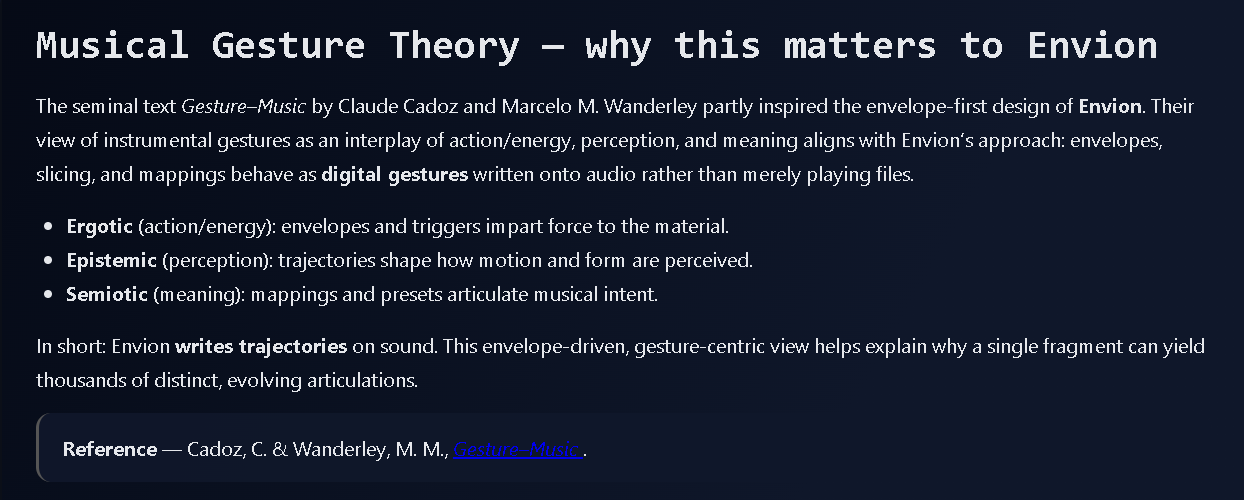
but i was reading about Avenir’s new Envion: Algorithmic Dynatext Envelope Sequencer for Pure Data and the concept of “envelope driven composition” really caught my attention

I believe that envelopes are kind of underrated in the hardware audio world, where we mainly get maybe 2 pretty basic adsr envelopes with no additional rate or loop controls, rarely the ability to route it freely or connect to other envelopes, and even if we do have that option (as in hydrasynth), the envelope is still often 4-stage and the behavior and contours arent really as malleable as one would hope for when sculpting malleable dynamic “animation”/expression of sound

i haven yet dug into this app, but the concept alone is very intriguing to me. what if we had the freedom to p-lock 2-freely assignable envelopes (recursively modulatable - with the ability to connect one to the other or send the adsr out to the adsr in), each with multiple customizable stages - per-step?

this is larger and more ambiguous than a basic fw update request and im sure it would add a lot of complexity to the p-lock limits and cpu in general. but, i think it would be really cool if elektron focused more on flexible envelopes as tools to drive motion in patterns of sound. you can achieve complex dynamic movement per-step with p-locks currently in the elektron sequencer, but the actual functions that determine the movement aren’t as flexible as i’d prefer in a perfect world . so i get that its not a realistic request, but maybe one day if elektron starts thinking about mod matrices or more complex modulation sources, they could integrate some 8-stage looping envelopes where each stage can have an incrementally adjustable logarithmic or exponential curve, sort of like in serum. and that would allow users to drive their patterns forward in a more fluid manner, more organically and sort of less rigid than a step sequencer allows

if the envelope time could be locked to the step which overrides the clock for that particular step, and we could maybe even have a reverse function, that swings a big logarithmic curve to the left of the pattern via a single step, which rises, then snaps the clock back a step. if clocks could be that malleable in the future, p-lock s could manipulate and bend time the way you can kind of drive the clock with multiple lfos in MN Rene

I’m not even sure how he’s using it in Envion yet, i am sure im underestimating the real power of an envelope driven compositional tool and i cant even fully wrap my brain around it. maybe you could even chain Zadar-style envelopes together to create a full sequence in some instances. but i think it’s a really smart direction for better articulation in sound design and composing. the most frustration i experience when working with hardware synths or grooveboxes or samplers is when i cant shape the articulation of a sound the way i imagine in my head.

so, not really a true request, but i wanted to put that out there into the world. even though you could argue that other tools exist with these types of features, i really am stuck in the elektron workflow and it’s just the environment that i personally feel would be the best platform for a workflow like this: in a complex p locking sequencer tied to 8 - 16 independent internal synth tracks/voices

Cadoz, C. & Wanderley, M. M., Gesture–Music .
4 Likes

I was happy to see tonverk as the first elektron I’ve had with an actual mod envelope and do wish they’d catch up on having mod sources sent to multiple targets at once, but have a hard time envisioning them doing this for the digitone ii or any digi sized box. I have many synths with really flexible and amazing modulation capabilities (multi/poly, peak, hydrasynth, 3rd wave, etc) and all of them share one feature: elaborate modulation on a patch comes at the cost of immediacy. With the digi boxes the entire value proposition is the balance of sound design power to workflow speed and I’m not sure I’d choose to use a digitone ii if deeper modulation was needed beyond what the macros could provide over something like an opsix, which was designed much more explicitly for that modular style and with dedicated modulation sequencing in addition to complex matrix modulation.

One thing I think would go very far in advancing your idea without fundamentally complicating the workflow would be the ability to motion record or parameter lock the mod macros on a track.

2 Likes

good point about mod macros. i agree. and im not sure i’d really need or even want a mod matrix in an elektron box

really, i just want mod envelopes, but ideally looping & with a rate and log/exp control, like function generator

i did anticipate this comment and tried to pre-empt it, but it is a fair point

i agree with the main sentiment here mostly. but if dn2 was more opsix like, i would be extremely happy. its an incredible box, but the opsix is extremely flexible and i think it sounds great. the only downside for me is that its not split into 8 individual polyphonic tracks that each have their own sequencer

using envelopes for driving dynamic gestures is a further extrapolation of what more complex eg’s could potentially do. i’m kind of just trying to imagine what elektron p-lock sequencing could possibly look like in the future

1 Like

One or two mod envelopes with loop ability and settable response curves would be a good feature, as would giving macro mods for the filter and amp envelopes and lfos but I guess they did not plan the data architecture that way at all. My third wave has very cool mod envelopes that you can use to introduce a lot of movement at various delay times, it’s very neat.

1 Like

@jeffroman @less_wexners

3 Likes