Do you want to procude only with hardware, or do you have working together with a daw in mind?
You can just use the 4 outputs to record tracks out four at a time for mono or two stereo, or sum them in any way you choose. But you cannot transfer stems out via USB, just the samples.
1 Like
He specifically says hands on, and you can get a used AH for 300-400 EUR (not talking about +FX)
1 Like
Together with a DAW but primarily produced on hardware.
Gotcha
A big part of the Elektron “way” is the sequencer. It’s a step sequencer. You don’t have linear time and the ability to place a note freely anywhere. Instead you have a fixed number of slots/steps per pattern. It’s more flexible than I’m making out (with microtiming, swing, flexible pattern and track lengths and “multipliers”) but it’s important to appreciate the limits of the thing, especially if you’re coming from a rich DAW or live band mindset.
5 Likes
I’ve never found this to be a hindrance with the OT since you can play a longform ambient sample from the memory card and trigger other samples on top by hand, or switch to external gear while the OT just does it’s own thing. Or program the drums and maybe a bassline on the OT and play on top of it.
1 Like
When you work with a lot of send fx in your elektron boxes it might get complicated feeding stems into your daw.
You can “grab” multiple tracks at once and get that into your daw, but they are dry.
With Octatrack you can’t record stems (no overbridget, and there are tedious ways around it), and Tonverk doesn’t have overbridge yet.
Just to keep that in mind, it can get complicated.
The DT2 workflow has been personally extremely gratifying.
Sampling is easy. Only 1.5 months into 1st Elektron but as long as there is passion, you can get the hang of it quite fast… I think. Especially with someone whose name is math*3 
DN2 seems also capable, it can as I recently learned (thanks @shigginpit) be used with a midi-kb to live-record chords played on both hands into it. (while DT2 isn’t meant for that.)
You can record each track of OT into the OT’s recording buffer, save it to OT data card then connect OT to computer via USB to access these recordings. Recording buffer uses OT’s RAM so there is a limit to the length of recordings.
Here is a thread about it:
And here is a video explaining the workflow:
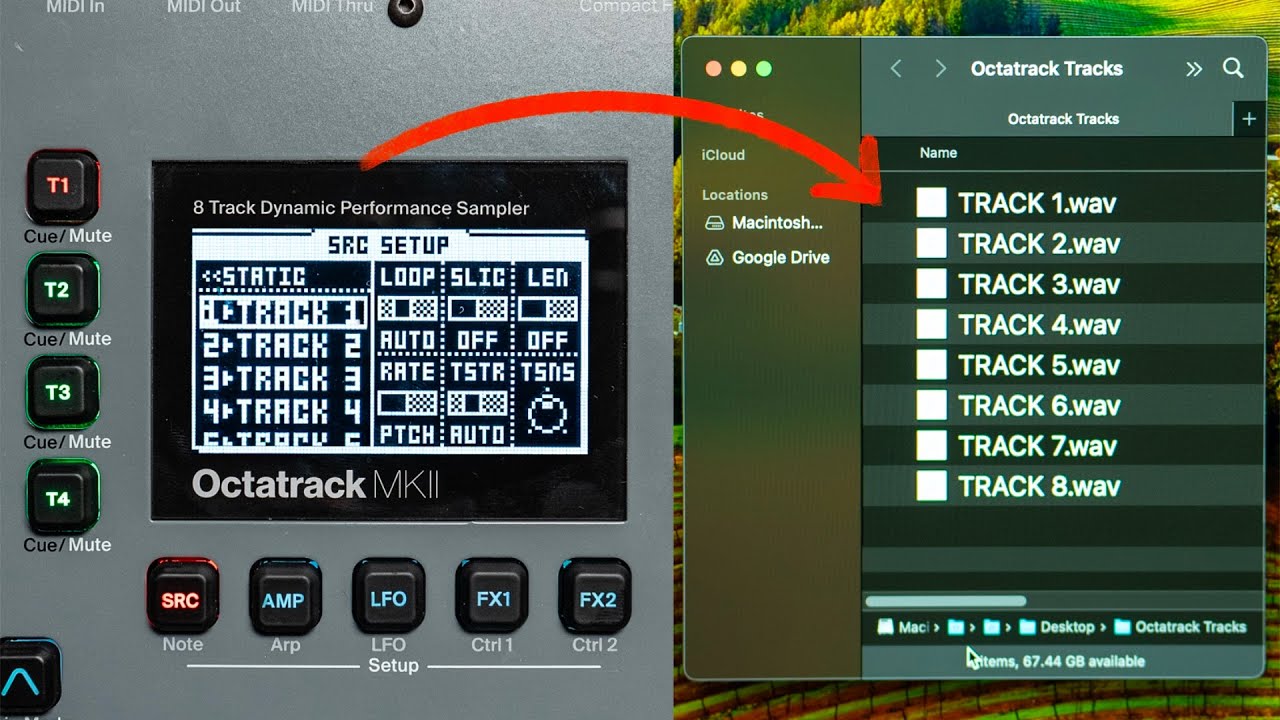
1 Like
The limit is sadly so low that it’s not really a good way of saving stems. I’ve found that just recording the tracks into a DAW is the fastest and least cumbersome way.
depends on your needs and genre I guess. apparently works fine for Ricky writing house and might be applicable for OP’s vision.
Years later
I know there are ways, but they take time.
And: have fun if you want to record scene mayham. You can’t easily reproduce xfader action with each record.
Sure, not saying my experience is the definitive one!
1 Like
the caveat here being that the total recording time is specifically limited, and pretty small. and as @gekkonier points out, you lose out on any performative cross fader stuff
like, yes in theory there are several ways to capture stems from the octatrack but they all involve caveats and/or tedious workarounds and unwanted limitations being imposed
2 Likes
Appreciated indeed - coming off of Logic, I totally get what you mean. As they say, restrictions can be very helpful.
1 Like
For sure. As @RT said upthread, it’s not a problem. It’s just a different way of working.
I can probably second this, as I like how the workflow makes me “focus”, as if it were. Working with a computer DAW made me feel much more intimidated with the bells and whistles they had to offer you, almost all in one go (even though you don’t have to use them). The power in Elektron’s devices almost makes me feel the same way, but at least the deliberately limited UI helps me not worry about that too much. Sound design is deliberately kept in a separate window to, say, laying down notes. A computer DAW lets you have all of it available at once, which may be helpful to some, but distracting to others.
I guess Elektron’s so far my only real experience with hardware, but with regards to computer DAWs, it’s a bit too easy for me to just Alt-Tab elsewhere and focus on that if I feel too uninspired without waiting for the device to switch on or off. With the step sequencer, I never really liked the exclusively real-time-based recording systems of stuff like in Yamaha home keyboards, as I don’t really find the challenge of playing every note without a mistake that enjoyable - I guess it’s similar to why there’s kids out there who prefer Minecraft to Lego, they’re not as bound by the laws of physics with what they want to create. Step sequencers to me are a bit niche, considering how software has virtually taken its place, and most hardware implementations of it are quite rudimentary (due to user interface limitations in part). Elektron’s approach is one I happen to like in addition to the piano roll system of software.
1 Like
I’d get one of the Model: devices and see if you like the Elektron way of doing things. It’ll expose you to the core ideas and workflow.
My own progression was Model:Cycles, Digitone, Model:Samples, Octatrack. I’ll probably sell them all except the Octatrack.
But if I had started with the Octatrack, I doubt I’d have gotten very far with it. Learning on the other devices gave me enough tools not to get overwhelmed by the Octatrack design.
3 Likes
Digitakt MK2 is my recommendation
1 Like