It is kind of funny but a lot of this kind of polished stuff has the opposite of the intended effect on a lot of us, so it begs the question who is it for, I wonder if there are a bunch of guys who can’t listen to raw stuff “its too unpolished and dirty”
One thing that often crosses my mind is that a bit of noise, or artefacts from imperfect synthesis or effects, and other subtle imperfections add a bit of subliminal novelty to mostly otherwise repetitive stuff, maybe this is why overly clean sterile productions sound so boring.
……….
Tangent:
I think that a lot of modern media suffers from “improvements” in technicalities often at the cost of improvement in content, you can see parallels in a lot of modern movies, games, etc.
Everything turned up to 11, highest resolution, bigger everything, yet does not often stand up to content which places higher value on artistic choices over technical ones.
Interesting the number of younger people seeking out obsolete technology and making new content with it, I like to see that.
I’m definitely in the category of “ugh, too clean.” I often make that comment with friends and family when they play me records they like, which they think I’ll enjoy.
Yeah the two examples @acidhouseforall posted were a very good demonstration of this.
That said, clean production can sound great done right, for example a lot of Kraftwerk stuff sounds clean and precise yet without being devoid of mojo.
Maybe it is an Ableton thing? Or a “producers masterclass academy” thing, don’t know, I just know I don’t like it. Obviously it goes without saying that I’m not suggesting all Ableton/DAW stuff is too clean, but just that when it is, it is.
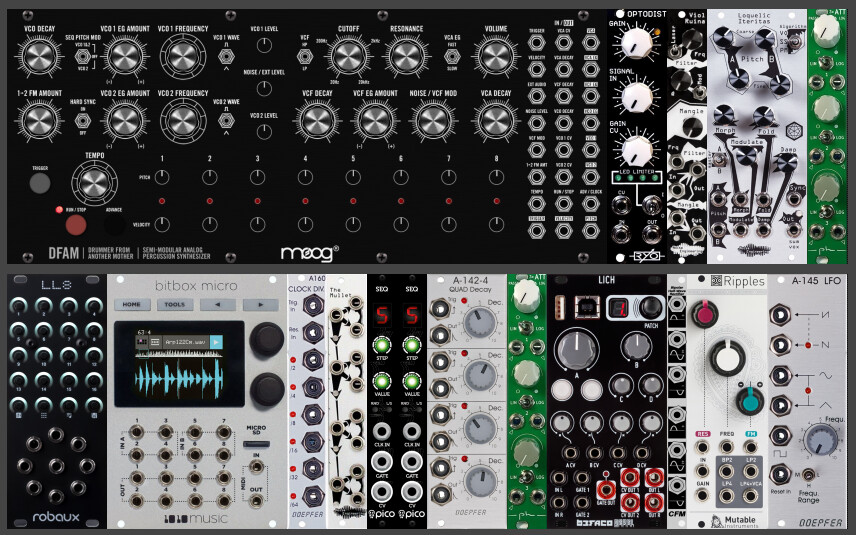
Great thread which I’ve been coming back to a lot to feed my thought process before I (possibly) buy some eurorack (again). Although I do like noodling ambient music and generative stuff like that, I think what I’m really interested in is the ability to make pulsating, hypnotic techno. I bought a DFAM a few years ago and I really loved it but, again, I was not in the right “headspace” at the time and I got rid of it. I now have the money and I’ve established that although I enjoy using a DAW sometimes, I also really need something that is totally away from a computer and a screen.
I’m very tempted to start this journey again by getting a 2x10⁴hp case (probably a tiptop mantis) with a DFAM and an output module and then augment that setup with a some extra modulation so that I can be more flexible with the DFAM and also some additional standalone voices such as the Noise Engineering BIA (a flexible techno favourite as far as I can tell) and some other stuff that can work without needing lots of VCAs, envelopes and other traditional synth voice architecture lego. I understand that if you want to build a traditional synth voice then you need all those components but if you want to focus on a relatively minimalist percussive/rhythmic setup then it seems like there is another path that can be taken.
One thing I’m trying to understand properly is if I can make a simple synth voice with just an oscillator and a resonant LPG. If I then get a flexible oscillator, an LPG and some sequencing in order to “ping” the LPG then I have another voice right there without the need for all the individual envelopes, VCAs and filters etc.
Can anyone clarify if that last paragraph makes sense? If I have e.g. 3 or 4 of those different “voices” that includes a DFAM, a BIA and at least one other then I reckon that’s a decent source of techno that could probably squeeze into 2 x 10⁴hp.
Pinging lowpass gates is great and works well enough for percussive elements or melodic stuff with a bit of ‚knock‘ in the beginning! Could get a little tricky though when you‘re looking for a stable (?) synthesizer voice, but it‘s debatable whether you need something like that in techno. Plus you could do synth voices outside the eurorack with much less clutter.
I had the Erica Synths LPG for a while and used that to ‚percussionificate‘ some stuff coming from my Digitakt. Nice, because I had all the pitch, amp and prefiltering stuff done in the Digitakt and then just the LPG with a MIDI converter in eurorack. Saves a lot of cabling and modules.
I use a regular filter with an envelope follower and an LFO now though, fits my workflow a little better.
No idea where I‘m going with this post, haha. I guess you mentioned reducing these utility modules, so… maybe consider how you could repurpose some external gear for these bread and butter tasks.
You can make a synth voice with an oscillator and an LPG. You may wish to combine the oscillator with a utility oscillator to frequency modulate it, a waveshaper and so on to get that “west coast” type sound.
For things like BIA and DFAM you really want ample sources of things like envelopes, gates and looped randomness to get the most out of them. And also VCAs aren’t just for controlling amplitude of audio but also modulation - so you’d still benefit from VCAs to “modulate your modulators”, as well as utilities like matrix mixer, logic, etc. That type of complex, controlled and interacting modulation is how you can get new and interesting sounds and get the most out of modular in my experience.
@SierraOskar I understand that VCAs are used to modulate attenuate all signal types and not just audio amplitude but thanks for clarifying. I guess I’m just curious about some of these “build a techno groovebox” videos where some of the setups are very compact and are very light on utility modules, focusing on modules that can generate sounds by themselves or with very little extra help. I also note that some modulator modules also have attenuation built in at the source, which is arguably less flexible but means you get more “value” in a smaller space if they don’t need to be attenuated further down the chain.
I need to get back on Modular Grid and have a play. I think I definitely want a DFAM because it’s so much fun and so much “bang for buck” with lots of functions in one “module” and I could make some techno just with that, giving me a bit of time to decide what else to buy afterwards. When I owned one before I found it hard to make anything that sounded bad, it’s one giant sweet spot!
Yeah absolutely - and it depends on what you want to do. For my small case that I pair with Analog Rytm I use a couple of modules (Lapsus Os and Makrow) to modulate things remotely because it makes it easier to perform with. With my other case, which is more for exploring sounds I’m happier to use the built in attenuators/ attenuverters and so on.
I have found though after a few years that it’s really true I get more excited about utilities now because those let me get the most out of my voices
Highly recommend this article on the Noise Engineering blog about modular systems for techno production and live improvisation.
It goes into many concepts and ideas, it’s a great read even for People not interested in modular:
Midi beat clock syncing my TR8s to my SP-16 is great. The SP-16 live samples so it in essence turns into a multi track recorder. In the SP you can just jam your parts like Ableton or something. Plus use Pioneers FX. Fun stuff for being in the moment.
I think these short 20 second grainy poor audio quality snippets qualify as techno