Its a very typical Bitwig product- clever, practical and some original thought…but FUGLY
I know beauty is in the eye of the beholder, but no Orange in my studio
I hope they do well with this, but there are some great I/O in this price range now so I guess the real USP is the CV side. Like many I use an ADAT to CV converter.
Look forward to more real world reviews on the Drivers (stability/latency) and conversion…will probably live or die based on this rather than the CV side.
PS- you could do the hover/turn thing years ago with a Surface Dial and Elephant (Elephant – Surface Dial As Controller – SaveTheHuman5) and I used it for a while, but ultimately it was hand of mouse so the mouse wheel still gets more use!
I agree with this. Might sound vein, but I don’t need my audio interface to match my DAW. I really like the functionality’s of it tho. I’ve been using am RME Babyface for a few years and for my purpose I’m not sure this is something that I would need. The Babyface has ADAT for expansion, so I have an old RME fireface that I use for 8 extra ins and outs. If I had the Connect 4/12, I think the size and functionality(CV in and out in a package about the same as the Babyface) would be better, but I would loose the RME ADAT, drivers and reliability.
I’ll be keeping my eye’s pealed for this one. If I were more excited about using my modular with my DAW, I would be way more hyped.
Just got a email from Bitwig to purchase. Two questions come to mind - is it a better alternative to Roto-Control for transport and automation and is this nice timing for a major Bitwig OS version for Superbooth i.e. 6.0?
Really digging Bitwig at the moment for some reason
Not sure if should rather post it in the main Bitwig thread. Has anyone had it purchased and already delivered? Any feedback? How does it compare to other interfaces, any downsides?
So far it looks great (my primary interest is CV-integration, not much keen on the control surface capabilities, but it’s nice to have it too)…
Have had mine for about a week, but have only had a couple of hours to test some stuff as I am finishing some projects with my previous interface.
-Well built, actually a tank
-CV integration is fantastic, exactly as advertised and super ergonomic. It’s a real joy to make grid devices with lots of CV/audio flow back and forth between the modular and BW
-Plugged my guitar in (it’s a noisy MF) and did not get any ground loops or much RF interference, so the isolation is good I guess?
things I have yet to try:
-Plugging in mic to hear the pre-amps
-Check if the balanced outputs on the back can comfortably go up to Eurorack audio levels
-Spend more time with the control knob in BW mode to see if it’s much use
I would say some downsides are:
-Only one XLR input (this is crazy to me, maybe a power consideration?)
-CV integration is great, but 2 ins and 4 outs is not that much, requires thinking ahead with patching
EDIT- there are obviously 4 inputs, and I checked with BW support to confirm that they are all happy with Eurorack levels, but 2 are on the back of the unit and I am lazy
Cool, thanks. I think that this combination of audio outs and CV-outputs would work for me. Just wanted one-stop solution and selection of interfaces in the last year did not suit me… Like control surface features, but no dc-coupled outs, or vice versa or too pricey.
Just got mine - first impressions are very positive. Build quality is among the best, and the sound quality is surprisingly good too (well, at least better than the MOTUs, IMO). CV ins and outs work out of the box. And of course, I’m an Ableton user, lol.
Physical side is indeed premium. Very heavy, I’m not sure I ever had such sturdy piece of gear, even analog synths… Packaging is also very nice
Some hiccups on Windows 10 - it took me 2 cycles of restarts until I heard any sound. It was a bit weird: control panel was up and running, Windows showed that interface was receiving a signal, but absolutely no sound from any output. Fixed itself on the second restart.
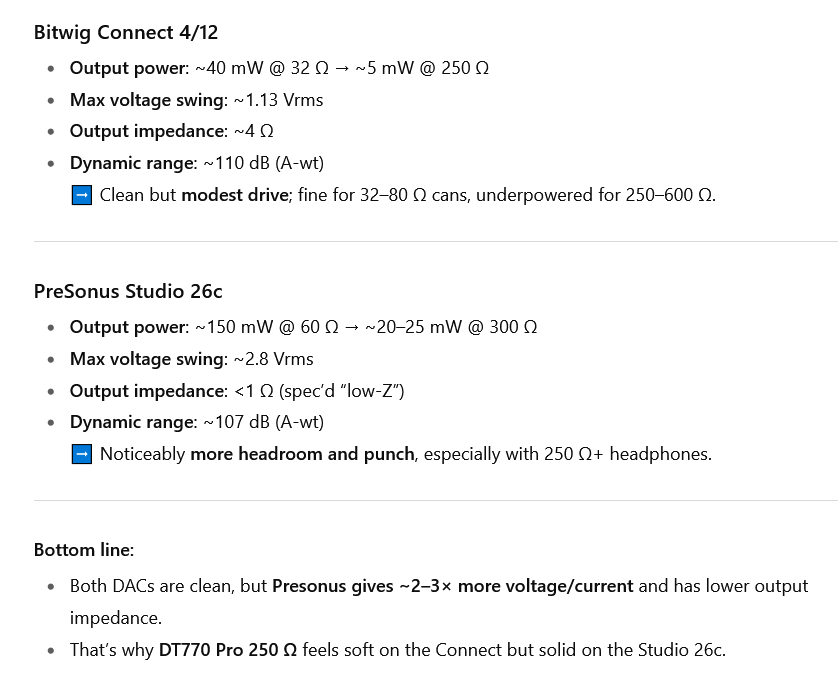
Biggest difference - headphone output. It feels quite different from my not so new Presonus 26c, like the sound became softer. Nothing critical, just a matter of time/taste, but I think I’ll keep the older interface for a while. AI explains it this way and suggests using a headphone preamp… which is a bit of overkill for me (and keep in mind that GPT5 became dumber ) :
Weird stuff seems to happen with bigger projects in Ableton when using the interface (on Windows 11). The CPU overloads much more easily than with any other interface I’ve used, and oftentimes I have to restart the audio engine in Ableton just to make the playhead move. None of this happens in Bitwig, even with the same project. I’m now thinking about switching to Bitwig… maybe it’s part of the design plan.
I have sometimes the same irregular behavior of the card I mentioned before: no sound being produced (while all the meters show the signal is there) or sound played twice slower (!). Switching bit rate back and forth (48 - 96) or power cycling usually helps. It could be something related to USB-drivers on Windows or to the hibernate mode (usually the issue is after wake). We are on the very first iteration of drivers/firmware, so no big surprise there, I hope it will be eventually sorted out. Besides that all works just fine (recording, playback, control surface in Bitwig, etc).
@protrusion and any other Linux users. I replied to you on January saying that it should “just work” in theory. Well, I got the 4/12 a couple of months ago and I just confirm that this audio interface works perfectly on Linux out of the box. Plug and play.
Not only that, the app that comes with it allowing to control the device from your computer also runs natively on Linux and it is officially supported. I’m not aware of any other commercial audio interface that offers this level of Linux support.
Christ - what a heavy beast this is, build quality seems superb. Quite enjoying it on the desktop with Bitwig V6 configured as an aggregate device (my main rack gear is routed to a different interface) but can see myself probably wanting more I/O for Grid experiments. Nice first hardware attempt for sure.
A power switch would have been nice mind!! Too many bits of kit without them nowadays
Still very happy with it (see my previous comment about Linux support above). The big knob and its overall sturdiness still feel good.
The most important point for me is that I’m using it at 64 / 128 samples & 48000 regularly and it just works. No latency perceived, and 64 samples works in my system without pops & cracks in most situations. When there is something, I go to 128 (which still has no annoying latency) and the sound is clean.
About the DAW features, in the past months I have been playing more than producing in the DAW less, and therefore I haven’t been using the scrolling/zooming much. I’m not sure I would use the knob for that instead of just the mouse, time will tell.
I was using the transport buttons regularly but then I got another controller that is in front of me most of the time (Oxi One mk2) and I use its transport instead because it’s closer and silent.
I like the point-and-turn feature to modulate parameters with the mouse and the big knob. But then I got the Roto Control, and I use it for most knob tweaking instead.
I was missing a power on/off button, I got a magnetic adapter, and now I pull or connect the power cable easily, to the point that I like it.
The most frequent complain seems to be that it doesn’t have enough ins and no ADAT to expand. Well, luckily that is an obvious detail, and if that is a problem you can move on. I see Bitwig’s point, given that this interface is the first audio interface from the creators of a DAW featuring a bunch of soft synths + CLAP & VST support for more soft synths. That, and USB audio keeping expanding across hardware synths.


 ) :
) :