I think in this instance you could think of that row as ‘pre-master busses’? Stereo busses that take track audio and are eventually routed to the main outputs.
I think you can obtain that behavior by setting up the track to monophonic rather than poly.
On the subtracks you can’t sound-lock different samples, afaik.
Probably you will come up with a new M83 album 
3 Likes
Does the Tonverk sample sounds at 32-bit or 24-bit?
Yes. I’ll add them.
I wouldn’t count a subtrack as a track, but I’ll add a row for polyphony, I think that is a fitting comparison.
Yes, that is possible, you can route the inputs to a bus, to the mix out, or to a track.
You directly load samples into each subtracks, you don’t assign slots in the sample pool. That’s why you can’t plock the sample in a subtrack.
Or as subgrups in a mixer.
It has “48 kHz, 24-bit D/A and A/D converters” (manual, pg.77), so my guess is it samples at 24 bit.
Edit but OT, DT and DT2 have 24 bit converters, so my guess is not worth much.
3 Likes
I just want to say thank you for this overview, this is super helpful  .
.
5 Likes
I added more hardware-related info and reshuffled the table a bit.
And I found out that compared to the DT2 the Toneverk apparently loses two features:
- keytracking setup (maps up to 4 parameters to keytracking)
- velocity setup (maps up to 4 parameters to velocity)
4 Likes
@Lizard-of-Oz, you’re a hero! Thanks for making this. It’s really clarified a bunch of things for me. One observation is that, via subtracks, the TV effectively offers up to 8 internal DT 1’s which is pretty insane. Also, for my own purposes, it’d be interesting to add another column for the Analog RYTM Mk2 (not that I’m asking). My sense is that the AR is fairly similar to the the DT 1 but adds the analog compression, filters, etc. Great work!
I thought about creating a bigger feature matrix that includes ST, DN, A4 and RYTM, but I found that editing tables here eventually becomes a mess, so I kept it simple.
But I’ll maybe create a table that compares the “synthesizers” separately, that will make for a shorter table, as they all share features all samplers would lack, and vice versa.
The RYTM is an analog drum machine that can layer samples over analog sound. I never used any samples when I had one.
OT, longer description of Rytm
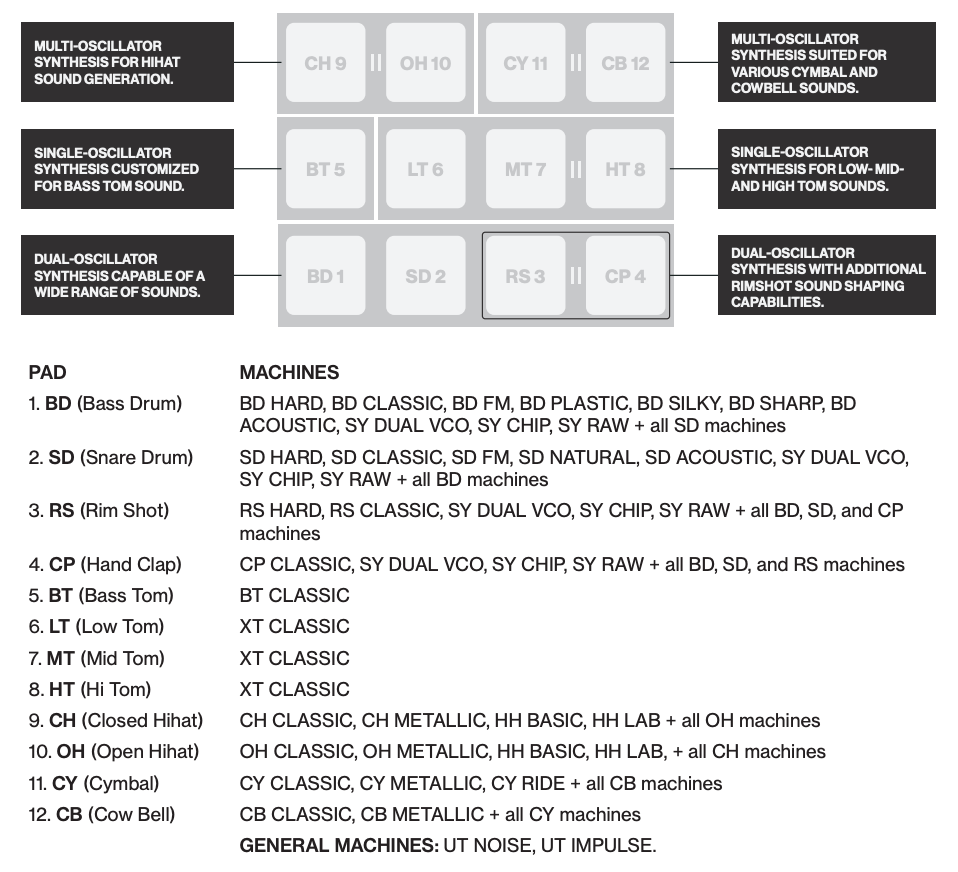
Analog Rytm has 16 tracks, but only 8 total voices, so some tracks share the same voice (like open and closed HH, Cymbal and Cowbell, Ri(m and Clap).
Each voice has a specific set of machines available, e.g. the Bass Tom only has the Bass Tom Classic, White Noise and Impulse Machines. The output of each machine is layered with a sample, and then routed through an analog filter. The envelopes are much slower than on the DT, and there is only one LFO.
If you can live with one set of send levels for all subtracks. I find that a pretty massive limitation, YMMV.
There’s things a simple table of features cannot communicate 
3 Likes
What do you mean by “send levels”? I thought each subtracks could have individual p locks.
apart from sends and routing iirc
1 Like
Maybe this was intentional, but on the headings of the table, Toneverk has an added “e” in it.
Yes, but there are two notable exceptions, samples and FX-related parameters
Samples are not taken from the sample pool, so you can’t plock samples.
And FX related parameters are controlled in the supertrack (manual, pg. 81)
The subtracks mostly have their own set of parameters they control, but there are some parameters that impact the sound of all subtracks. For this reason, the Subtracks machine has an additional sequencer track called the supertrack that is used to mainly handle parameter locks for these shared parameters. The supertrack controls the parameters on the FX pages and the two FX LFOs on the MOD pages. In addition, the supertrack has its own TRIG PARAMETERS page. This page is used to control the trig-sensitive parameters on the supertracks FX and MOD pages, such as the MODE parameter for the Track FX LFO.
That is probably a direct consequence of the internal architecture, and not a feature that was not ready by release.
2 Likes
I always use it as a hybrid mixing samples and synths and occasionally as just a sampler with analog filters. The row of tom synths is especially limited so I use those as sample slots a lot. Thing is a beast, even with its limitations (choke tracks, single LFO.
A useful comparison, thanks.
Nah, it just took me a while to get that it’s actually spelled “Tonverk”, and another while to fix all occasions where I’d misspelt it. I hope that was the last one.
1 Like
TV manual suggest that each subtrack has its own amp page so we can address the subtrack level there.
1 Like
Each subtrack does have its own AMP page.
However, the send levels are for the supertrack i.e. all subtracks.
1 Like
Very interesting Lizard
I think the bigger question though that isn’t captured in this useful comparison is workflow.
Tonverk seems like the Elektron Verselab to me … sort of a loop arranger/manglers tool with decent multisampler functionality, a ‘lite’ approach to digitakt surgical tools and a new step into the FX world.
It is going to be very interesting to see if this is a distinguished new paradigm that cannot be discerned from spec comparisons alone
As a melodic/rhythmic phrase-slut - I see the Torso S4 / 1010 BlackBox tilt of the Tonverk as potentially a very interesting new Elektron way. Which to me means there won’t be a firmware upgrade future add-back of the best-of-digitakt and instead it will plough its own path as a chase bliss Elektron for full piece composers who want to operate at the mid and high rather than low level of drumcomputer …
2 Likes
This is the key point. Tonverk in my eyes is a device where you can clearly see the layout and intent being angled towards full song creation.
1 Like
Perhaps elektron did some savvy market research … 99% of Ableton and Elektron users make a great 4 bar loop and then abandon interest. The Tonverk will take you to the next level …
Not by micro evolving your track locks, but by providing you with inspiring FX to recompose your ideas
3 Likes