Thank you !
ASM making a wind synth

1 Like
Doesn’t look like it is up on Long And McQuade yet to see the canadian price.
Edit: I’m not seeing Electronic Wind (Akai Style with every key a modifier) or Custom Fingerings so I’m not sure if I’d be missing some of my regular ones on Aerophones/EWI.
This unexpected news made my day! Looking forward to seeing more demos. So far, I’m impressed by how ‘non-clunky’ it sounds when players move between the notes. It doesn’t sound like they’re having to fight the instrument as they play. It’s also refreshing to hear some more modern-sounding patches. 
2 Likes
So with wind synths there’s usually a key delay setting that controls how forgiving it is with transitions.
If you set the delay higher its more forgiving but lower you can trigger notes faster.

Even with those settings, some key actions can get in the way a bit.
I completely support this!! It’s very cool to have all the options. My snark was directed at the demo videos, and not at all at the product. This is the first wind synth I’ve genuinely considered ordering. My experience with the Hydrasynth is really pulling me in.
The modulation options and physical keys are both very very welcome!
Good look on the tag @Phillip Who’d have thunk it?
I’m a simple man. I see a reputable synth company make a new wind synth and I buy it. Roland set the bar pretty high with AE30/20. Samples, 4 layers, gyro, several performance buttons, thumb pad.
At any rate it’ll be good to feel, hear ASM take. Different components, material, weight, approaches will create nuance. If I can get just a few new tones out of it it’ll be worth the very generous price.
Capitol One is doing 10% cashback and $50 reward for Sweetwater purchases over $250 so I’ll technically be paying $950 which is impossible to resist.
3 Likes
Two questions on Diosynth functionality – probably for Glen ( @GDarcey ) or Flux ( @Flux302 ).
Will the Diosynth have a MIDI local off ?
I really like to be able to use external MIDI processing on wind controllers, and it would be great if i can send it back to the built in synth on the Diosynth.
And … does the Hydrasynth functionality in the Diosynth include some of the FM paths ? I couldn’t find anything on that on your web-site.
ADDED : I see there is a manual online.
Local Off is included. Hurrah!
1 Like
Fingering charts ! For those interested.
ADDED : Oh wow. It’s got scales with microtuning like the HS.
3 Likes
yes, it has local off. We have the manual available for download on the web page under SUPPORT/DOWNLOADS.
There are no FM paths in this. To be clear, we have some of the DSP modules from Hydrasynth in there but this a whole new engine that is built for the windplayer experience. It wasn’t designed to be a sound module, but it does a better job of that than some of the others.
3 Likes
I really like that there are scales, and microtuning !!!
2 Likes
i can’t play keys but i still manage. i honestly think this will be pretty cool. for those of us that are musically ‘special’, i can pretend i’m a saxophonist and see how it pans out on the octatrack or sp404. with that said, all i ever picture when i see this is the dude from star wars band in the movie playing a wind instrument
2 Likes
Looking through the manual I think the fingerings are the most open question for me.
There’s usually 2 philosophies these devices operate on for fingering modes:
-
Saxophone/instrument base set of fingerings with custom fingerings to fill in the gaps or missing fingerings that the player relies upon. A good example is people programming in their altissimo fingerings they tend to use on their real saxophone. This approach is used by: Artinoise Recorder, Roland Aerophones, Robkoo R1
-
Akai style where every key is a modifier so there’s a large number of combinations if you need to vary a fingering but usually there’s no custom fingering controls. This is used by: Akai EWIs, Roland Aerophones, Berglund NuRAD
The Roland Aerophone Pro has the ability to do a combination of both 1&2 with custom fingerings layered on.
The Diosynth seems to have #1 only but doesn’t appear to have custom fingering yet to fill in the gaps.
Akai style has no dead zones in the fingering charts but some of the implementations of #1 can lead to a fingering combination that produces nothing so I’m not sure how the Diosynth will handle those.
The Akai EWI fingering algorithm can be found here:
1 Like
Thank you for building something so cool! Amazing price as well and I appreciate all the extra accessories/case. Ordered instantly.
I am already sold as a MIDI controller + rarer large wind instrument samples, but I am curious if it can get close to the aggressive sounds the Hydrasynth easily makes with its synth engine? I didn’t notice anything really harsh or heavy in the demos, which makes sense, but I am still curious.
Also any chance there are samples of a duduk, fujara, zurna, or qeej in there? I have no expectations, but those would complete my dream list I have yet to own as high-quality physical instruments.
1 Like
Looking at the sound engine and considering patching and performance.
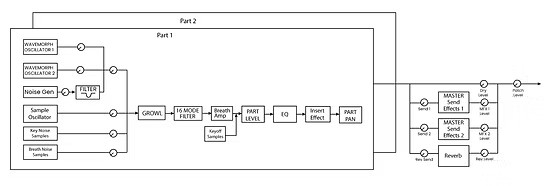
There are seven sound sources, four major and three minor ones. ( Six along the left hand side, plus the little one, Keyoff Samples on the bottom. ) I am not minimizing the three, just recognizing the four as a primary part of the sound.
Also notice there are two parts. This, along with usable control in playing could be key to having the Dio really break new ground.
Two wavetable oscillators, in two parts, can give up to four wavetable oscillator parts. Give each an LFO sequence operator, and some sort of harmonic structure and control, and perhaps you catch my thinking here. The harmonic waves at the very end of the 219 wave choices in a wave table, also should do interesting things in combination with separate LFOs and under control of envelopes and the user interface. I might put some silent slots in the wavetables too.
I am also thinking about the noise generator, with its own state variable filter, that can go through a growl, a sixteen mod HS filter ( including the formant filter ) plus an EQ and multiple effects, al controlled in your wind synth mouth and hands.
Add the samples then, maybe as just a part of the mix.
I am also noticing in the patch categories given. There is included – Chord, Chord 4th, and Chord Rotate. I am looking forward to breaking down the detail in these three categories.
Chordal playing, especially harmonically guided chordal playing is an exciting aspect for wind synth playing.
Excited to dive in to patching on the Dio.
4 Likes
I’m impressed they got it running on 2 AA batteries as opposed to the 6 required by Aerophone.
I wonder if the chord presets were done by just offsetting oscillator pitches in relation to a main oscillator or some other technique was involved
1 Like
Incorrect and important to note.
Those are 18650 lithium rechargeable batteries.
The voltage of a standard 18650 lithium-ion battery ranges from approximately 3.0 V to 4.2 V with a nominal voltage of 3.7 V.
At the same time they are fairly inexpensive, but you will need a charger specifically for them.
ADDED : Oh and they say 9900 mAh suggested with that as well.
.
1 Like
I thought fellow Aerophone users would understand I was talking about appropriate AA batteries. Do I really have to say 18650 lithium AA every single time on this thread? Come on, man.
Yes, I have rechargable AAs and a charger for them.