Thanks. It is important to me because this is going to be the machine that I learn FM on and if it was going to be a rare bird then I would think twice about holding on to it. It seems that’s not the case.
1 Like
Something I may have overlooked is the use of wave table synthesis in Berlin School. As I have it there is a wave form engine in the DN2. I’ve been watching a few videos but haven’t really got a good grasp of it yet to know how limiting or expansive that is compared to what you get in a wave table synth. I have perused these but I’m not well informed on what to really look for in wave table synthesis to know whether I’ve hit the sweet spot or not.
The other thing to note is that the DN2 has TWO different FM machines in it.
“FM drum” is a complete, 3 operator FM synth. It’s maybe more useful for learning FM than the main one. 
Not really. There’s a couple of machines that let you choose a wave but it’s very limited. Only one or two tables and nothing is user-definable.
1 Like
I was petitioning for wavetables before they appeared on DN2 and its a bit of a dissapointment as its currently implemented. Ive got the Waldorf iPad app for that at the moment. Seems like a gaping hole in Elektrons offerings, its so basic on DN2 it makes me think there’s going to be a full on Wavetable device in future if there isn’t an expansion of the DN2 capabilities planned.
1 Like
First, FM is not this hard to understand.
Secondly, DN is making it relatively easy.
But yes, the principle of FM that are learned are the same used in any FM synth. They might be implemented slightly differently but you’ll find similarities.
2 Likes
Two more videos on FM synthesis:
2 Likes
It’s very, very useful to have a little oscilloscope hooked up to it for learning FM.
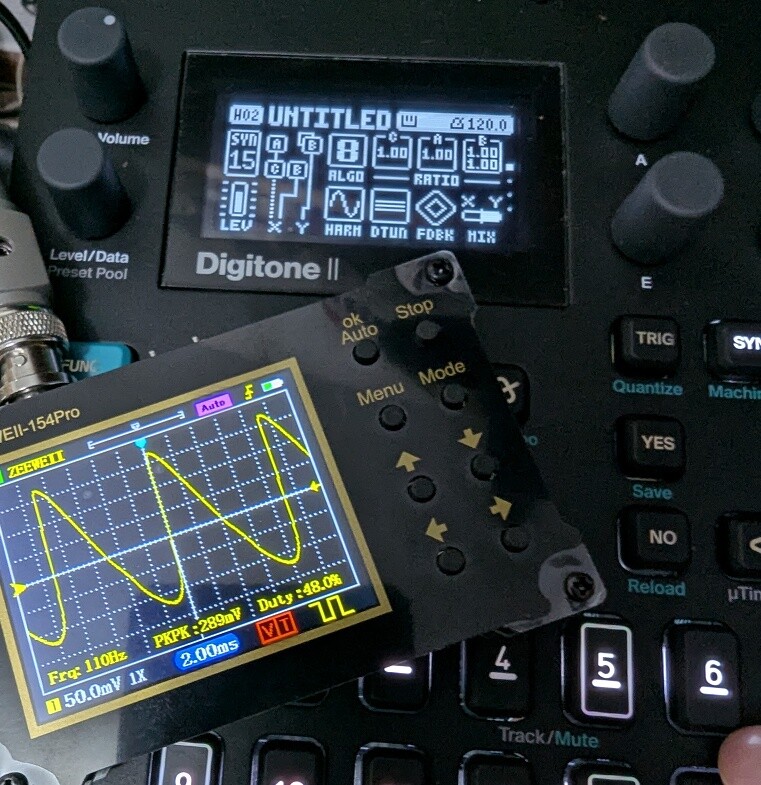
This way you can see exactly how much feedback gives a good sawtooth, and where it starts to distort and go crazy.
(Answer: 36 )
Beyond that point it starts to do this:
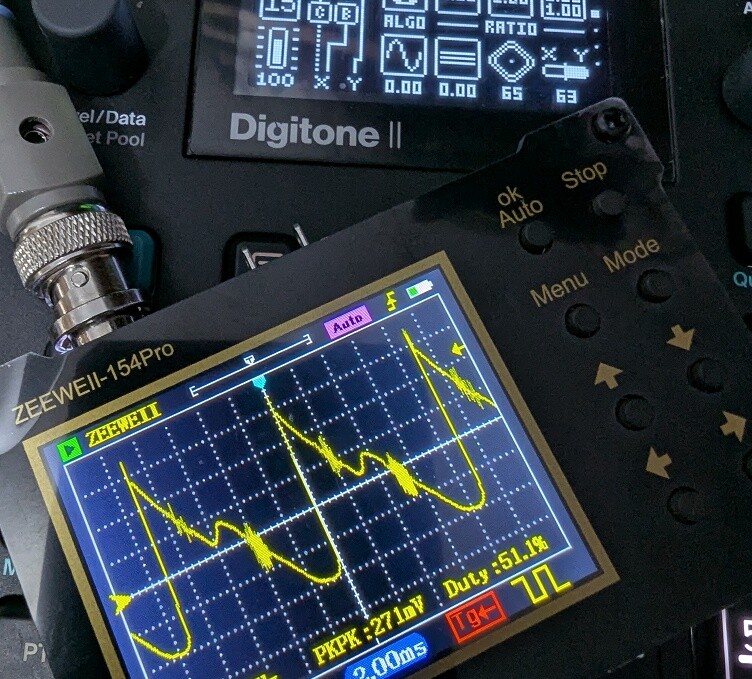
This little ZEEWEII works great and they’re only about $30 on Aliexpress.
(Hint: Get the one with the internal battery… you’ll thank me)
7 Likes
There is a bunch of free oscilloscope/spectrum analyzer apps for Android/iOS though.
or connect to your laptop/desktop and use a plugin or m4l one.
I’ve never done this though, just listening and reading the manual.
1 Like
Sounds a bit like using a DAW. 
well yes ha - if it helps people learn there’s nothing wrong with that.
2 Likes
I have an adjacent question to this about FM. Sometimes I make a great patch on the DN2, but when I try playing multiple notes or chords they all mash together and it sounds shit. Why is this?
I have a bit of commentary here, but you need a bit of retained high-school trig and calc.
https://cs.uwaterloo.ca/~plragde/flaneries/TSOM/top.html#(part._.Vibrato_and_.F.M)
Let me try to briefly explain if you don’t want the math.
When you modulate the frequency or phase of a pure sine wave with another, what happens is that a number of “sidebands” are added. These occur at pitches that can be computed by knowing the carrier frequency and the modulator frequency. If those two are in a nice relationship (such as the default dialing-in on DN, ratios like 2, 3.5) then it will sound harmonious; otherwise it might sound metallic or glassy.
Now, if you add another note to it, even if made with the same recipe, another set of carrier and sidebands is imposed on the frequency spectrum. If your other note is an octave above, then the sidebands might line up and it’ll be okay. But otherwise, they’ll tend to intermingle, and things get sonically messy.
Bottom line is that clean sounds made from integer ratios are the most likely to work in chords. Detuning, off ratios, feedback, all of these tend to mess with the harmonic relationships needed for chords to sound nice.
8 Likes
Very nice explanation, thankyou!
2 Likes
Have experienced DN (or general FM) users like you folks @Jeanne @LyingDalai @plragde and others - developed an intuition for reaching a desired sound on DN faster by assuming which algo + settings + FM modulation + OSC modulation to use, or are you still mainly doing it by trial and error?
I don’t always know what I’m doing, but when I do… I still have room for surprises ^^
I give a few hints here (feels like I am repeating myself but just in case you’ve skipped these)
Additional ones:
- Algo #2 with its dual/parallel setting is the best to understand FM and explore it when you don’t know what is does what: you work on one side, get a first tone, set your mix to full B, get a second tone, then adjust the mix (possibly with an LFO). Really good one, dead simple to understand what is going on
- in the default setting for the OG machine (FM TONE), use offset close to -1 to get extremely slow oscillators with aliasing. Boost the feedback for more noise.
- in the same screen as the offset, you have keytrack that lets you tame treble frequencies if needed
Now what is going on with every algorithm is just incrementing complexity (thus tones).
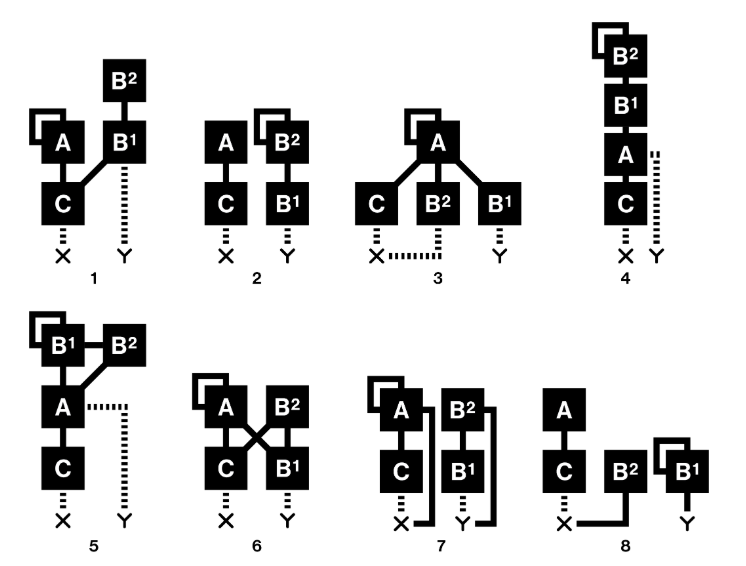
- I learned 1 cause it’s the default and rather interesting configuration for starting from scratch
- 2 is the simplest, I use it quite a lot as well for “simpler” tones, and it was how I learned what I was doing
- I don’t use 3 a lot, cause you loose B modulations.
- 4 is the one you want to check once you understand 2. Rather straightforward then
- 6 is the one with the most modulations, it’s good for percussions I found. You will most likely need A and B2 to have a decreasing envelope.
- 7 gets you lots of outputs, it can be nice, especially if you want chords.
We have LFOs to add extra envelopes, e.g. with decreasing exponential LFO set to ONE. Many places to experiment here, maybe Offset is the one I have overlooked for the longest time. It’s nice cause it lets you tune the oscillators individually, but on a short range.
Keytracking is brilliant macro, the cherry on the cake to have sounds that can be useful on a wider range of the keyboard.
Check this place for extra knowledge:
And of course
11 Likes
I can’t claim to be able to hear a sound and know what algorithm and modulations to use. I know what 2-op FM sounds like with envelopes on both operators. I then proceed to ask what I want done with some of that range (another voice to mix in? another operator?) and experiment. If I really want a specific sound, I’ll audition presets and tweak them. There are definitely people here who have more mastery of DN than I do, but they may not be able to distill that into a few paragraphs of useful tips or recipes. What @LyingDalai wrote just above is really good and I wouldn’t attempt to add to it myself.
4 Likes